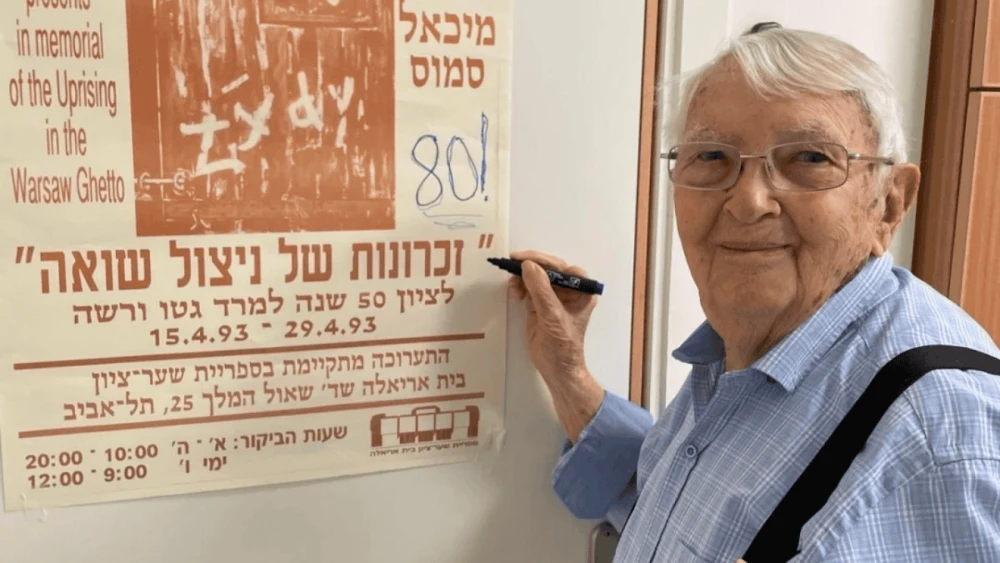
Michael Smuss, one of the last surviving fighters of the Warsaw Ghetto Uprising who later became an artist to express his Holocaust trauma, has died in Israel at the age of 99.
Smuss, who famously fought Nazi soldiers with homemade Molotov cocktails during the 1943 uprising, passed away on Oct. 21 and was buried in Petach Tikvah on Friday, his wife Ruthy said.
The International March of the Living mourned his passing in a statement, calling Smuss “a symbol of defiance, dignity and Jewish courage.”
“With many of the last Warsaw Ghetto fighters now gone, a historic page has turned,” said its chairman, Shmuel Rosenman. “The role of telling the story has now officially passed to the next generation—to us. We will tell the story—fully, faithfully and forever.”
Aliza Vitis Shomron, a comrade of Smuss in the Jewish underground of the Warsaw Ghetto, said she was saddened to hear of his death. “He was a brave fighter and a man of exceptional character,” she said. “His courage embodies the will and resilience that carried us through the darkest days of the Holocaust.”
She added, “It is important to remember the heroism and bravery of the members of the underground. I feel increasingly alone; so many of my comrades are gone. May his memory be a blessing.”
Smuss lived to see the Jewish people rise from the ashes. His life traced the arc of defiance, endurance and renewal—from the burning ghetto of Warsaw to the creative light of his art and testimony.
“I thank God for saving me … so I could tell people about what happened,” Smuss said in a recent interview—a philosophy he conveyed in his many talks to students and diplomats in Israel and Germany.
The Jewish Combat Organization
Born in 1926 in what was then Danzig (now Gdansk, Poland), Smuss moved with his family to Lodz and Warsaw. In 1940, he was among the hundreds of thousands of Jews forced into the Warsaw Ghetto, which was once home to nearly half a million people suffering starvation, disease and Nazi brutality.
Amid the despair, Smuss joined the Jewish resistance under Mordechai Anielewicz, commander of the Jewish Combat Organization (ŻOB). While assigned to restore Nazi helmets, he discovered access to a thinning chemical that could ignite Molotov cocktails.
“We filled up bottles which were then put up on the roofs of all the houses close to the entrance of the ghetto,” he recalled in a 2022 interview with the Sumter County Museum in South Carolina. “Once they were going to come, we’d be throwing them down.”
On April 19, 1943, as Nazi forces entered the ghetto to annihilate its inhabitants, Smuss took part in the desperate uprising, hurling Molotov cocktails from the rooftops. The fighting lasted nearly a month before the ghetto was destroyed. Smuss was one of the few to survive.
Captured by Nazi soldiers, he was sent toward Treblinka but was diverted for forced labor. He endured several concentration camps and survived a death march in 1945 before liberation.
After the war, Smuss moved to the United States, where he began a new life and started a family, the Associated Press reported. He later immigrated to Israel, where he met and married his second wife, Ruthy.
Turning to art as a form of healing, Smuss painted to process his wartime trauma. His works were later exhibited internationally, including in Germany, where he spoke to students about the Holocaust.
German Ambassador to Israel Steffen Seibert awarded Smuss the Order of Merit of the Federal Republic of Germany at the Anita Miller-Cohen Home for the elderly in Ramat Gan on Sept. 10, 2025, in recognition of his contributions to promoting Holocaust education and fostering dialogue between Germany and Israel.
“I was saddened to hear of Michael Smuss’s passing,” Seibert said. “He dedicated his life to teaching about the Holocaust.”