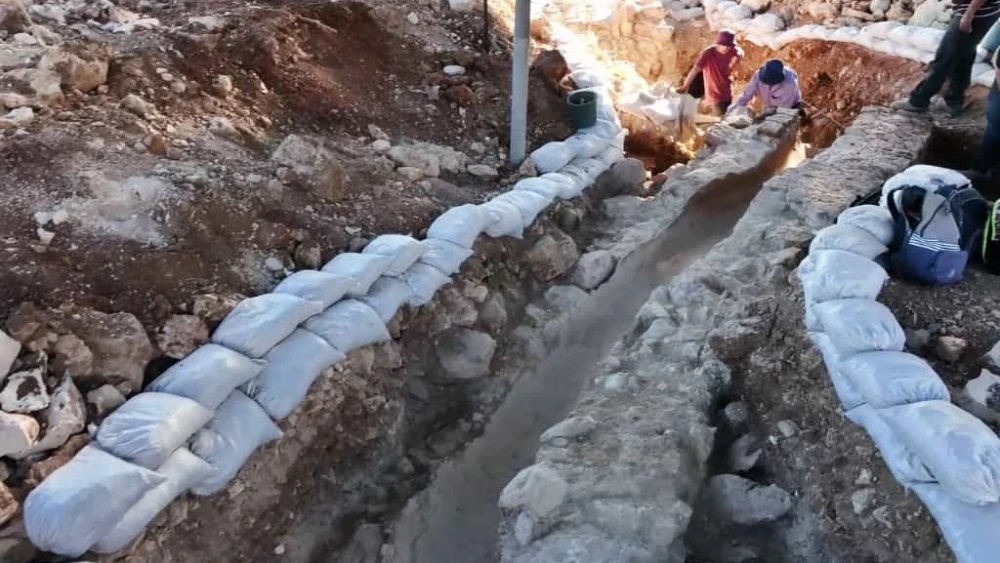
Archaeologists in Jerusalem have discovered a 300-meter (985-foot) portion of a Second Temple-era aqueduct, the longest such continuous stretch ever found in Israel’s capital, the Israeli Antiquities Authority announced on Monday.
The ancient waterway was discovered at a building site in the southern Jerusalem neighborhood of Givat HaMatos.
“The aqueducts of Jerusalem tell the story of the city,” said Antiquities Authority director Eli Eskosido.
“Their construction required huge budgets, extensive engineering knowledge and daily operation,” Eskosido explained. “They bear witness to the glory days of the Temple, to the destruction of the city and its construction after the destruction of the Temple, and in the days of Aelia Capitolina as an idol city.”
Excavation managers Ofer Shion and Rotam Cohen said that the waterway was built to bring water from further away because Jerusalem’s primary water source, the Gihon Spring, couldn’t meet the needs of the growing number of residents and pilgrims.
The Hasmoneans’ King Herod built two elaborate aqueducts for Jerusalem, which were among the largest and most complex waterworks in the Land of Israel. The system concentrated spring water in the Bethlehem area and transferred it to Jerusalem by taking advantage of topography, the laws of gravity and large pools, said Shion and Cohen.
The aqueduct known as the “Upper Aqueduct” brought water to the Upper City—the area of the Old City’s current Jewish and Armenian Quarters. Meanwhile, the so-called “Lower Aqueduct” transferred water directly to the Temple.
According to Shion and Cohen, the Upper Aqueduct remained in use after the Romans destroyed the Second Temple in 70 C.E.
The Roman 10th Legion “carried out extensive renovations in it, and raised the ancient level by half a meter,” they said. “We found about 25 coins, scattered at relatively equal distances. In our opinion, this is not a coincidence; just like the practice today, the coins were placed there for good luck.”
Jerusalem Mayor Moshe Lion said that the Givat HaMatos development plans would be adjusted to work around the new discovery.
“Jerusalem is the city whose past and future are intertwined. The Municipality of Jerusalem is happy to discover that during the construction of three schools on Givat HaMatos, which will contribute to the education of the future generation, we received a greeting from the past: an aqueduct from the time of the Second Temple,” stated Lion.
“The development boom that will contribute to the future of Jerusalem also requires the preservation of its glorious past,” he said.
The Jerusalem Municipality said it was working “in full coordination” with the Antiquities Authority, vowing to complete the Givat HaMatos expansion plans “with complete consideration of the preservation of the aqueduct that will be integrated into the project.”