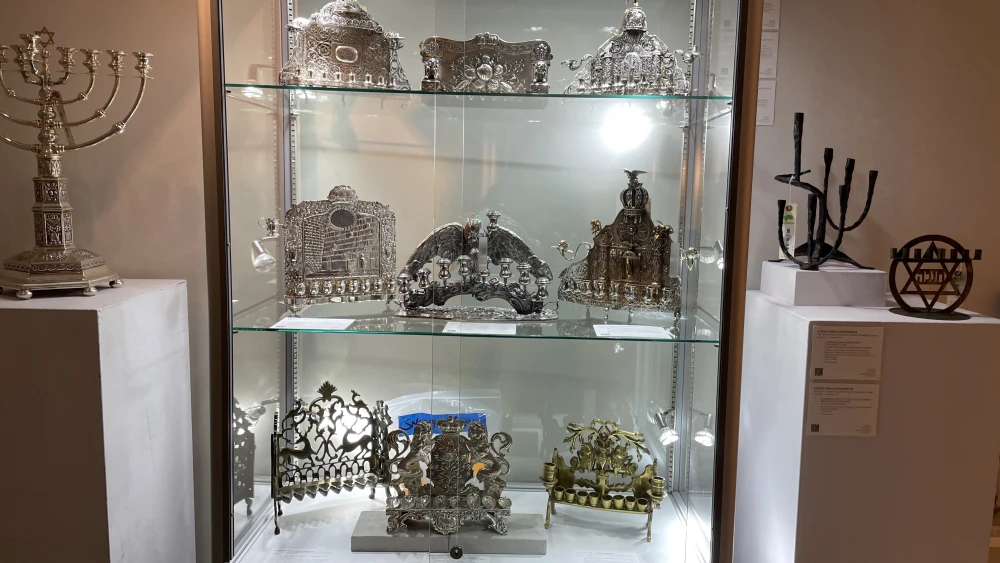
Several menorahs from the early days of the Bezalel Academy of Arts and Design—the school founded in Jerusalem in 1906 and named for the biblical Tabernacle architect—are at the center of a sale of 35 Chanukah lamps at the auction house Christie’s.
The menorahs, which Christie’s began exhibiting on Friday at its Rockefeller Center lobby in Manhattan and which it intends to show until Dec. 12, come from the Judaica collection of Max N. Berry.
The auction house has been showing the Chanukah lamps to private collectors since Nov. 18 and plans to continue to do so until Dec. 22. Chanukah this year is from the night of Dec. 14 until Dec. 22 at night.
Berry, who was born in Cushing, Okla., in 1935, grew up in Tulsa and has “had a long career as an attorney in both public service and in private practice,” the auction house said. It added that he supports more than 80 nonprofits and has held board-level positions at the Metropolitan Museum of Art, National Gallery of Art, Smithsonian Institution and Museum of Art, among other institutions.
The 35 lamps on sale date largely to the 19th and 20th centuries, are made of brass and silver and come from Europe, America and Israel. There are also modern sculptures in hammered iron by Israeli artist David Palombo.
“We assembled a group of lamps, many hand-selected by Mr. Berry, that we believe reflect the breadth and depth of his collection,” Casey Rogers, head of sale at Christie’s, told JNS during a walkthrough of the exhibit.
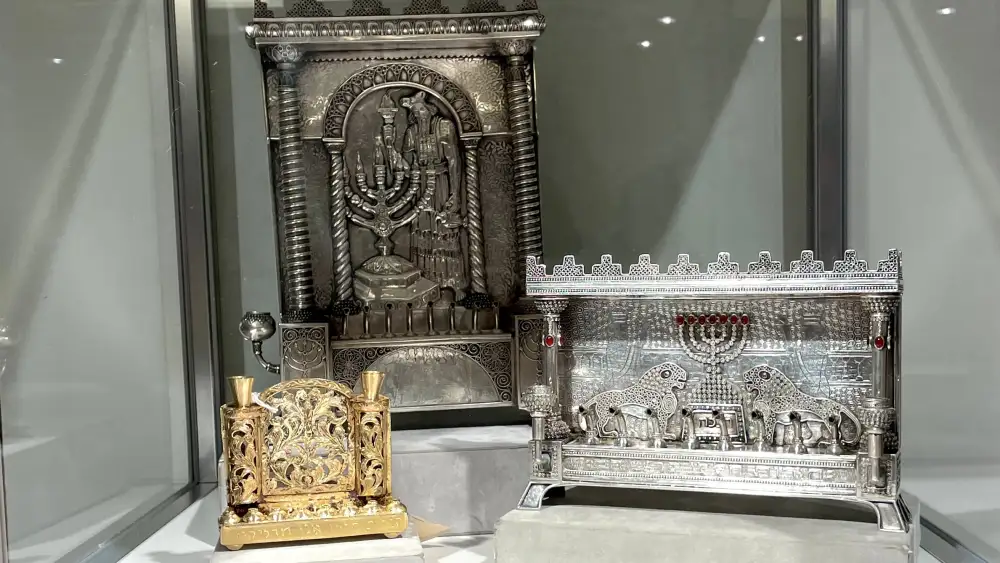
An early 20th-century silver lamp is an “exquisite example of silversmithing by artisans in the Bezalel School, utilizing a variety of techniques and materials,” according to Rogers.
The menorah uses a technique called filigree, in which twisted wires create patterns. Two lions flank a six-branched Temple menorah, which has carnelian red stones to suggest the lights. An inscription below in Hebrew states that “these candles are holy,” and in the background, two crowned figures—perhaps references to Temple priests—hold torches, readying to light the menorah.
Rogers noted the “fine chasing of the priestly figures to the background, contrasting beautifully with the applied filigree to form the lions in the foreground.”
She added that the Israeli school has “a robust history of pioneering design and aesthetic at the beginning of the 20th century.”
“We are pleased to offer multiple lamps from its earliest period, as well as works by former students of the school, such as David Palombo,” she said.
A 1986 menorah in the sale that has a bald eagle as the shamash and Statues of Liberty holding the candle holders is by Manfred Anson, a German-born artist who survived the Holocaust as a child. The artist and Judaica collector “was among 20 boys rescued by the Jewish Welfare Guardian Society of Australia during World War II and eventually settled in the United States in 1963,” Rogers told JNS.
“The sconces were cast from souvenirs produced for the Statue of Liberty Centennial, and this model has been included in various museum exhibitions exploring traditions of Jewish life in America,” she said. (The Smithsonian’s National Museum of American History tends to display one around Chanukah time.)
Four lamps by Palombo, a former student and teacher at Bezalel, are included in the sale. The artist “had his career cut short by a tragic motorcycle accident,” Rogers said. “His enduring legacy remains in these distinctive works in hammered iron which explore a visual language grounded in abstraction, weight and texture.”
The lamps are priced from $5,000 to $90,000. Most fall between $10,000 and $30,000. The works are being offered in a private sale rather than a traditional auction. Christie’s hasn’t said publicly why the collector chose that way to sell the works.
The auction house opted to exhibit the menorahs in its main lobby, rather than a dedicated gallery, due to logistics during a busy auction season, according to Rogers.
The auction house is currently selling a variety of Berry’s works beyond Judaica. Rogers told JNS that there will be a Judaica sale and American paintings sales in January and sales of Chinese artworks over the “next few years.”
A spokesman for Christie’s told JNS that amid rising Jew-hatred since Oct. 7, the auction house is committed to the “security of our clients, guests, staff and the works in our care.”