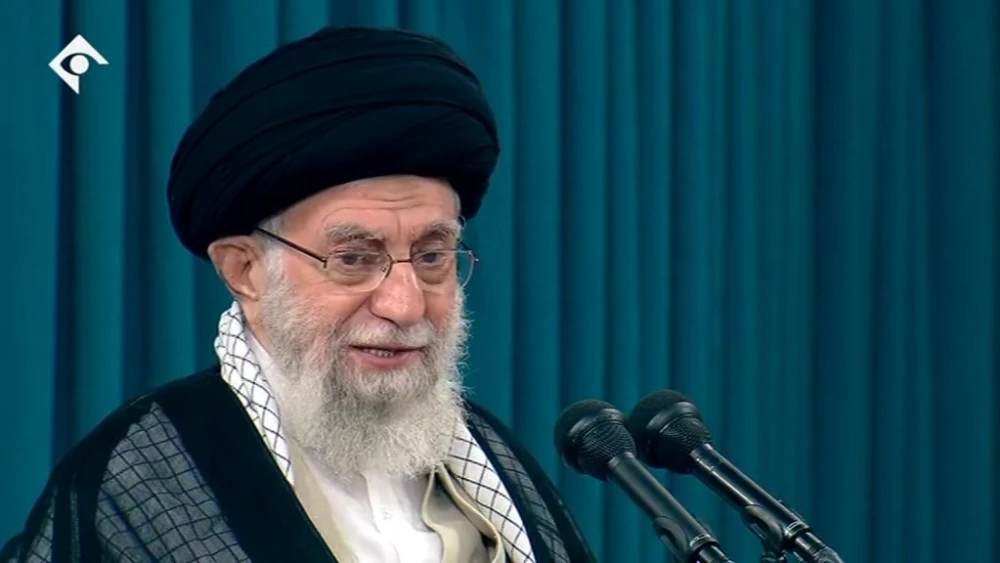
Iran’s Supreme Leader Ali Khamenei indicated a potential willingness on Tuesday to re-engage in nuclear negotiations with the United States, according to the Associated Press.
Addressing the government led by newly installed Iranian President Masoud Pezeshkian, Khamenei said there was “no harm” in engaging with Iran’s “enemy,” according to the report. But he reportedly set forth “clear red lines” for any potential talks and emphasized that the U.S. government “couldn’t be trusted.”
These comments echo similar sentiments expressed in 2015 when Iran agreed to a landmark nuclear agreement with world powers.
The 2015 nuclear deal, officially known as the Joint Comprehensive Plan of Action (JCPOA), saw Iran agree to limit its nuclear program in exchange for relief from economic sanctions. The deal was short-lived, as former U.S. president Donald Trump unilaterally withdrew from the agreement in May 2018, citing concerns over its effectiveness.
Since that collapse, Iran has steadily moved away from the limits imposed on its nuclear development, raising alarm bells in the international community.
The situation has been further complicated by Iran’s increasing obstruction of international oversight. The International Atomic Energy Agency has reported disruptions to its surveillance cameras in Iran, while some of its most experienced inspectors have been barred from entering the country, according to AP. Iranian officials, including Iranian lawmaker Mohammad-Reza Sabbaghian, have also made increasingly provocative statements about pursuing atomic weapons.
These developments, coupled with reports from Israeli and American officials of suspicious activities by Iranian nuclear scientists, have led to speculation that Iran may be taking advantage of the current geopolitical climate to advance its nuclear program.
Against this backdrop, Pezeshkian’s ascension to power after the death of hardline President Ebrahim Raisi in a helicopter crash in May could represent a change in Tehran’s approach. Pezeshkian, a former lawmaker, campaigned on a promise to re-engage with the West. Khamenei’s recent remarks could provide the political cover needed for such a move.
The appointment of Abbas Araghchi as foreign minister further supports this potential shift. Araghchi was involved in negotiating the JCPOA.
Still, the U.S. State Department remains cautious. In a statement to the AP, it emphasized: “We will judge Iran’s leadership by their actions, not their words.”
The department reiterated its preference for diplomacy as the best path forward but noted that Iran’s recent actions, including nuclear escalations and lack of cooperation with the IAEA, have created significant obstacles.
“If Iran wants to demonstrate seriousness or a new approach, they should stop nuclear escalations and start meaningfully cooperating with the IAEA,” the State Department concluded.