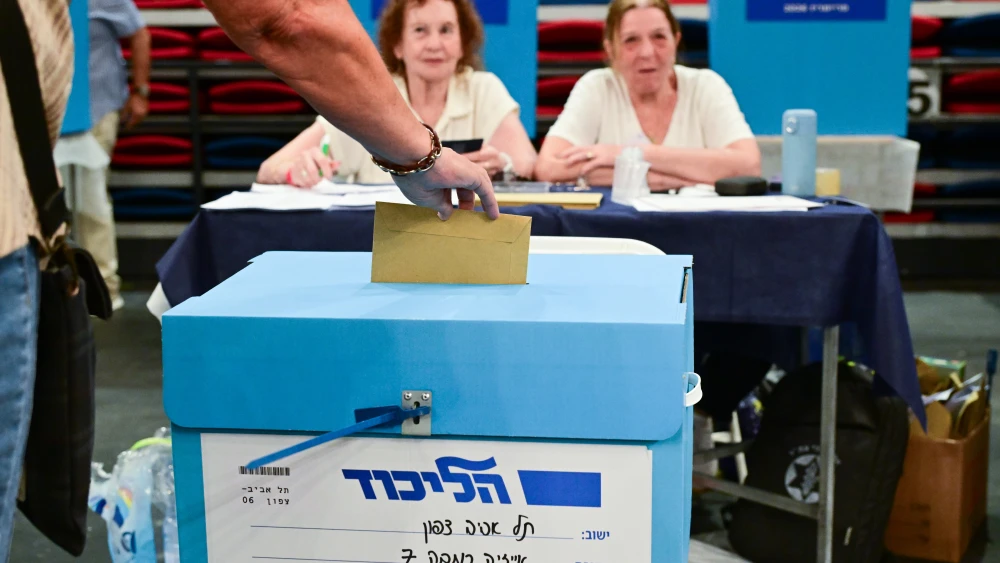
Monday’s Likud primary will produce a list of Knesset candidates “that will not be afraid of the deep state” and will press on with the party’s agenda on the judiciary and the economy, Israeli Communications Minister Shlomo Karhi told JNS on Monday.
“With that list, we will win [the Oct. 27 national election],” said Karhi.
He urged fellow Likud members to back candidates unafraid of “the bureaucrats, courts and judges.” The aim is “to return power to the voters and the people of Israel, to restore governance to the people,” he said.
“That is our mission, because right now it doesn’t matter what law or reform we pass, the High Court of Justice simply stops it,” said Karhi.
Likud Knesset Speaker Amir Ohana told JNS on Monday that he hopes the primaries will produce the best team to confront the judiciary and the left in the general election.
“Together, we will win the most important election ever in the history of Israel,” he said. “We hope we will have a majority so that we can have a broad national government for the benefit of the people.”
Some 140,000 Likud members are eligible to vote in Monday’s primary. Polling stations opened at 10 a.m. and close at 8 p.m.
“I think the most central issue, and the one that needs to be completed, is judicial reform. It requires a deep change after I exposed the truth to the public and the reality that we have a judicial system that does not provide justice,” Justice Minister and Likud member Yariv Levin told JNS on Monday.
“I want to finish this, and I believe [the primary] will give me great confidence, as it will show that public support for this issue has strengthened,” he said.

Likud members understand just how important the primary is, Israeli Agriculture and Food Security Minister Avi Dichter told JNS on Monday. He had visited Ashkelon, Beersheva and Jerusalem over the course of the day, he said, adding, “I have rarely seen so many voters at 2 p.m.”
Likudniks “understand the importance, and this time it’s something special,” he said. “We can see it clearly.”
Israeli Transportation and Road Safety Minister Miri Regev told JNS on Monday that the primary demonstrates that “there is democracy within Likud.”
Registered members “are coming to vote and will put together the next list that will, God willing, form the next government,” she said.
Regev added that the vote would help produce “the best list” to run alongside “our leader, Bibi Netanyahu” in the Oct. 27 election.
Israeli Prime Minister Benjamin Netanyahu said on Sunday night he would vote in the primary for a Knesset slate that would prevent opposition leaders from forming a governing coalition dependent on Arab parties.
“I will vote tomorrow in the Likud primary for a winning list that will ensure that [Yashar Party leader Gadi] Eisenkot and [The Democrats Party head] Yair Golan do not form a narrow government with the Arab parties, as they promised,” the prime minister wrote in Hebrew.
Netanyahu said he trusted Likud members to choose their representatives “according to your own judgment,” adding that he was not intervening in the composition of the national list. He wished all the candidates success.
Israeli Culture and Sports Minister Miki Zohar told JNS on Monday that the primary is about “succeeding in the [Oct. 27 national] elections and returning the prime minister to the leadership of the country.
“I think the range of issues that voters will consider is very diverse. Likud is a very diverse faction, and there is a wide range of opinions on all the topics,” said Zohar.
That diversity is “what is beautiful about it,” he said, and the reason Likud is the governing faction.
“Among the things I have done, I am proud of my cinema reform. We removed funding for movies against the IDF, and now the content offered to viewers is more in line with what Israelis love,” added the minister.

The primary follows a Likud Central Committee decision last month granting Netanyahu the authority to fill eight of the first 30 slots on the party’s Knesset candidates list, positions 3, 5, 9, 11, 15, 18, 26, and 29.
Last week, Netanyahu announced the first (non-incumbent) reserved position would go to Oren Dobronsky, a high-tech entrepreneur well-known in Israel and Silicon Valley.
The party subsequently reserved spots for three more candidates, including Defense Minister Israel Katz and Foreign Minister Gideon Sa’ar.
Likud lawmaker Amit Halevi told JNS on Monday that he wants the party’s Knesset candidates list to work for “our real defense, our real freedom and real democracy.”
“Look at the citizens, active members of Likud, who will determine the list,” Halevi said of the primary voting, calling it “real democracy.”
He said the result would be “a list that represents the free thoughts of Likud voters,” and described the process as “the free voice of Israel, of Likud.”
Halevi contrasted the vote with the Jewish state’s current system of governance, “where one woman decides for one million people—I mean the attorney general or Supreme Court judges.”
“That can’t be,” he said. “That’s why we need real fighters in Likud tonight to continue the fight for the citizens of Israel.”
Likud MK Hanoch Milwidsky told JNS on Monday that “primary voters want to see people who know how to fight for their positions, are loyal to Prime Minister Netanyahu and to Likud’s way—the right-wing way—and are committed to the judicial reform we need to carry out in the next term.”
“I think it will be a tight election, but after Oct. 7, people moved to the right, and I believe right-wing parties will prevail and lead the next government,” he said.
“I was head of the Finance Committee in the last Knesset. We worked a lot on compensation for businesses, the people of the North and communities that were evacuated during the war. We dealt with anti-terrorism laws and took care of our soldiers,” Milwidsky added.
An Aug. 10 poll published by Israel’s Channel 14 showed the Likud-led (33 seats) right-wing bloc winning 62 seats in the 120-member Knesset, enough to form a governing coalition. The bloc includes Shas (10 seats), United Torah Judaism (7), Otzma Yehudit (6) and Religious Zionism (6).
The opposition parties collectively won 48 seats. They include the new Yashar party, led by former IDF Chief of Staff Gadi Eisenkot (23 seats); The Democrats, a merger of the Labor and Meretz parties (10); Yisrael Beiteinu, led by Avigdor Lieberman (8); and B’Yachad, led by former Prime Minister Naftali Bennett (7).
The Arab parties Hadash-Ta’al and Ra’am each received five seats, for a combined 10.
Several parties fell below the electoral threshold (3.25%) and would not enter the Knesset, including the Arab party Balad (2.3%); the Religious Zionist Zehut (1.3%), headed by Moshe Feiglin; and Zionist Home–The Reservists (1.2%), led by Yoaz Hendel and Chili Tropper.
Benny Gantz’s Blue and White (0.4%) and two as-yet unnamed parties—one led by former Likud Knesset member Gilad Erdan (0.9%) and another by retired IDF Brig. Gen. Ofer Winter (0.6%)—also failed to cross the threshold.
Netanyahu was viewed as the most suitable person to lead Israel by a wide margin, with 54% of respondents backing him. Eisenkot received 34%, while Bennett received 6%, Lieberman 5% and Gantz 1%.