


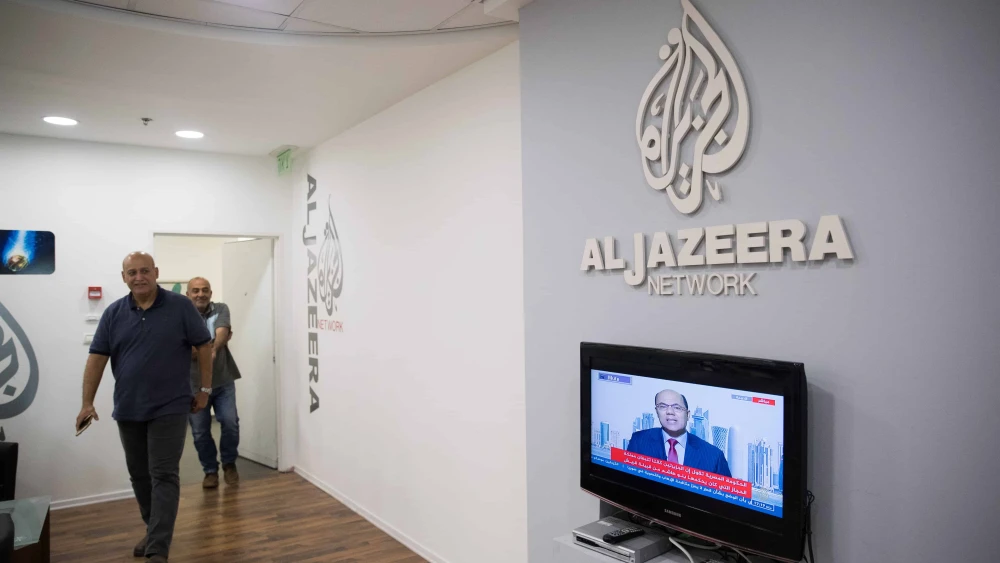
The Knesset on Monday night passed in first reading a bill that would make permanent a temporary order banning Qatari network Al Jazeera‘s operations in Israel.
The temporary order, “Preventing a Foreign Broadcasting Organization from Harming State Security (Temporary Provision‒Swords of Iron),” was extended for six months in May and is set to expire on Nov. 30.
According to the explanatory section of the current bill, which was proposed by Knesset member Ariel Kallner of the Likud Party:
“Due to the need to preserve the powers and tools required to deal with foreign channels whose broadcast content seriously harms national security, even unconnected from the ‘Swords of Iron War,’ it is proposed to determine that the temporary order will become a standing order and its validity will not depend on significant military operations or the declaration of a special situation on the home front.”
Other provisions of the bill include expanding the powers of the communications minister to deal with hostile news outlets, and eliminating the need for court approval to take actions against them.
“We are fighting not only against those who shoot at us. Limiting the fight to that misses the entire concept of the Islamist imperialist threat,” Likud lawmaker Ariel Kallner told JNS on Tuesday. “We are fighting against that ideology and against those who, through propaganda, recruit terrorists. Al Jazeera is one of their weapons. They brainwash people, incite hatred—and the result is Oct. 7,” he added, referring to the Hamas-led invasion of southern Israel on Oct. 7, 2023.
Kallner noted that Israel is in a constant state of war against this threat and warned that the entire Western world faces growing danger.
Al Jazeera, he said, operates with two main “arms.” One, he explained, functions as an intelligence arm—taking photos, revealing the locations of Israeli soldiers, publishing that information worldwide and leaking it to terrorist groups. The other is its propaganda arm, through which the network presents itself as a journalistic outlet.
“Some of our former hostages, like Noa Argamani, were held by Al Jazeera employees, and some of them even took part in the Oct. 7 massacre,” said Kallner. “I can’t say that without Al Jazeera Oct. 7 wouldn’t have happened, but it is certainly one of the tools of this Islamist threat.”
“We must protect ourselves and not allow them to broadcast freely and spread propaganda,” he continued.
In 2024, lawmakers voted 71-10 to pass the original legislation giving Israeli Prime Minister Benjamin Netanyahu the authority to shut down Al Jazeera. Under that law, the communications minister may act against a foreign channel that harms the state’s security, with the consent of the prime minister and the approval of the Cabinet.
The measure enabled authorities to order television providers to stop broadcasting the Qatari news outlet, close its offices in Israel, seize its equipment, shut down its website and revoke press credentials for staff.
In September, Jerusalem announced its intention to revoke all press passes of Al Jazeera reporters working in territory under its control.
Qatar, which hosts Hamas leaders and has provided the terrorist group with hundreds of millions of dollars, played a role in mediating the release of some hostages from Gaza in exchange for Palestinian prisoners.


