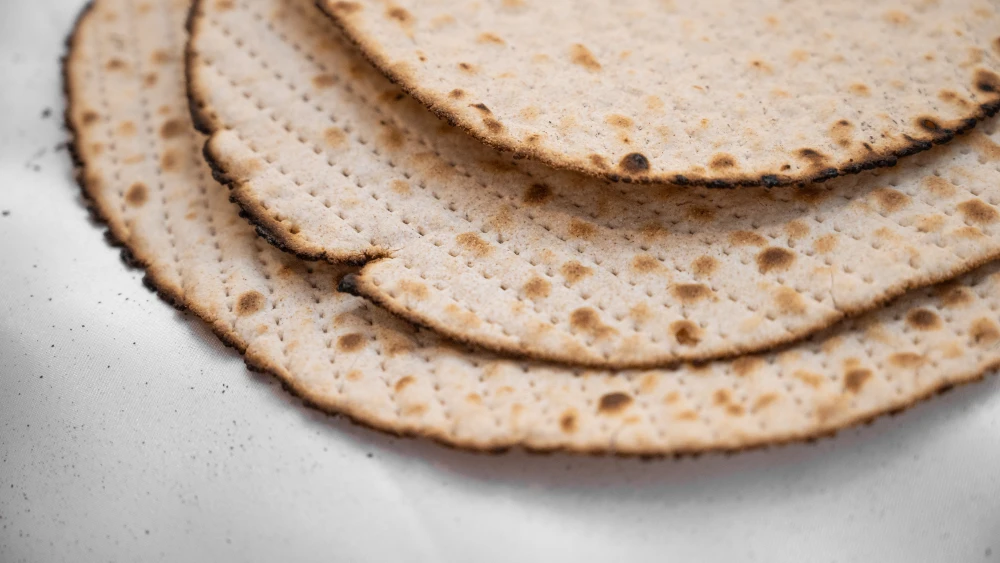

When is matzah mentioned for the first time in the Torah?
It’s not in the story of the Exodus. It’s not even in the book of Exodus. The very first time that matzah is mentioned is in Genesis 19:3, where the two angels come to Sodom to destroy the city, and to save Lot and his family.
Lot grew up in his uncle Abraham’s house and learned about hospitality from him. He therefore invited these strangers to his home, “He made them a feast and baked matzahs for them … .” Rashi says it was Passover then. Presumably, Lot also learned about the holiday from Abraham, who, in his prophetic insight, perceived the Torah way of life long before it was given.
Only generations later, on the eve of the actual Exodus from Egypt, would the Israelites be commanded to bake matzah in preparation for their hasty departure from Egypt and to take them along with them as they journeyed into the wilderness.
Rabbi Yaakov Duschinsky, the late Av Beth Din (chairman of a Jewish ecclesiastical court) of Cape Town, South Africa, in his writings makes the following powerful observation. It is no coincidence that the Matzah of Hospitality precedes the Matzah of Freedom. The reason is to teach us that we cannot truly enjoy our own freedom unless we first share it with others.
Long before matzah became a symbol of freedom and independence from foreign domination, the Torah records it as a symbol of hospitality, where even in the wicked city of Sodom, Lot was faithful to Abraham’s tradition of kindness.
True liberation is not merely the absence of slavery. To be free means to be a human being with genuine human feelings of love, caring, sharing, kindness and generosity. The matzah of Lot symbolizes that hospitality is the first step toward transforming selfish bondage into sincere and genuine friendship.
Primo Levi, the Jewish Italian chemist, author and famous survivor of Auschwitz, tells the story of when the Nazis left the concentration camp in January 1945 in anticipation of its liberation by the Russians, the only ones left behind were the sick and those unable to move. Levi describes how he and two other survivors lit a fire to keep their fellow inmates warm.
“When the stove began to spread its heat, something seemed to relax in everyone there,” he wrote. One of the survivors proposed that they each give a slice of bread to those of us who had helped make the fire and brought them life-saving warmth in that bitter European winter.
Levi writes that only a day earlier, such a gesture would have been unimaginable. In the camps, the unwritten law was: “Eat your own bread, and if you can, that of your neighbor, too.” To be ready to share their meager rations of bread with others was a powerful proof that the zombie-like inmates were becoming human once again.
That’s why right at the beginning of the Passover seder, we declare: “Let all who are hungry come and eat.”
Of course, that really isn’t the opportune time. You should have done that weeks ago; after all, you’re already seated at the seder table. And now you are inviting guests?
The answer is that we are reminding ourselves that a seder without guests is not a seder. Hospitality must precede freedom. Only if we show kindness and hospitality, as did Lot back in Genesis, can we then move on to celebrate the Matzah of Freedom. As we make that invitation, suddenly, the “bread of affliction” is transformed into the “bread of hospitality and freedom.”
Later on in the seder, we stand and open the door for Elijah the Prophet. Some rabbis suggest that when we make the invitation for anyone who is hungry to join us, we should also open the door as we do for Elijah. If we truly want to help those in need, then our doors and hearts should be open, and all who wish to celebrate should be invited in.
If any of our festivals is about sharing and a sense of community, it is Passover. Whereas charity is a fundamental of Jewish life, before the holiday, there is a special mitzvah to provide ma’ot chittim, literally “wheat money” (to be used for food or charity ahead of the holiday), but figuratively, the wherewithal for the less fortunate to make Passover. It is, after all, the most expensive holiday on the Jewish calendar.
Before we can celebrate our own festival of freedom, we need to know that we have done our duty to help others feel free, too.
Whether we are inviting the less privileged to join us at our seder or not, we are expected to contribute to the local charitable fund in our communities to help the less fortunate purchase provisions needed for Passover.
May we merit to celebrate Pesach and enjoy the Matzah of Freedom with our own families. And may we ensure that every Jew has what they need to celebrate Passover in freedom, too. Let our Matzah of Compassion bring the Matzah of Freedom to one and all.