


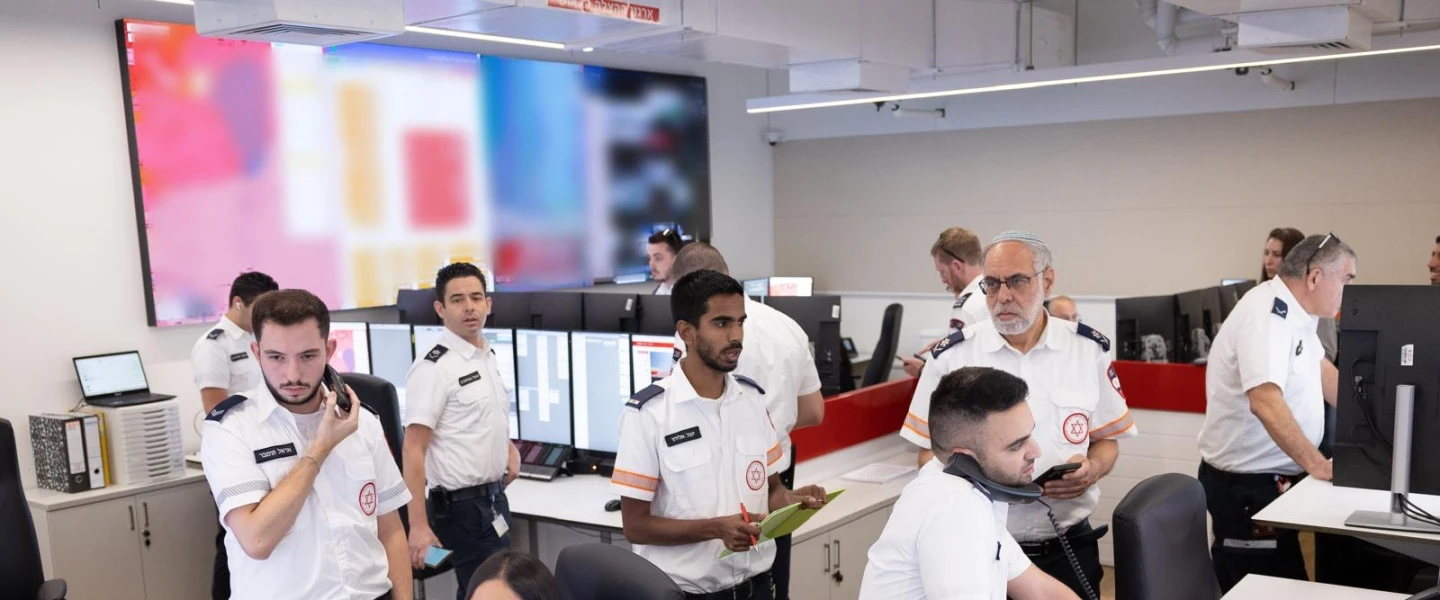
RAMLA, Israel—A steady hum fills the main dispatch room at the fortified national operations center of Israel’s emergency service, where staff handle the unusual combination of incoming missile alerts and routine medical emergencies in an intense wartime environment.
It is all part of a day’s work at Magen David Adom’s national operations center in the central Israeli city of Ramla, near Tel Aviv. In a sign of the times, the organization moved into the six-story fortified building on Oct. 7, 2023, the day of the Hamas-led invasion of southern Israel.
The state-of-the-art $130 million facility, funded by donors to the predominantly volunteer organization, houses the national ambulance dispatch center as well as underground national blood and human milk banks.
During the first three weeks of war with Iran, the blood bank—which provides 95% of hospital and Israel Defense Forces needs—continued operating from protected underground vaults. Meanwhile, the call center has become a regular presence on Israeli television news broadcasts, as the public awaits official updates on casualties following each missile attack.
Dispatchers at the center—one of seven nationwide—normally handle about 5,000 calls each day. Since the start of the war, they have also been working in coordination with the IDF Home Front Command, using advanced technology to track incoming missiles so emergency crews can be placed on standby while continuing their routine responsibilities.
Because most Israelis remain in protected spaces during missile alerts, many calls reporting injuries are received 10-15 minutes after air-raid sirens sound, when residents leave shelters. In many cases, technological monitoring systems alert medics to unusual activity even before calls are received.
Routine emergencies still dominate
“Even in the middle of the war, 90% of what we are doing is routine,” Aryeh Myers, a 49-year-old paramedic from Modi’in who is also assisting the organization’s international-relations department during the war, told JNS at the center last week.
As he spoke, a notification appeared on a dispatch screen reporting a collision between a car and a motorcycle, along with an alert of an incoming missile strike that highlighted locations across Israel on the center’s digital maps.
To date, despite a missile strike in Beit Shemesh that killed nine people, and additional attacks in southern Israel over the weekend in that left more than 100 people wounded, most injuries treated by MDA have been sustained by residents rushing to protected rooms, Myers said.
Sixteen people have been killed in Israel by Iranian missile attacks since the start of the three-week war, and more than 400 have been wounded, including 18 seriously, according to figures released Sunday by MDA.
Overall, the organization has treated about 1,600 people for war-related injuries, approximately 1,300 of whom were physically harmed and the rest suffered from shock.

‘You never expect something like this near your own home’
“It doesn’t matter how much you practice, the reality is always harder when you meet the person injured,” said Elad Slama, a 30-year-old paramedic from Beit Shemesh who was among the first-responders at the scene of an Iranian ballistic-missile impact in his neighborhood. “You never expect something like this to happen just outside of your own home.”
With 90% of its 39,000 personnel serving as volunteers, MDA relies heavily on ordinary citizens who dedicate time to emergency response. The organization receives most of its funding from services provided, about one-quarter from philanthropy and roughly 12% from government support.

‘A new perspective on life’
“We get to see people in their worst moments of life,” said Birmingham-born Lee Ross, 55, from the city of Holon in the greater Tel Aviv area, who has volunteered as an EMT for more than three decades and now drives one of three new intensive-care buses donated to the organization last year. “But it gives you an immense amount of satisfaction to have been able to help people.”
Pointing to the organization’s large number of teenage volunteers, as well as its emergency training center for paramedics located at the facility, he added, “This opens up a whole new world and gives them a different perspective on life.”


