


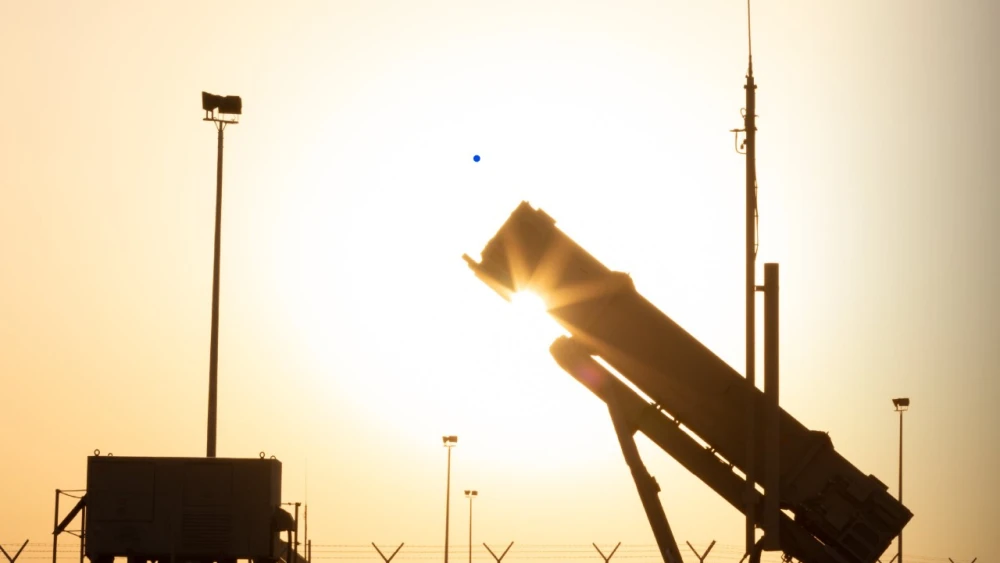
Debris from an intercepted Iranian missile killed two people in the United Arab Emirates on Thursday, bringing the death toll from Iranian attacks outside Israel to at least 66.
The incident in Abu Dhabi, which the Abu Dhabi Media Office said followed a successful interception, was one of thousands of attacks by Iran on 11 or 12 of its neighbors in an apparent effort to create international pressure on the U.S. and Israel to end their joint military operation, which they launched on Feb. 28 against Iran’s regime.
On Wednesday evening, Iranian drones penetrated the airspace of Saudi Arabia and Kuwait, the defense ministries of those countries said. Air defense intercepted and shot down the drones in both countries, they said.
Iran has fired at least 410 missiles at Israel and 550 drones or UAVs, according to Tel Aviv University’s Institute of National Security Studies. It has fired about 370 missiles and 1,800 drones at the UAE and 260 missiles and 570 drones at Kuwait, according to the INSS.
In Israel, Iranian projectiles have killed 19 people, including four Palestinian women near Hebron, according to INSS. More than 5,000 others have been wounded.
The Israel Defense Forces and other branches of the security establishment have focused on neutralizing Iran’s ability to fire missiles at Israel, as well as, along with the U.S., striking Iranian military infrastructure, including its nuclear facilities, the IDF has said. In parallel, the IDF has continued to target Iranian officials and top officers. On Thursday, Israeli officials said the IDF killed the head of the Islamic Revolutionary Guard Corps’ Navy, Alireza Tangsiri, in Bandar Abbas.
Tangrisi was in charge of enforcing Iran’s decision to block maritime traffic through the Strait of Hormuz, a bottleneck along a major shipping route for oil and LNG going from the Persian Gulf to China, India, other Asian markets and beyond.
U.S. efforts, including recent strikes on underground facilities used to store anti-ship missiles and mobile launchers, are now focused on securing the Strait of Hormuz, White House Press Secretary Karoline Leavitt said during a media briefing on Wednesday. “For all of these reasons, we are very close to meeting the core objectives of ‘Operation Epic Fury’ and this military mission continues unabated,” she said.
U.S. President Donald Trump on Wednesday said his envoys were negotiating with Iran on ending the hostilities, though Iranian officials denied this. Trump said the denial was the result of fear on the part of the Iranians to reveal a perceived sign of weakness.
One of the countries targeted by Iran is neighboring Iraq, whose population is mostly Shi’ite and therefore has many Iran supporters, alongside staunch opponents of Iranian control, including Kurdish militias. Iran has sent drones to strike U.S. facilities in Iraq, including the U.S. embassy in Baghdad.
On Wednesday, the U.S. struck targets in Iraq belonging to the pro-Iranian Popular Mobilization Forces, which U.S. officials have accused of targeting Americans. The PMF is a member of the ruling coalition of Iraq’s Prime Minister Mohammed Shia al-Sudani, and on Tuesday, he appeared to threaten to fight the U.S. if its strikes in Iraq continue.
His government called the U.S. strikes in Iraq “unjustified” and a “grave violation of Iraqi sovereignty” in a statement. The Iraqi government will “confront and respond to military attacks carried out by military aircraft and drones targeting the headquarters and formations of the Popular Mobilization Forces Commission and other formations of our armed forces, using available means, in accordance with the right to respond and self-defense,” it said.


