At an emergency meeting on Wednesday about Belgium’s indictment of three Jewish circumcisers, the European Commission’s point person for fighting antisemitism warned that outlawing the custom would “ban” Jewish life.
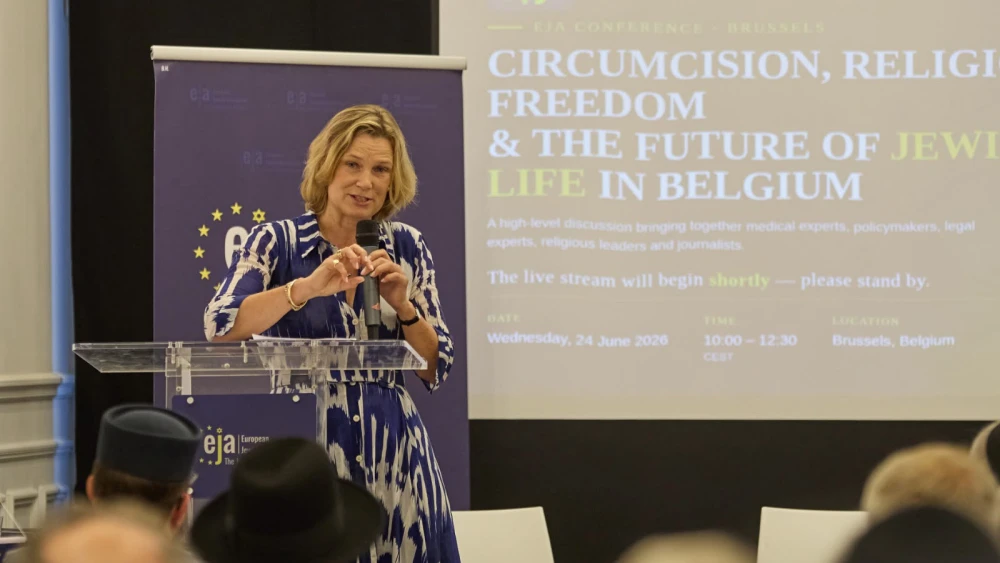
Katharina von Schnurbein, the European Commission’s coordinator on combating antisemitism and fostering Jewish life, made the remarks at an emergency meeting of Jewish, Christian and Muslims faith leaders in Brussels under the auspices of the European Jewish Association.
The European Commission is “aware that circumcision is one of the most important traditions for Jews. Banning this ancient practice would in effect ban the possibility of Jewish life to flourish in any member state. We acknowledge the threats and difficult public discussion, and we do not underestimate its effect on European Jews,” said von Schnurbein.
In a statement about the gathering, EJA said that the issue “could determine the future of Jewish life in Europe.” EJA chairman Rabbi Menachem Margolin added: “The question facing Belgium today is not what kind of Jews can live in Europe. The question is what kind of Europe Europe wants to be.”
The gathering followed the decision last month by Belgian prosecutors to indict three Jewish men for performing nonmedical circumcisions, or brit milah. The men, mohels, are accused of violating the law by conducting brit milah, the Jewish ritual circumcision of boys, typically performed on eight-day-old infants.
The prosecution triggered a diplomatic crisis between Belgium and Israel and the United States. Belgium’s relationship with those non-European allies have been strained by Belgium’s critical stance on military actions in Gaza and Lebanon, and on the joint Israeli-U.S. operation in Iran. Diplomats from Israel and the United States vocally criticized the legal procedure against the mohels as antisemitic.
Belgian MP Michael Freilich, the EJA’s special diplomatic envoy for intercultural dialogue and Holocaust remembrance, unveiled a new EJA position paper. It set out what it said was a fundamental “democratic choice” facing Belgium: “whether a religious practice observed safely by Jewish and Muslim communities for centuries should face criminal prosecution” or not. Physicians and scientists attended the conference, alongside Jewish community leaders from Belgium and beyond. Dutch Chief Rabbi Binyomin Jacobs also attended.
Dr. Michael Ben Akon, director of the pediatric department at Laniado Hospital in Israel, noted in his address at the meeting that an estimated 2 billion men worldwide have undergone circumcision, with “extremely low” complication rates of below 0.4%, with infection rates of less than 0.06%. Of more than 70,000–75,000 circumcisions performed annually in Israel, only 35 complications were reported in 2018, representing an incidence rate of approximately 0.5 cases per 1,000 procedures, he added.
Dr. Sas Barmoshe, a senior urologist in Belgium, and Dr. Nuphar Veiga, a senior biomedical expert at Leuven University in Belgium, highlighted research linking circumcision to significantly lower rates of urinary tract infections, certain cancers and some sexually transmitted infections.
European Commissioner for Health and Animal Welfare Olivér Várhelyi reaffirmed in a written letter to the gathering’s participants that the European Commission was committed to protecting Jewish life and traditions across Europe.