


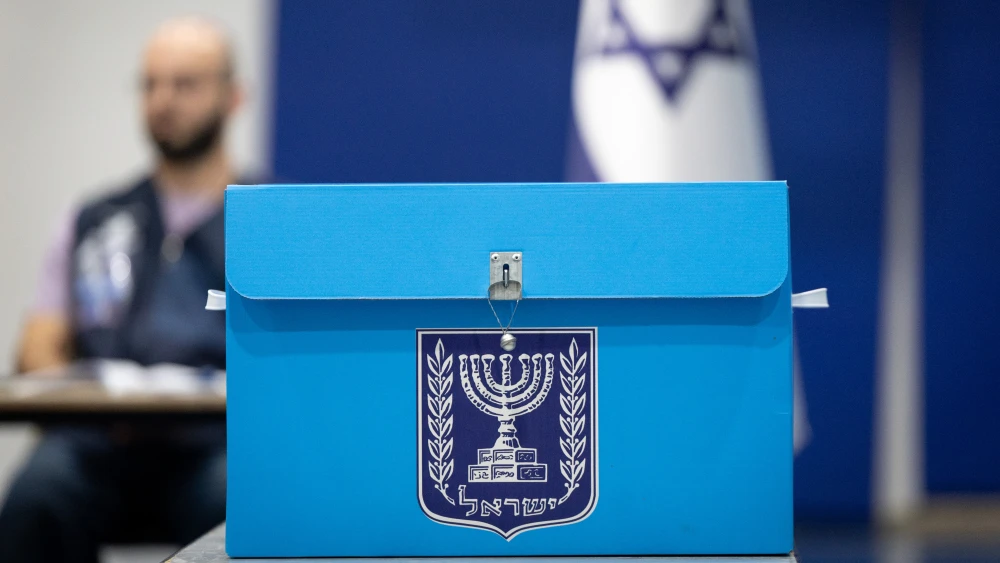
“Voters didn’t even go behind the voting booth. They got their ballot slip outside, walked up to the election committee, received an envelope, and put the slip right in. Someone takes a photo of them from outside, since phones aren’t allowed inside. So he stands 10 centimeters behind them, just past the doorway. Four hundred shekels, 500 shekels—whatever their budget is. Just like that, done.”
This is how Avihai Shorshan, CEO of Ad Kan, an Israeli nonprofit known for its undercover investigations of left-wing and Palestinian organizations, describes what he claims took place at polling stations in the Arab sector on Election Day for the 26th Knesset.
The allegations come as questions about possible election irregularities and foreign interference have drawn public attention since the Oct. 27 vote.
On Election Day, three suspects were arrested in the Negev after police searches uncovered envelopes containing cash and Ra’am ballot slips. Four additional suspects were arrested later that week.
By Tuesday, six of the seven had been released from police custody, although some remained under house arrest. The seventh suspect remained in custody pending a Wednesday hearing. The suspects have denied wrongdoing, with attorneys for some saying the money was intended for charitable purposes.
Meanwhile, Central Elections Committee Chairman and Supreme Court Justice Noam Sohlberg asked Shin Bet director David Zini to examine information regarding possible improper interference in the election through foreign funding from entities acting against Israeli interests. Police have said there is no connection between the two cases.
Threats were made
Shorshan, whose organization has spent the past decade conducting investigations into left-wing and Palestinian groups, says the first reports came on Election Day itself from salaried polling-station officials.
“I’m an election observer at a certain polling station. I saw envelopes of cash. I saw fuel vouchers being handed out outside. Something smells fishy to me,” he quotes one as saying.
According to Shorshan, “After three such instances, a red light went off for us—that this wasn’t an isolated incident.”
Since then, he says, “hundreds of personal testimonies have accumulated, where someone comes forward and says, ‘My name is so-and-so, my ID number is such-and-such, and I served in such-and-such a role at this specific polling station.’”
“These aren’t rumors. It’s not like I just gathered posts from Facebook,” he added.
However, Shorshan declined to give an exact number and stressed that the investigation is still underway.
“This is research currently taking place,” he said. “If you had asked me to investigate something like this on a normal day, I’d tell you, ‘Let’s talk in four months.’ Here, we’re 72 hours in, including the weekend.”
According to Shorshan, the alleged method was consistent.
“The main headline here is certainly election bribery,” he said. “You vote for whoever I tell you to, and you prove to me that you voted. Usually, that means taking a photo of yourself and showing it to whoever needs to see it. Then you get money—or more often than not, a fuel voucher.”
Shorshan described tables set up outside polling stations and posts openly uploaded to social media.
“You have to look on Instagram and take a screenshot to record it before they delete it,” he said.
According to Shorshan, the alleged system was set up in advance.
“This is an operation that takes six months to a year of preparation. Hundreds of people are deployed in the field to execute it.”
In some cases, he said, those allegedly offering bribes did not even check whom they were approaching.
“There were places where the polling station secretaries didn’t look Jewish, so in their sheer stupidity, they’d approach them and say, ‘Do you want to vote for the Joint List? Do you want to vote for Ra’am? Come on, take 400 shekels, take 600 shekels.’ They didn’t realize they were talking to a Jew sent on behalf of a Zionist party.”
Alongside bribery, Shorshan said, there were also threats, “mostly verbal, but also physical.”
According to him, observers who tried to document such incidents felt they could not do so without putting themselves in danger.
An ‘unnatural’ gap
Ad Kan came to public attention on Oct. 29, two days after the election, when its chairman, Gilad Ach, released a video claiming that “there wasn’t a single polling station in the Arab sector without electoral bribery and fraud.”
He estimated that at least five Knesset seats were affected and called to “stop the vote count now, stop everything.”
What stands out in Shorshan’s remarks, however, is what he refrains from claiming. Contrary to public speculation linking alleged election interference to Qatari funding, he said: “I can’t answer whether it’s Qatar, Turkey, Hamas, or the Islamic Movement. I don’t know. I’m not investigating that either, because I don’t have the tools to do so.”
However, he estimated that the sums involved were “already in the millions, maybe even tens of millions.”
Shorshan also clarified that he is not seeking to challenge the overall election result.
“Any analysis shows that this wouldn’t change the outcome of the election,” he said.
He estimated the number of allegedly tainted votes at “around 200,000 to 220,000 votes, which equal about five Knesset seats.”
Shorshan based that estimate in part on what he described as an unusual increase in Arab voter turnout, saying: “In the previous election, voter turnout in the Arab sector was 53%, and in this election it reached 82%. Their highest turnout up until then was 64%. A jump from 53% to 64%, had it occurred now, would have been logical and natural. The gap between 64% and 82% that actually occurred is not natural.”
However, an Israel Democracy Institute analysis of polling-station data from Arab and Druze localities put turnout in Arab society in the 2026 election at approximately 77%. The institute noted that similarly high turnout was recorded in earlier elections, including 79.3% in 1996.
Turnout among Arab voters was 53.2% in the 2022 election and about 65% in 2020.
‘All it takes is the will’
Shorshan is calling for a pause in coalition-building efforts.
“What’s called a ‘timeout’ in sports,” he said. “Let’s give this situation 72 hours, a week, until we have a solid basis to understand where this is heading.”
In his view, party leaders across the political spectrum, “including Netanyahu, Eisenkot and Bennett,” should freeze government-formation efforts until authorities understand the full scope of the allegations.
“How can they rush to form a government based on numbers that might not even be valid?” he asked.
That demand runs counter to the findings announced by the Central Elections Committee on Wednesday following its review of the election results.
The committee said it had examined protocols from 9,069 polling stations and, where necessary, conducted more extensive checks of voting materials, including ballots and voter registries.
“The conclusion of the operation revealed no irregularities or findings that would suggest that the integrity of the elections had been compromised or that the results had been altered,” the committee said.
Acting Central Elections Committee Director-General Dean Livne said every inquiry received from political parties, candidate lists and members of the public had been examined individually, with corrections made where warranted by official records and voting materials.
The committee said the official results would be submitted to President Isaac Herzog on Wednesday as scheduled.
A separate Shin Bet investigation into suspicions of foreign interference in the election remains ongoing. Sohlberg has said the suspicions are serious and must be thoroughly investigated, while stressing that the information uncovered does not call the overall election results into question.
Shorshan, for his part, stressed that Ad Kan is not seeking to replace the official authorities.
“We are not a state authority; we aren’t coming to replace the police, Shin Bet, Mossad, the Elections Committee, or Judge Sohlberg,” he said.
In his view, investigating the allegations should be straightforward.
“A fuel card is like a credit card—someone purchased it. How hard is it to go to Delek, Paz, or Dor Alon?” he said. “All it takes is the will to do it.”
He placed the ultimate responsibility on the state.
“There is neglect here on the part of the State of Israel,” Shorshan said. “Not neglect of Arab society, but neglect of law enforcement. There is an entire community here that for decades no one has gotten their hands dirty dealing with. Today, it’s blowing up in our faces.”


