At a recent speech therapy session, logopedic Efrat Last discovered that a Jewish teenage boy in Israel did not know the Hebrew word for cantor, chazan. He could not name a single Jewish prayer and had never heard of the Shema Yisrael, Judaism’s central declaration of faith.
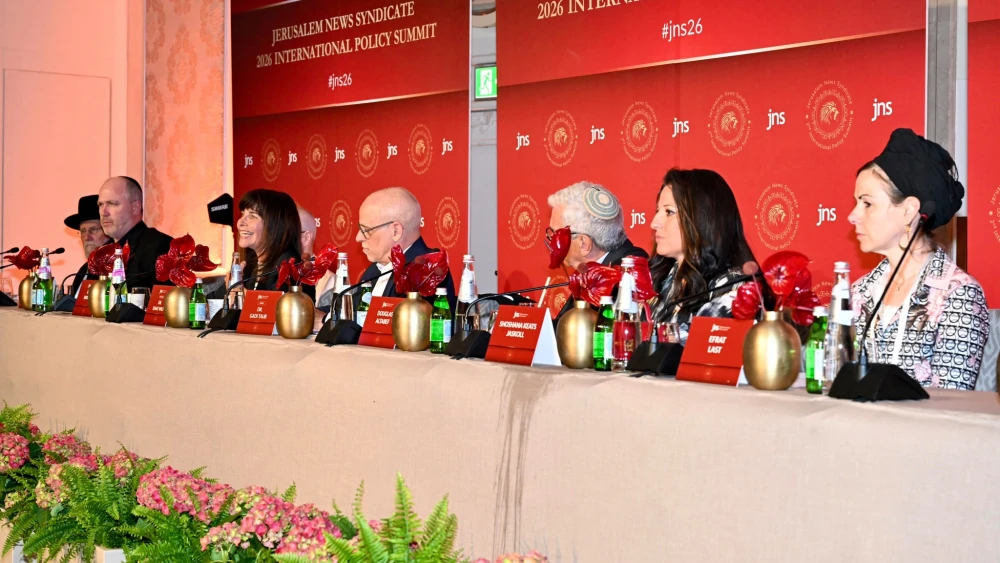
Last recounted the encounter on Monday at the second JNS International Policy Summit in Jerusalem during a panel on the challenges facing Israel’s democracy. The episode, she said, illustrates what she sees as an often-overlooked threat to that social pact: the erosion of the shared Jewish identity that underpins democratic self-government and compromise.
“Democracy isn’t merely a set of procedures. At its core, it’s a national self-determination—but this requires a ‘self.’ A people must know who it is before it can govern itself,” said Last, who, in addition to being a speech therapist, serves as director of international relations at Netsach Israel, a prominent right-wing leadership organization.
Other speakers at the high-profile panel, chaired by historian Gadi Taub, identified more immediate challenges and solutions.
The discussion traced Israeli society’s fault lines and featured philosophical observations alongside practical proposals, ranging from rebalancing power between the judiciary and elected officials to integrating the growing Haredi population into civic life, improving governmental accountability and countering identity politics.
Taub, an influential commentator and founder of the Shomer Saf podcast, seconded Last’s diagnosis of identity loss as an eroder of democracy.
“The enemies of nationalism end up being the enemies of democracy as well, because the majorities are nationalist—and democratic,” he said.
Taub reserved his sharpest criticism for the protest movement that sought to block the government’s judicial reform agenda in 2023. The reforms, championed by the government elected in 2022, sparked months of demonstrations, work stoppages and threats by some reservists to suspend volunteer service. “Israel’s elite broke the rules, threatened to burn down the country, tore the army until the majority surrendered,” said Taub. “And that majority has been humiliated, its face has been pushed into the ground, and it will not forget this.”
The internal clash over the judiciary was largely eclipsed by the Hamas-led Oct. 7, 2023, attack and the regional war that followed. Yet the dispute remains a potent fault line in Israeli politics, reflecting deeper divisions over class, ethnicity, religion and competing visions of democracy.
Opponents of the judicial overhaul, who tend to be opponents of Israeli Prime Minister Benjamin Netanyahu and his right-wing partners, argue it would weaken democratic checks and balances and remove constraints on executive power. Hundreds of thousands participated in demonstrations that eventually led the government to freeze parts of the initiative.
Taub argued that the controversy has created a dangerous fragmentation of authority within the state. Some officials increasingly view the attorney general and judiciary, rather than the elected government, as their primary source of legitimacy, he said.
As an example, he cited former Israel Security Agency (Shin Bet) chief Ronen Bar’s initial refusal to leave office after being dismissed by Netanyahu while the matter was under judicial review. Bar’s “rebellion,” said Taub, “was the most dangerous point” to Israeli democracy. “This is a danger of the collapse of the state, not just the subversion of democracy,” he continued. “It is a system where the will of the majority is considered tyranny and the minority is considered enlightened.”
Fellow panelist Einat Wilf, a former Labor lawmaker and founder of the Oz Party, rejected Taub’s “pathos,” as she termed it. But she agreed that Israeli democracy suffers from an imbalance between elected and unelected institutions.
“The judiciary and the executive have to give up power that they have steadily taken from the Knesset,” she said.
Wilf argued that Israel lacks a clear hierarchy of laws. Strengthening parliament should be a central goal of reform, she said. She also called for expanding the Knesset, which still has 120 members despite Israel’s population having grown more than tenfold since independence. “How do you strengthen the Knesset?” she asked. “We actually need a bigger Knesset. Some people gasp here, but we’re the same number of people.”
Douglas Altabef, chairman of the board of Im Tirtzu, said Israel’s democratic system suffers from a broader accountability deficit. He pointed to what he called the “autocratic workings” of the Supreme Court, Attorney General Gali Baharav-Miara and ministry legal advisers, who he described as exercising authority “thuggishly” beyond their intended roles.
Altabef also criticized Israel’s electoral system, arguing that voters have little direct representation.
“We have no direct representation in the Knesset, and our only recourse here is to the party,” he said.
Ran Baratz, a former Netanyahu spokesman, founder of the Mida website and CEO of El HaPrat civil liberties organization, argued that Israel’s problems mirror broader trends across the democratic West. The rise of identity politics, he said, has replaced debates over policy with emotional and tribal conflicts centered on group affiliation. This shift has empowered bureaucracies at the expense of elected politicians and institutions, and encouraged political players to focus on symbolism instead of effective action, he continued. This, he said, leads to polarization that trickles down into society, eroding democratic governance.
“When we start looking at politicians not as rabbis or commissars, but as carpenters, then things will start to get better,” said Baratz.
Ariel Kahana, diplomatic correspondent for Israel Hayom, directed his criticism toward the audience.
“The problem is you,” he told attendees.
Kahana argued that voters and media consumers increasingly reward sensationalism over substance, creating incentives for politicians and journalists to focus on controversy rather than serious policymaking. As a result, he said, thoughtful and policy-oriented figures often struggle to gain traction in public life. He cited Wilf, a centrist pragmatist with a PhD in political science from the University of Cambridge, as an example, predicting she would struggle to cross the voting threshold.
Shoshana Keats Jaskoll, co-host of JNS’s “Israel Undiplomatic” podcast and chair of the Abba Eban Institute at Reichman University, focused on the exclusion of Haredi women from political representation.
The two Haredi parties in the Knesset do not permit women to run on their lists. As a result, she argued, issues affecting Haredi women often go unaddressed.
“Women’s health has become taboo” in parts of Haredi society, she said, leading to preventable suffering while broader Israeli society often remains silent out of “cultural sensitivity.”
“Though we do have a vibrant democracy and I want it to be Jewish and I want it to be democratic, we don’t do a good enough job in making sure that everyone is represented,” she continued..
Rabbi Karmi Gross, a Haredi educator who works to bridge gaps between Haredim and other sectors of Israeli society, addressed the contentious issue of Haredi military service. The dispute has become one of the country’s most explosive political issues. Haredi leaders seek to preserve broad exemptions for yeshiva students, while the courts and many non-Haredi parties insist on wider participation in military or national service. The disagreement has triggered protests, arrests and repeated threats to the stability of Netanyahu’s governing coalition. Gross argued that no policy solution would succeed without a broader effort to rebuild trust between communities.
“Unity demands sacrifice and compromise, but unity will only come when we have a shared vision of our destiny,” he said.
Asked by Taub how such a vision could be achieved, Gross replied: “We have to speak to each other.”