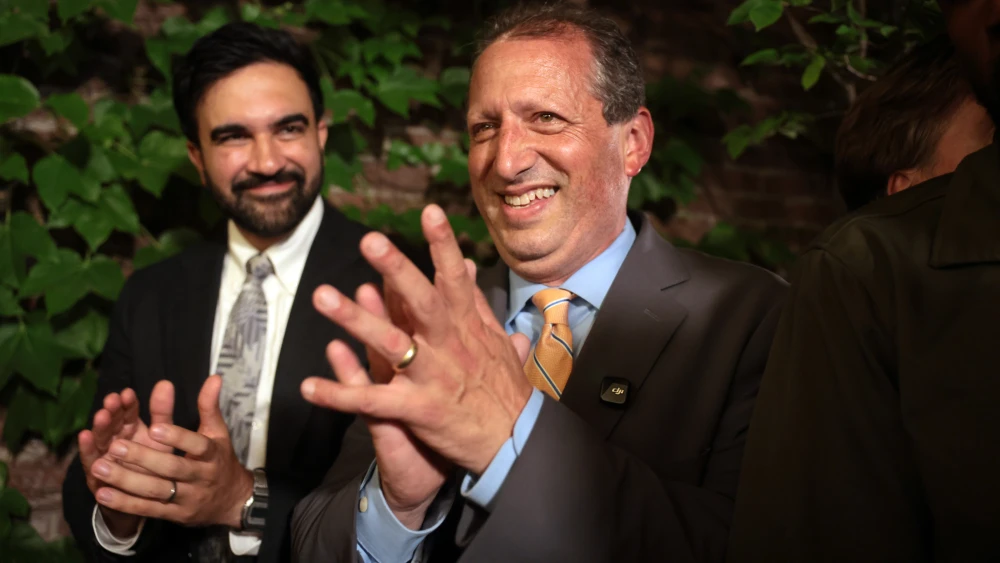
On the last two Fridays, Brad Lander, congressman-elect from New York’s 10th District and former New York City comptroller, has issued a video on social media about the weekly Torah portion, or parsha.
In one, Lander said that the lesson of the Torah portion was to treat workers better, which he interpreted to mean a charge to raise the minimum wage and pass legislation to help workers unionize.
In the other, the congressman-elect said that the parsha illustrated why Israeli Prime Minister Benjamin Netanyahu was wrong and why it was a “blessing” that Dr. Abdul El-Sayed—whom the Republican Jewish Coalition called the most antisemitic Senate candidate in the nation and who, like Lander, has accused the Jewish state of “genocide”—was elected.
Rabbi Steven Burg, CEO of Aish, told JNS that Lander’s “recent efforts to present himself as an interpreter of Torah” are “deeply troubling.”
“I have interacted with Brad personally over the years, and based on those experiences, I have serious questions about the depth of his Jewish knowledge and his understanding of traditional Jewish values,” Burg said. “More importantly, I believe his political positions and alliances have placed him fundamentally at odds with significant portions of the organized Jewish community.”
Burg told JNS that prominent Jewish leaders have publicized “serious concerns” about the congressman-elect and those with whom he associates politically.
“There is a phenomenon I often refer to as the ‘as-a-Jew’ phenomenon, where individuals invoke their Jewish identity to give religious legitimacy to political positions they already hold,” the rabbi said. “That is precisely what I believe we are witnessing here. Rather than allowing the Torah to shape and challenge his worldview, Lander appears determined to reshape the Torah to fit his political ideology.”
The Biblical prophets spoke about “justice, responsibility, compassion and the obligations we have toward one another,” and “Judaism has always had something to say about the moral challenges facing society,” according to Burg.
“The Torah is meant to inform every aspect of our lives, including how we approach public policy,” he told JNS. “There is, however, an enormous difference between drawing wisdom from the Torah and using it as a vehicle to promote a predetermined political agenda.”

Lander’s remarks about Netanyahu and about Israeli politics are “particularly revealing” to Burg.
“Lander’s opposition to Netanyahu is well established, and in my view, that opposition appears to be driving his interpretation of the biblical text,” the rabbi said. “He takes a profound Torah teaching about human relationships and uses it to advocate for a very specific political outcome in Israel.”
“I believe Lander’s political associations, including his support for figures whose positions on Israel have generated serious concerns among Jewish communal leaders, call into question his judgment on matters affecting Jewish safety,” Burg told JNS. “It is difficult for me to take his interpretations of Jewish responsibility seriously when I believe his political approach fails to give sufficient weight to the security of Israel and Israelis.”
That also extends to when Lander talks about the importance of Jewish unity.
“Too often, Lander’s approach to coexistence places the burden of compromise on the Jewish community rather than demanding genuine mutual respect and accountability from everyone involved,” Burg told JNS. “Frankly, I find it extraordinary that someone whose positions have generated such serious disagreements with prominent Jewish communal institutions would now position himself as a voice for Jewish unity.”
“Unity requires a willingness to stand with your own people, particularly when they are under attack. It cannot simply be a slogan used to advance a political agenda,” he said.
As he walked around New York City on Nov. 20, Lander began with a Hebrew quote from the Torah. “I’m not going to be able to do a little drash on the Torah portion every week, but this Shabbat’s portion is Veyetzeh, and that was my son’s bar mitzvah portion,” he then said. “So I gotta say a little something about it.”
Explaining that Jacob was treated very badly by Laban, Lander said, in a video that he posted 45 minutes after candle lighting time for the Sabbath, that “it’s like the Torah’s first labor dispute.”
“To me the lesson is pretty straightforward. There is holiness here if we are awake to it and also we’ve got a responsibility to make sure that that holiness belongs to everyone,” he said. “Our workers, the people who are doing that hard work by night, by day, and who are so often getting screwed, so that’s the work.”

“Stay awake to holiness and make sure that we raise the minimum wage, that we pass the PRO Act, so workers can organize that we make it possible not only to recognize the dignity of every place but to lift up and empower the dignity of every person,” he said. “Shabbat Shalom.”
A week prior, on Nov. 13, he said—this time well before Shabbat started—that the Torah directs Jews not to hate Edomites. “Unfortunately, that commandment is too often ignored,” he said. “This week, Netanyahu stood in the new Knesset, branded the Arab parties terror supporters and called for a unity government among Jewish parties only. As if the one in five Israeli citizens who are Palestinian aren’t part of the nation. That’s not unity.”
“The way forward is a broad coalition. Jews of many kinds, who love Israel, working together with Palestinians, who see things very differently,” he said. “I hope Gadi Eisenkot rejects Netanyahu’s fear mongering and builds a coalition with the Palestinian-led parties. And here in the United States, in this new Congress, Michigan will be represented by a Jewish senator, Elissa Slotkin, and a Muslim senator, Abdul El-Sayed. Georgia will be represented by a Jewish senator, Jon Ossoff, and a Christian pastor Raphael Warnock. There are so many blessings.”
In the ostensible Torah sermon, Lander referred to “atrocities committed in our name and with our tax dollars.”
“We can argue about what to call them, and more importantly, how to end them, without setting brother against brother or parents against children,” he said.
Rabbi Yaakov Menken, executive vice president of the Coalition for Jewish Values, told JNS that “the Torah is the source of morality, and he is hardly the first to attempt to twist the Biblical text to claim that it meets his own beliefs.”
“But the Torah only educates us when we let it guide our thinking, not when we superimpose our preconceived notions upon it,” Menken said.
The Torah “clearly differentiates” between the holiness that Jacob experienced at the site of the future Temple and when he lived with Laban, the “swindler and cheat,” and Jacob prayed to God to protect him when he was amid the idolatrous and immoral Arameans, the rabbi said.

“The Torah clearly teaches us that not everything is holy, that not every place or person exemplifies ‘dignity,’” Menken told JNS. “But of course Lander knows this, because he brands Netanyahu and Israelis as evil. He’s merely inverting the evil and the good.”
If Lander genuinely wanted to understand the Torah’s message, he would know that the false accusation of Jewish theft is as old as Jacob and Laban, according to the rabbi.
“He would know that to falsely accuse Jews of atrocities and disregard for others is not much newer. In the current case, the so-called ‘atrocities’ ceased when Hamas released the hostages and stopped fighting, meaning that Israel was fighting for lives and human dignity throughout,” Menken told JNS. “To call that an ‘atrocity’ is incontrovertible evidence of a broken moral compass.”
“A Torah message is not consonant with lies or slander. The notion that a ‘Palestinian’ is an Arab is historical revisionism at its finest, and Netanyahu is not ‘fear mongering’ when he points to the association of Arab parties with terror and groups seeking Israel’s eradication,” the rabbi said.
“If he were a racist, he would not have had multiple Druze Arab members not just in his government but in his Likud faction,” Menken said. “Lander’s version of a Torah lecture is to make ridiculous accusations against Israelis.”
Burg, of Aish, thinks that Lander is producing the Torah videos “as part of a broader pattern of wrapping his political ideology in the language of Jewish tradition.”
“His commentary repeatedly arrives at conclusions that align neatly with his existing political positions,” Burg said. “That raises serious questions about whether he is genuinely exploring what the Torah demands of us or simply searching for religious language to support what he already believes.”
“There is something particularly troubling about presenting oneself as a voice of Jewish values while remaining so far apart from the concerns expressed by many of the institutions responsible for protecting and sustaining Jewish communal life,” he told JNS.

“Ultimately, my concern is not that Brad Lander is talking about Torah. I welcome anyone who wants to engage seriously with Jewish learning,” he said. “My concern is that he is presenting his own political ideology as though it represents the values of Judaism itself. I believe that is a profound distortion of what the Torah stands for.”
“The Torah is not a political prop. It is a sacred tradition that has guided the Jewish people for thousands of years,” Burg told JNS. “We are supposed to shape our lives and our beliefs around the Torah, not reshape the Torah around our politics.”
Morton Klein, national president of the Zionist Organization of America, told JNS that the congressman-elect is trying, in part, to gloss over his support for Zohran Mamdani, mayor of New York City.
“I think Lander has been so hostile to the Jewish state and friendly toward the Jew-hating, Israel-hater Mamdani that he wants to divert and distract us from his own anti-Jewish bigotry by discussing his meaningless Torah insights,” Klein said.
Daniel Friedman, a rabbi and professor of political science at Touro University and founder of the Center for Torah Values, told JNS that “Brad Lander’s newfound enthusiasm for sharing weekly Torah insights needs to be understood in the context of the changing political landscape.”
“The incoming class of Democratic congressional leaders includes a number of prominent Christians, who are quite comfortable invoking their faith as part of their political identity,” Friedman said. “Lander appears to recognize that he, too, has a rich biblical tradition from which to draw.”
To date, Lander has publicly been associated with his criticism of Israel, and “he has been perceived by some as an ‘as a Jew’ Jew, someone who invokes his Jewish credentials primarily to lend credibility to his criticism of the Jewish state,” Friedman told JNS. “These weekly Torah reflections offer him an opportunity to broaden that identity. He is signaling that he is not simply a Jewish politician with opinions about Israel. He is a Jewish politician with biblical wisdom to share with America.”
The Touro professor thinks that Lander is showing Jewish voters that he is familiar with “Jewish texts, traditions and leading rabbinic thinkers” and is demonstrating to non-Jews that he is “someone who can participate in the broader American conversation about faith and public morality.”
“His movement between Hebrew terminology and familiar English biblical names such as Genesis and Jacob is particularly revealing,” Friedman said. “He wants to sound authentically Jewish while remaining accessible to a wider American audience.”
“In that sense, he may also be positioning himself within a new generation of political leaders, who recognize that religious literacy can be an asset in appealing to an America whose moral vocabulary remains deeply influenced by the Judeo-Christian tradition,” he told JNS.
Friedman thinks that it is a good thing that Lander is using the Torah to advance his political agenda.
“The Bible has always been subject to interpretation, and people inevitably approach its teachings through their own sociopolitical lenses. Conservatives and progressives will often find different lessons in the very same biblical passages,” he said. “What matters is that he is actually opening the Bible, engaging with its teachings and implicitly encouraging other Jews to do likewise.”
Conversations about Jewish values have long been severed from engaging seriously with Jewish texts, according to Friedman.
“Sometimes, the entire conversation begins and ends with an amorphous invocation of tzedek, tzedek tirdof, ‘Justice, justice shall you pursue,’ without much consideration of what the Torah actually means by justice or how that principle fits into the broader biblical worldview,” he said. “I may disagree with Lander’s interpretation of a particular Torah portion. I may even believe that he is reading contemporary political positions into a text that deserves a more nuanced treatment. But I would much rather have that debate grounded in the Torah than have Jewish identity reduced to a collection of fashionable political slogans.”
Friedman is “especially delighted” that Lander is quoting Rabbi Jonathan Sacks, “one of the great Jewish thinkers of our generation, whose unique contribution was demonstrating that the Torah has something profound to say to the entire world.”
“If Brad Lander’s weekly sermons encourage more American Jews to open a Chumash, study the weekly portion, discover Rabbi Sacks and consider what our ancient tradition has to teach contemporary society, then we should welcome the initiative,” he said.