At 1:15 am., according to the large clock outside Tel Aviv’s Mugrabi Cinema, the streets were still packed with people.
In photographs preserved in the Central Zionist Archives, young men and women can be seen clambering onto the roof of a bus, strangers dancing together and blue-and-white flags being waved above the crowds. In Jerusalem, a man rides a donkey carrying a Jewish flag, while a British policeman raises a glass.
It was the early morning of Nov. 30, 1947, following a night that would become known to generations of Israelis as Kaf-Tet B’November (29th of November). Across the Land of Israel, Jews were celebrating a state that did not yet exist.
It had no name, no national army, no currency and no passports. Its borders were disputed, and its survival was far from assured.
But that night, after listening to the results of a vote taking place thousands of miles away, a nation danced.
Ten students in pajamas
At 11 am. on Sunday, Nov. 30, Zipporah (Zippy) Porath sat down in her room in Jerusalem to write to her parents and sister in the United States.
The young American had arrived in pre-state Israel weeks earlier to study at the Hebrew University. She had intended to go to bed early the previous evening, having heard rumors that the U.N. vote would be postponed.
At around 11 pm., however, there was a knock on her door.
Ten students in pajamas squeezed into a room barely large enough for five, anxiously trying to pick up the broadcast from Lake Success, N.Y., on a battered radio.
They managed to get reception just as the final result was announced.
The students embraced, and stood at attention to sing “Hatikvah.” Bottles of wine, cookies and candy appeared. Hastily throwing on their clothes, they ran through the building, waking those who had slept through the historic announcement.
Soon, the students were dancing on the roof of the building. From there, they took to the streets, banging on doors and shutters and shouting the news to sleeping residents.
“Down the road we raced like a million hearts on fire,” Porath wrote.
By morning, British military vehicles were carrying cheering, flag-waving children. Cafes and wine shops had opened their doors, offering free drinks. Shopkeepers had hung portraits of Theodor Herzl in their windows.
“Now that it was happening, it seemed more than ever like a dream,” she wrote.
Porath’s letters, subsequently published in Letters from Jerusalem: 1947–1948, document not only the celebrations surrounding the partition vote but also her transformation from an American university student into a participant in Israel’s struggle for independence. She joined the Haganah and eventually made Israel her permanent home.
Thirty-three votes that changed history
For days, the roughly 630,000 Jews living in the Land of Israel had been following developments at the United Nations with mounting anxiety.
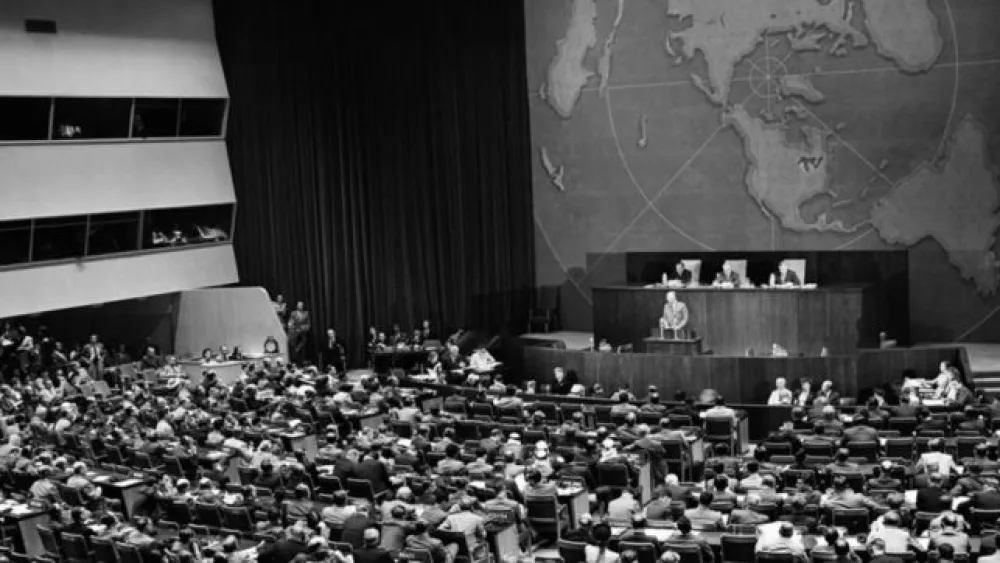
UN General Assembly Resolution 181 proposed the termination of the British Mandate and the establishment of independent Jewish and Arab states, with Jerusalem and its surroundings placed under a special international administration.
Despite reservations about the proposed borders and the exclusion of Jerusalem from the Jewish state, the Jewish Agency accepted the plan. The Arab leadership rejected it.
One of those anxiously following developments was Mordecai Chertoff, a young American immigrant working as a journalist at The Palestine Post and secretly serving in the Haganah.
In a four-page handwritten letter to his family dated Nov. 30, 1947, Chertoff recalled how the newspaper’s staff had gathered around the radio on Friday afternoon, only to hear a proposal to postpone the vote.
“Our eyes dimmed and our blood froze in our veins,” he wrote.
Walking through the subdued streets of Jerusalem afterward, Chertoff feared the prospect of renewed violence.
On Saturday morning, residents made their way to the Western Wall, the Kotel, to pray alongside the chief rabbis. Chertoff visited Chief Rabbi Isaac Herzog, grandfather of Israel’s current president, before returning to the newspaper’s offices.
Despite having little rational reason for optimism, he recalled feeling “that despite all, we will triumph.”
That evening, families gathered around radio receivers, listening as the names of the countries were called out, one after another.
The final tally: 33 in favor, 13 against and 10 abstentions.
Both the United States and the Soviet Union, increasingly at odds in the emerging Cold War, voted in favor. Britain abstained.
Decades later, following his father’s death at the age of 91, Daniel Chertoff discovered his father’s letters in a dresser drawer. They became the basis of his book, Palestine Posts: An Eyewitness Account of the Birth of Israel.

Dancing behind barbed wire
The celebrations were by no means confined to the Land of Israel.
On the Mediterranean island of Cyprus, thousands of Jewish refugees, most of them Holocaust survivors, were being held in British detention camps at Xylotimbu and Caraolos, after attempting to reach the shores of the Land of Israel.
Aaron Cohen, a survivor from Europe wrote in his testimony preserved in the archives of the Atlit Detention Camp heritage site near Haifa: “We listened next to a tiny radio we owned. After the vote, we all jumped up and sang HaTikva with tears pouring down our faces. Immediately afterwards, we shouted and whistled, we went crazy with happiness.”
“It was the first happy day for the Cyprus refugees in many years,” noted a contemporary report from Nicosia, reproduced in Anny Latour’s book, The Resurrection of Israel.
For some refugees, freedom was still more than a year away. The last of the British detention camps in Cyprus would not close until February 1949, nine months after the establishment of the State of Israel.
A father’s tears
Among the children celebrating in Jerusalem that night was eight-year-old Amos Klausner, who would later become one of Israel’s most acclaimed authors, Amos Oz.
Writing more than half a century later in his autobiographical work A Tale of Love and Darkness, Oz recalled wandering through the crowds perched on his father’s shoulders.
“Just you look, my boy, take a very good look, son,” his father told him.
He wanted Amos to remember the night for the rest of his life and to recount it to his own children, grandchildren and great-grandchildren.
It was three or four in the morning when the exhausted child finally crawled into bed, still fully dressed.
A little later, his father lifted the blanket and lay down beside him.
In the darkness, he told Amos about his childhood in Europe, about the humiliation and physical abuse that he and his family had endured simply because they were Jews.
He could not promise his son that he would never be bullied at school. But he believed that, in a Jewish country, being Jewish would no longer be the reason for it.
As his father spoke, Amos reached up to touch his face.
It was wet with tears.

Among the joyful
At the Jewish Agency headquarters on Jerusalem’s King George Street, crowds gathered beneath the balcony, eager to hear from the leaders of the Yishuv, the pre-state Jewish community.
Among those who addressed them was Golda Meyerson (later Meir), acting head of the Jewish Agency’s Political Department and Israel’s future fourth prime minister.
Porath, who witnessed her appearance on the balcony, described a woman so overcome with joy that she struggled to speak.
“Choked with emotion, she managed to say ‘Mazal tov,’” Porath wrote.
Not everyone could surrender themselves entirely to the celebrations.
David Ben-Gurion, chairman of the Jewish Agency and Israel’s future first prime minister, was staying at the Kalia Hotel on the northern shores of the Dead Sea when he was awakened with news of the vote. Workers from the nearby Dead Sea Works arrived at the hotel and began dancing.
Returning to Jerusalem the following morning, he found the celebrations still in full swing.
“I could not dance, I could not sing that night,” Ben-Gurion later recalled. “I looked at them so happy dancing and I could only think that they were all going to war.”
The morning after
On Sunday, Nov. 30, Jews across the land awoke to newspapers announcing the historic decision.
Some had not been to bed at all.
Already that morning, news was reaching the Yishuv of deadly attacks on buses carrying Jewish passengers. Near Petach Tikvah, seven Jews were killed in two attacks on buses, widely regarded as marking the beginning of Israel’s War of Independence.
Less than six months later, on May 14, 1948, Ben-Gurion proclaimed the establishment of the State of Israel.
That day, as celebrations once again erupted throughout the country, he recorded his feelings in his personal diary:
“Across the land, there is joy and profound happiness, and again I mourn among the joyful, as on November 29.”