
Tensions between Israel and the Board of Peace (BoP) have increasingly spilled into the public arena, with senior officials from the U.S.-led initiative accusing Jerusalem of delaying President Donald Trump’s plan for Gaza, and raising the possibility of abandoning the project.
“If Israel does not want the Board of Peace to operate, it should simply tell President Trump, and we will walk away,” Josh Gruenbaum, a senior adviser to the Board, said on Nov. 22, identifying the United Nations and the Palestinian Authority as potential alternatives.
The remarks followed the Board’s second implementation report to the U.N. Security Council on Nov. 17. Despite substantial preparations over the preceding six months, the report acknowledged limited progress on the ground, citing continued Hamas military activity and outstanding Israeli commitments.
According to Gruenbaum, the Board had moderated its pressure on Jerusalem during Israel’s election campaign. However, the Oct. 27 election failed to produce a decisive majority, leaving Prime Minister Benjamin Netanyahu heading a caretaker government and the implementation process stalled.
In a recent interview with Jewish Insider, Gruenbaum accused Israel of “not honoring their commitments.”
Netanyahu, meanwhile, has reaffirmed Israel’s commitment to Trump’s original 20-point plan while signaling skepticism about the Board’s subsequent roadmap. “There is a huge gap between the initial 20-point plan and the Board of Peace roadmap that the Board developed,” Kobi Michael, a senior researcher at the Institute for National Security Studies (INSS) in Tel Aviv and a senior research fellow at the Misgav Institute for National Security and Zionist Strategy in Jerusalem, told JNS. “The roadmap actually contradicts many of the points in the initial agreement. It requires compromises from Israel that Israel never agreed to and has no reason to accept.”
The election may help explain the delay. The dispute over what Israel agreed to requires a closer look at the original plan and the roadmap the Board subsequently negotiated.
The BoP framework
Gaza’s postwar transition framework was established under Trump’s 20-point plan, unveiled on Sept. 29, 2025, and endorsed by U.N. Security Council Resolution 2803. While the first phase secured a ceasefire and hostage-release agreement, the second envisioned dismantling Hamas’s military and governing apparatus and establishing an alternative Gazan administration.
The framework distributes responsibility among three institutions. The Board of Peace provides international oversight, strategic direction, and coordination of reconstruction financing. The National Committee for the Administration of Gaza (NCAG), composed of Gazan technocrats, is tasked with civilian governance and public services. The International Stabilization Force (ISF), alongside an Israel-vetted Gazan police force, is responsible for supporting demilitarization and establishing a secure environment.
Israel’s withdrawal from the Gaza Strip is conditional on progress toward demilitarization, with a residual Israeli security presence maintained until the threat of renewed terrorism is adequately addressed.
“Withdrawal follows verified decommissioning and proceeds in phases,” Nickolay Mladenov, the Board’s high representative for Gaza, told the Security Council on Aug. 26.
The framework thus establishes an interdependence between security, civilian governance, reconstruction and Israeli withdrawal.
Since its inaugural meeting in Washington on Feb. 19, the Board has established an international organization with 28 member states, an executive leadership and a series of administrative, financial and security mechanisms dedicated to Gaza’s postwar transition.
Under Mladenov’s leadership, the Civil-Military Coordination Center in Kiryat Gat was reorganized into the International Gaza Support Center (IGSC), bringing together representatives from more than 25 countries and 75 organizations and coordinating with Israeli authorities. The Board has also centralized procurement, financial oversight and donor fund allocation.
The NCAG, headed by Ali Shaath, has operated from Cairo since January. It has established administrative departments covering healthcare, education, finance, infrastructure and internal security, alongside staffing arrangements, expenditure regulations and a fiscal plan for 2027–2031.
Preparations for a Gazan civilian police force have also advanced. According to the Board, thousands of Gazan civilian police candidates have undergone vetting by the Shin Bet and are awaiting training, with Egypt designated as the principal training partner. Their departure, training and deployment remain subject to Israeli authorization.
Furthermore, under U.S. Maj. Gen. Jasper Jeffers, the International Stabilization Force has secured preliminary troop commitments from Indonesia, Morocco, Kazakhstan, Kosovo and Albania. Morocco, Kosovo and Albania have concluded formal participation agreements.
However, negotiations over the Status of Forces Agreement (SOFA), governing the multinational force’s legal and operational conditions, remain unfinished. “The question is not how many countries are willing to send troops to Gaza. The question is what these troops will be willing to do once they are there,” Michael said. “I don’t see any countries that are willing to engage in a military confrontation with Hamas in order to disarm it.”
On reconstruction, the Board has put forward more concrete commitments. Its six-month recovery program encompasses 66 projects with an estimated budget of $2.45 billion, including $1.2 billion for infrastructure, $885 million for security and $303 million for human development. Specific initiatives include rehabilitating water and sanitation systems, restoring healthcare and educational facilities, and developing a United Arab Emirates-backed housing project intended to accommodate approximately 50,000 people.
According to the Board, donors have committed approximately $17 billion, of which $280 million has been deployed for preparatory activities.
However, for Jerusalem, the question is not merely whether the framework is ready, but whether the conditions governing its deployment safeguard Israel’s security interests. It is on these conditions that Israel and the Board diverge.
The fundamental disagreements
The differences between Israel and the Board crystallized on July 30, when, following months of negotiations with Hamas and other Gazan factions, the Board unveiled a 15-point roadmap for implementing Trump’s plan.
While the Board presented Hamas’s acceptance as a diplomatic breakthrough, Jerusalem questioned whether the arrangements would deliver genuine demilitarization and prevent the terrorist organization from reconstituting its capabilities.
“Israel does not accept the 15-point document,” Netanyahu stated at a Cabinet meeting on Aug. 9, emphasizing that the IDF would not withdraw before Hamas was genuinely disarmed.
The principal disagreement concerns the sequencing and execution of demilitarization. Article 8 stipulates that decommissioning heavy weapons and military infrastructure would commence after outstanding ceasefire commitments are fulfilled, the NCAG enters Gaza, and the ISF deploys.
Disarmament would proceed alongside phased Israeli withdrawals, with weapons transferred to NCAG custody under international supervision rather than surrendered directly to Israel. “The central problem is disarmament, and everything else is secondary,” Michael said. “Currently, the Board has already moved from total disarmament to new and unclear separations between ‘light’ and ‘heavy’ weapons. At this point, they have said they want the weapons to stay in Gaza and to be surrendered to the Palestinian administration, which is completely against the initial agreement.”
From Israel’s perspective, withdrawing before Hamas has been comprehensively disarmed risks relinquishing military leverage while the terrorist organization retains significant operational capabilities. The Board, conversely, maintains that establishing alternative security and governance institutions is a prerequisite for orderly, verifiable disarmament.
Furthermore, the Board argues that training Gazan police and deploying the NCAG would not require Israel to relinquish territorial control. Michael questioned what authority the committee could exercise while Hamas remained armed. “Hamas is not going to give up control of the Gaza Strip willingly,” he said. “They may be willing to let somebody else take care of the population, pay the salaries and provide the services, but Hamas wants to remain the most powerful actor in Gaza.”
A further complication concerns the composition of Gaza’s prospective administration. While the roadmap excludes Hamas members from the security services, it preserves existing civilian institutions and civil servants’ employment rights. Given Hamas’s nearly two decades of governance, the NCAG risks inheriting a civil apparatus deeply infiltrated by Hamas operatives and affiliates, raising questions about vetting and administrative independence.
Disagreements also extend to humanitarian rehabilitation preceding demilitarization. While both sides maintain that large-scale reconstruction must be conditional on verified security progress, the Board advocates expanding the provision of shelter materials, metal, generators, pumps and other essential infrastructure.
Jerusalem maintains that, as long as Hamas retains its military and organizational capabilities, introducing dual-use materials risks restoring its terrorist infrastructure, a danger Gruenbaum himself has acknowledged.
Underlying these disagreements is a more fundamental question: Even if mutually acceptable mechanisms can be negotiated, can the institutions assembled by the Board dismantle Hamas’s military and governing apparatus and guarantee Israel’s security?
“An agreed document on disarmament does not immediately mean a disarmed Gaza,” Mladenov acknowledged in his August briefing to the Security Council. The Board’s November report confirmed that Hamas continues military activity, including attacks against IDF troops, despite its commitments. On Nov. 11, Netanyahu stated that the terrorist organization had yet to surrender a single weapon. Brig. Gen. (res.) Assaf Orion, a senior researcher at the INSS, told JNS that Hamas’s refusal to disarm has created a situation where “the blame lies heavily on Israel for the project not advancing even though Hamas is the one who is actually causing the problem.”
Although the ISF possesses a broad mandate to support demilitarization, the roadmap establishes no automatic military enforcement mechanism should Hamas fail to comply. Participating countries’ willingness to confront Gazan terrorist organizations, alongside the force’s prospective rules of engagement and capabilities, remains unclear. “Israel’s experience with international forces has been very bad,” Orna Mizrahi, a senior researcher and head of the Lebanon Program at INSS, told JNS. “These international forces don’t want to get into military confrontations and fight. Israel is left to do the dirty work, and then Israel is the one accused of breaking the rules and harming civilians.”
Article 12 explicitly excludes the ISF from domestic policing, placing responsibility for internal security with the Gazan administration, whose ability, or even desire, to confront armed factions remains untested.
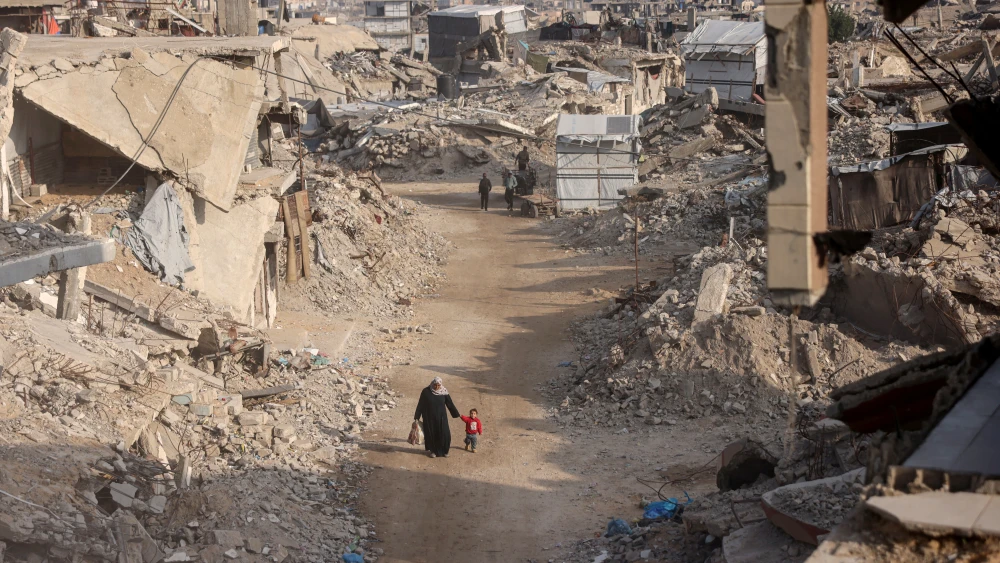
The magnitude of Gaza’s reconstruction presents another challenge. A joint assessment published in April by the World Bank, European Union and United Nations estimated that Gaza’s recovery would require $71.4 billion over the coming decade, including $26.3 billion within the first 18 months. Sustaining financing on this scale depends heavily on durable security conditions and credible administrative oversight.
The Board also faces institutional time constraints. Under Resolution 2803, its U.N. authorization, alongside that of the international security presence, extends only through Dec. 31, 2027.
For Israel, the strategic challenge lies in determining whether the international framework can advance its security objectives without making its long-term security dependent on institutions whose mandates may expire before the consequences of their actions become apparent.
Israel’s strategic options
Maintaining the current arrangements in Gaza allows Israel to preserve its territorial leverage, operational freedom and ability to respond directly to emerging terrorist threats. However, the status quo is increasingly difficult to sustain. Prolonged deployments strain the IDF’s manpower and Israel’s economy, expose Israeli forces to terrorist activity and risk increasing diplomatic friction. Furthermore, it is not on a trajectory to end Hamas’s rule.
If Israel remains committed to dismantling Hamas’s military and governing apparatus, it faces two alternatives: renewing large-scale military operations to eliminate the organization’s remaining capabilities or pursuing an internationally supported mechanism.
The former entails substantial military, economic and diplomatic costs, while the latter carries significant uncertainties regarding its effectiveness and enforceability and may ultimately fail, requiring a large-scale military operation under worse military and diplomatic conditions.
Orion said Israel would need international support but could not rely on other governments to disarm Hamas. “The people who can take on that challenge are either Israel or the local militias that we partner with,” Orion said.
Former Israeli Strategic Affairs Minister Ron Dermer, an architect of the original ceasefire agreement, has advocated testing the international framework before abandoning it.
“And I believe Israel should work with the Board of Peace now,” Dermer said in a Nov. 16 interview with the “School of War” podcast, advocating cooperation on tax revenues, police training and the establishment of a technocratic government.
Michael identified the areas already under Israeli control as a place to begin. “I don’t think we have to wait for the demilitarization of the entire Gaza Strip in order to start building an alternative to Hamas,” he said. “We can start developing this alternative in the areas controlled by Israel and, in parallel, continue the military pressure on Hamas in the other parts of the Gaza Strip.”
Orion echoed this assessment, saying, “You can’t solve the problem all at once. You have to go piecemeal.”
Such an approach need not entail unconditional acceptance of the Board’s roadmap. Negotiations could focus on enforceable disarmament benchmarks and preserving Israel’s operational freedom.
Ultimately, the risks inherent in the Board’s framework must be weighed not against an ideal postwar settlement but against the costs and uncertainties of Israel’s available alternatives. “The international community can help with the reconstruction of Gaza and with the establishment of an alternative government,” Michael said. “But when it comes to dismantling the military capabilities of Hamas, I think that eventually Israel will have to do the job.”
The challenge for Jerusalem is to translate its military achievements into a sustainable strategic outcome. An indefinite continuation of the impasse risks eroding those achievements without securing the fundamental objectives for which the war was fought.