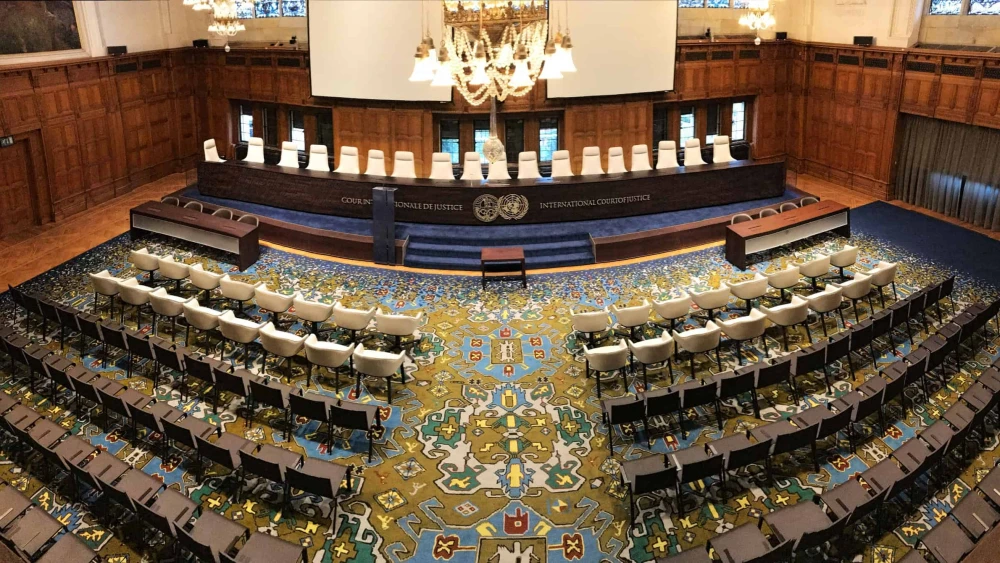
South Africa, which has accused Israel of committing genocide in Gaza, has agreed to an effective 36-month extension in proceedings before the International Court of Justice after requesting additional time to respond to Israel’s initial defense response.
The court, which is based in The Hague, is the principal judicial arm of the United Nations.
In an order dated May 21 and published on Friday, the ICJ gave South Africa until Nov. 22, 2027, to file its reply. Israel will then have until May 22, 2029, to submit a rejoinder.
According to the court, South Africa told judges last month that a second round of written pleadings was necessary because of “the complexity of the case,” the volume of Israel’s counter-memorial and Israel’s objections to the court’s jurisdiction and the admissibility of South Africa’s application.
Israel argued that another round of pleadings was unnecessary, the court said, but maintained that if South Africa were granted 18 months to respond, Israel should receive the same amount of time for its rejoinder.
The extension marks the latest delay in the case. In 2025, the ICJ granted Israel a six-month extension to file its counter-memorial after Jerusalem cited evidentiary and procedural issues and the growing number of third-party interventions in the case.
At the time, South Africa opposed the delay, arguing there was no legitimate basis for an extension given what it described as a humanitarian emergency in Gaza. The court nevertheless sided with Israel.
In previous cases, the ICJ has required “fully conclusive” evidence that an accused state had intended to commit genocide with no other feasible, competing motives, such as counterterrorism.
Several countries have since sought to intervene in the proceedings, including Ireland, Iceland, the Netherlands, Namibia and Paraguay.
Ireland, which joined the case in January 2025, urged the court to broaden the interpretation of genocidal intent under the 1948 Genocide Convention. Dublin argued that intent could be established when “a reasonable person would have foreseen” genocide as the likely consequence of a state’s actions, even absent explicit intent to destroy a protected group.
Some legal analysts have said the interventions reflect the difficulty of meeting the high evidentiary threshold required to prove genocide under international law, which generally requires proof of specific intent to destroy, in whole or in part, a national, ethnic, racial or religious group.
Israel has rejected South Africa’s allegations, arguing that its military campaign targets Hamas following the terrorist group’s attacks in southern Israel on Oct. 7, 2023. Israeli officials have said civilian casualties in Gaza, while tragic, are a consequence of urban warfare and Hamas’s practice of embedding fighters and military infrastructure within civilian areas. Israel has also said its forces have taken measures to minimize civilian harm and limit the civilian death toll.