



When I was growing up, Jewish adults often asked a blunt political question: “Is he good for the Jews?”
It was not elegant political science. But it was usually a pretty good test.
It meant: Does this candidate understand Jewish security? Does he respect Jewish continuity? Does she understand that Zionism is not a dirty word, but the national liberation movement of the Jewish people? Does he know the difference between criticizing an Israeli government and treating the Jewish state as uniquely illegitimate?
That old question is due for a comeback.
American Jews today face political danger from more than one direction. On the left, some democratic socialist and progressive candidates have made anti-Zionism, opposition to U.S. aid to Israel and hostility to pro-Israel advocacy part of their political identity. On the right, some candidates and activists flirt with antisemitic imagery, conspiracy theories and social-media rhetoric while claiming merely to be “anti-establishment.”
Jewish voters should not be fooled by either package.
The most recent and ugliest example came from Texas, where Democratic congressional candidate Maureen Galindo drew national condemnation after reportedly proposing to convert an immigration detention facility into a prison for “American Zionists.” Her remarks reportedly included claims about “Zionist billionaire Jews” controlling media and banking, and suggestions that politicians associated with Israel should face treason proceedings.
Galindo denied being antisemitic, insisting that her problem was with “Zionist Jews” and not Jews generally. But that is exactly the point. Increasingly, some candidates no longer say, “the Jews.” They say “the Zionists”—and then attach to that word the same old poison: money control, media control, dual loyalty, conspiracy and collective guilt.
That is not a foreign-policy debate. That is antisemitism with a new label.
The backlash against Galindo was strong and bipartisan. Democratic leaders, including New York Reps. Hakeem Jeffries and Alexandria Ocasio-Cortez, condemned her rhetoric. Jewish Democratic Congress members threatened expulsion efforts if she were elected. Even some anti-AIPAC activists reportedly withdrew support.
On Tuesday night, she lost the Democratic runoff for a Texas House seat to Johnny Garcia, who finished second to her back in March.
Still, the fact that a candidate for Congress could speak that way in 2026 and still be treated as a serious contender tells us something disturbing about the political atmosphere.
That case is the loudest example, but not the only one.
In Pennsylvania, progressive Chris Rabb won the Democratic primary in a heavily Democratic congressional district after campaigning with support from the party’s left wing. His platform included ending U.S. military aid to Israel, and his campaign was celebrated by groups and activists hostile to AIPAC and traditional pro-Israel politics.
In New York, Ocasio-Cortez reportedly pledged at a Democratic Socialists of America forum to oppose all U.S. military aid to Israel, including defensive aid such as the Iron Dome missile-defense system. That is no small distinction. Iron Dome does not occupy territory. It shoots rockets out of the sky before they land on Israeli civilians—Jews, Arabs, Druze, Christians, children and grandparents. Opposing even that tells Jewish voters something important.
In New Jersey’s 7th Congressional District, businessman Brian Varela has reportedly picked up endorsements from CAIR and the anti-Israel group, A New Policy, as Democrats become increasingly divided over military aid to Israel. That race is another reminder that Israel is becoming a litmus test in some primaries.
This is not merely about Israel’s policy. It is about whether Zionist Jews are regarded as legitimate participants in American public life.
A candidate who says, “I disagree with this Israeli government,” is taking a political position. A candidate who says supporters of Israel are traitors, agents of a foreign power or tools of sinister Jewish money is doing something quite different. One is debate, and the other is demonization.
There is also a deeper ideological question. Jewish success in America was not built on socialism. It was built by freedom: religious liberty, private enterprise, education, family stability, voluntary associations and the opportunity to work, build, own, fail, try again and succeed. Jews built businesses, professional practices, synagogues, schools, charities, hospitals and civic institutions because America gave them room to do so.
Capitalism did not solve every problem. No human system does. But the American system gave Jews something rare in history: the chance to advance without a czar, commissar, guild, quota or dictator standing at the door.
When candidates describe America mainly as an oppressive structure to be dismantled, Jewish voters should listen carefully. Our grandparents and parents did not come here to trade one ideological cage for another. They came here because liberty worked.
But Jewish voters should not think all the danger comes from the left.
Nor is the problem confined neatly to one ideological box.
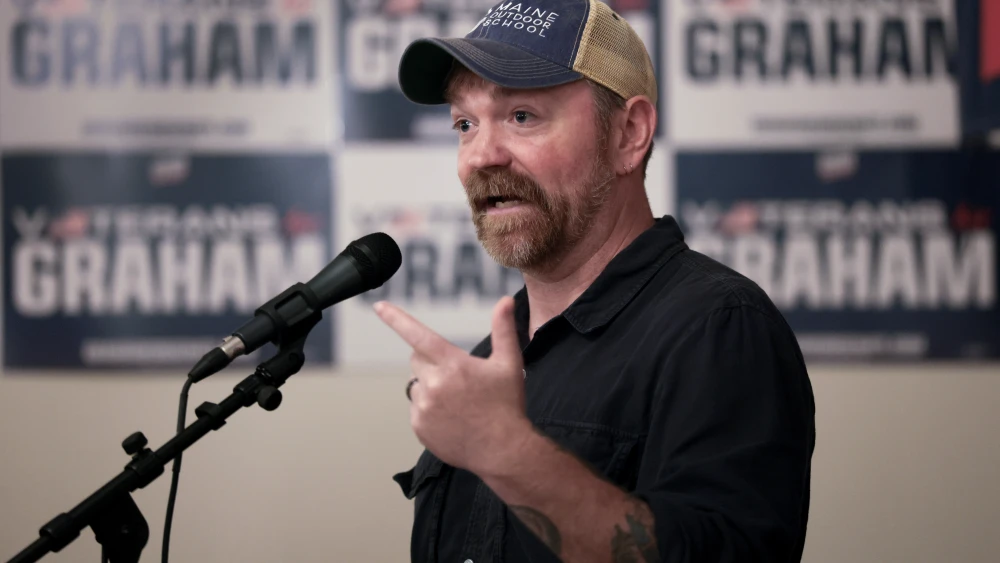
Maine Democratic Senate candidate Graham Platner, an outspoken critic of Israel, has faced scrutiny over a tattoo controversy involving imagery associated with Nazism, as well as past social-media activity that raised concerns among Jewish observers and others. His campaign has denied antisemitism, and such denials should be reported fairly.
Still, voters are entitled to ask why controversies involving Nazi imagery, anti-Israel politics and reckless online rhetoric keep appearing around candidates seeking high office.
On the right, antisemitic themes often come wrapped in words like “globalists,” “elites,” “bankers,” “puppeteers” or “the regime.” Not every use of those words is antisemitic.
Jews, however, have enough historical memory to know when political language begins drifting toward old and dangerous places.


