


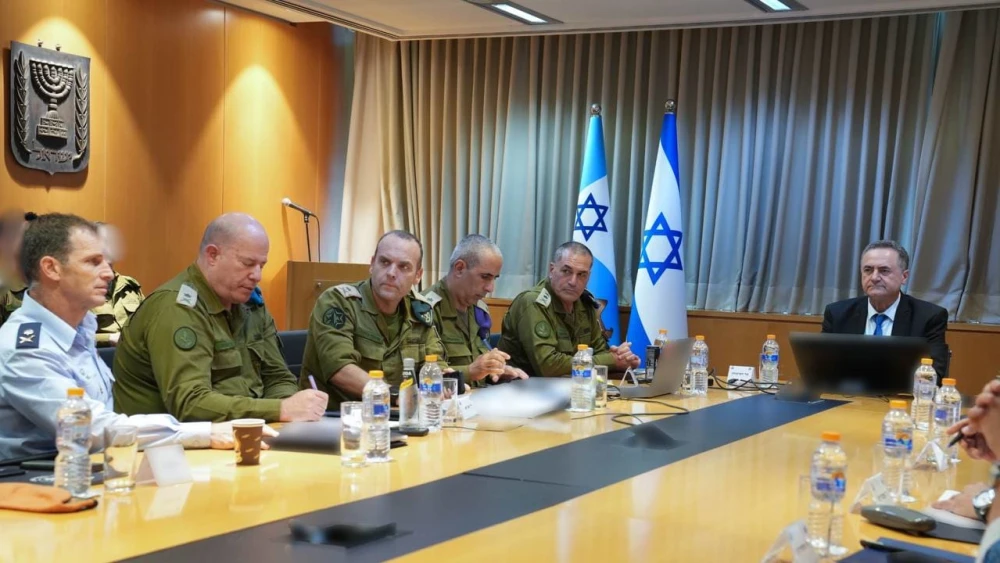
Defense Minister Israel Katz has instructed the military to prepare a plan to transfer all civilian law-enforcement responsibilities in Judea and Samaria to the Israel Police, his office said on Friday.
Katz issued the directive following a meeting on Thursday with IDF Chief of Staff Lt. Gen. Eyal Zamir, the heads of the IDF’s Operations Directorate and Military Intelligence and other senior commanders.
Under the proposed plan, which is to be drawn up in coordination with the Israel Police and other relevant authorities, civilian law enforcement in Judea and Samaria would be transferred from the IDF to the police, as is the case elsewhere in Israel.
The police would establish a dedicated force to handle civilian matters and receive the necessary authority and funding, according to Katz’s office.
The IDF would continue to combat Palestinian terrorism and focus on defending Israeli communities and borders.
“It is not the IDF’s role, nor does it have the capacity, to deal with the enforcement of civilian matters in Judea and Samaria, given the welcome expected increase in the number of residents in Judea and Samaria following the decisions to establish 104 new communities and formalize the agricultural farms, on the one hand, and the growing security threats and challenges that the IDF is facing and is expected to face on the central front, on the other,” Katz said.
“The IDF’s role is to fight Palestinian terrorism, focus on defending the borders and communities against threats, deal with the borders and the territory itself, and address security threats to the communities and the State of Israel—not to chase teenagers on the hilltops. All responsibility for handling and enforcing matters relating to the communities, residents and civilian issues will be transferred to the Israel Police, which will be required to prepare accordingly.”
Katz described the move as “a significant step toward strengthening governance and enforcing law and order throughout Judea and Samaria,” while freeing the military to concentrate on its primary missions.
“The Israeli government and the IDF will delegate to the police all the powers necessary to carry out these missions,” he said.
The announcement came a day after Israeli security forces dismantled two unauthorized outposts near the Palestinian villages of Qusra and Jalud in Samaria.
Israeli forces overnight Thursday cleared Israelis from an unauthorized outpost and sheep pen next to Qusra and dismantled a second unauthorized outpost near Jalud. Both had been established in Area B, where the Palestinian Authority exercises administrative control and Israel retains security responsibility. One Israeli was detained during the operation.
The IDF had previously received reports of Israelis entering Palestinian homes and areas near the villages. The military described the activity as “illegal, obscene and unacceptable” and declared the area a closed military zone, barring anyone who was not a local resident.
The military said it “strongly condemns” such incidents and that those involved would be dealt with in cooperation with the security forces.
Yisrael Ganz, chairman of the Yesha Council, an umbrella organization representing Israeli communities in Judea and Samaria, also condemned the actions.
He described the incidents as “serious and not our way,” saying, “There is no place to privately decide on establishing a hilltop in the yard of a house. There is no justification for violence against uninvolved parties or against security forces.”
U.S. Ambassador to Israel Mike Huckabee also issued a condemnation, saying Israeli security forces had arrived at the scene at the request of the United States. “The actions of those who attacked this family’s home are criminal,” Huckabee said, describing the incident as “a shocking act of terrorism designed to intimidate and harass this family.”
In a subsequent post, Huckabee adopted a more conciliatory tone, stressing that a small minority carried out the actions and should not be attributed to Israeli residents of Judea and Samaria as a whole.
“‘Settlers’ are not the problem in Judea/Samaria. ‘Unsettlers’ are,” the ambassador wrote on X. “Very small minority who do great damage to Palestinian families & to Israel.”
Huckabee added, “Real settlers like Ysrael Ganz, Governor of Judea/Samaria condemn the actions of the few,” using an alternate spelling of Ganz’s first name. “Let’s hope the media gives attention to this & balances their stories.”


