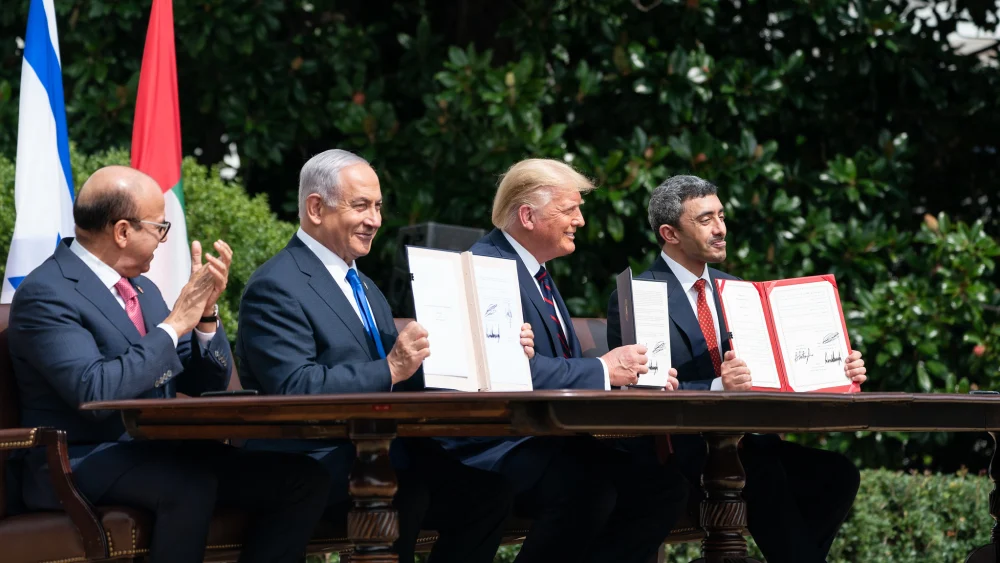
The Israel-Lebanon framework agreement signed last week “could eventually turn out to be even bigger than the Abraham Accords,” a senior Israeli official told JNS on Sunday.
The Abraham Accords are a series of U.S.-brokered normalization agreements launched by the first Trump administration in 2020 under which Jerusalem established diplomatic relations with the United Arab Emirates, Bahrain, Morocco and Sudan.
“Serious international relations scholars will tell you that a key achievement of the trilateral framework is that Lebanon recognizes the sovereignty of Israel for the first time since the very short-lived recognition in the early 1980s,” the Israeli official told JNS.
The scholars noted that Beirut failed to recognize Jerusalem’s sovereignty even in the “outrageous” maritime agreement negotiated by the Israeli government headed by Prime Minister Yair Lapid in late 2022.
Another achievement of U.S. Secretary of State Marco Rubio’s framework agreement with Lebanon is that it “trumps” the Memorandum of Understanding with Iran reached through Pakistani mediation earlier this month, the official said.
That agreement called for an “immediate and permanent termination of military operations on all fronts, including in Lebanon,” even before the disarmament of the Hezbollah terrorist organization.
The new agreement also “defines the limited pilot zones and the conditions for redeployment, including the disarmament of Hezbollah and other non-state actors,” they said.
Defense Minister Israel Katz said on Saturday that Jerusalem had instructed the IDF to prepare for a “prolonged stay” in the security zone in Southern Lebanon.
“The key principle established in the framework is that there will be no Israeli redeployment from Southern Lebanon, no withdrawal whatsoever, as long as the Hezbollah terrorist organization has not been disarmed throughout Lebanon, and the safety of northern residents is guaranteed,” he stated.
Iranian-backed Hezbollah renewed its rocket and drone attacks from Southern Lebanon on Israel on March 2, following the targeted killing in Tehran of Iranian Supreme Leader Ali Khamenei in Tehran on the first day of “Operation Roaring Lion” on Feb. 28.
In response, Jerusalem launched a broad aerial campaign against Hezbollah targets and expanded military operations in Lebanon aimed at preventing cross-border attacks on Israeli communities.