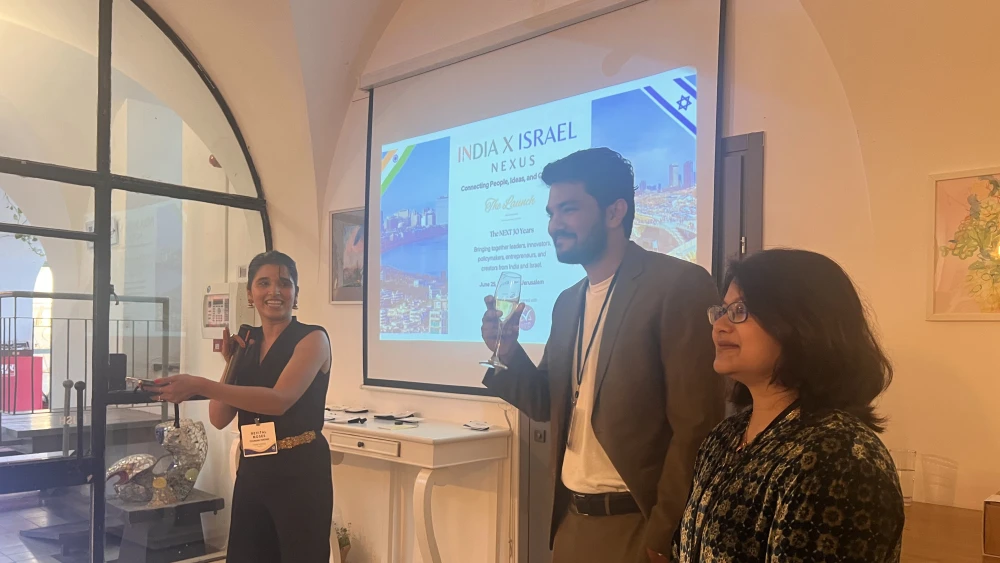
A new business and community platform connecting India and Israel was launched on Thursday night in Jerusalem to promote people-to-people relations amid expanding ties between the two countries.
The India x Israel Nexus aims to connect leaders, policymakers, businesses and cultural figures to deepen strategic cooperation between Israel and India.
“Strong relationships have existed between the U.S. and Israel for so many years because of the strong and frequent people-to-people ties, travel between the two countries and the shared Judeo-Christian heritage,” Paushali Lass, a geopolitical consultant and fellow at the Israel-India Friendship Club, told JNS. “We also need to find such common ground between Israel and its other big ally, India.”
The privately funded initiative, which has the informal backing of Israel’s Foreign Ministry, seeks to strengthen business, policy, cultural and community engagement between the two nations.
“The strongest relationships between nations are not built in boardrooms or government offices alone, but when people connect, trust each other and create opportunities,” said Joyston D’Mello, a founding partner of India x Israel Nexus. “We exist to be that bridge.”
Building on strategic ties
India and Israel share a growing strategic partnership spanning defense, artificial intelligence, cybersecurity and agricultural innovation.
India is Israel’s largest customer for defense exports, accounting for roughly one-third of Israeli arms exports, while also supplying military components to Israel.
Although India historically kept its distance from Israel to balance relations with Arab states, India’s Prime Minister Narendra Modi has elevated ties with the Jewish state, making the partnership a cornerstone of New Delhi’s security and deep-tech strategy.
“Defense tech and agri-tech laid the foundation for India-Israel relations,” said Revital Moses, a co-founder of the initiative. “Culture and soft power are what will carry it forward.”