


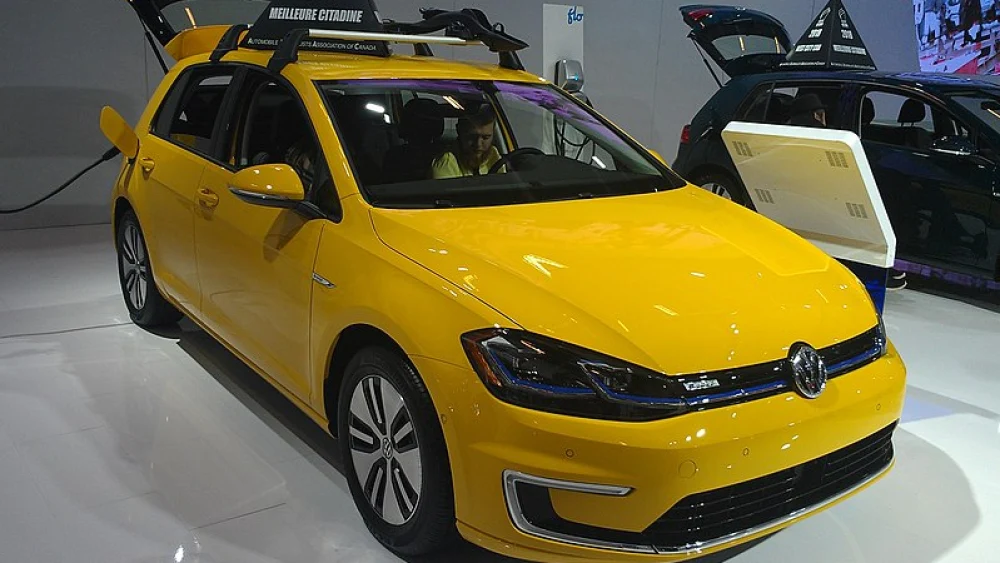
A plan to convert Volkswagen’s plant in Osnabrück, northwestern Germany, into a Rafael facility to produce Iron Dome components remains alive, despite reports to the contrary.
German business magazine WirtschaftsWoche reported in recent days that negotiations are continuing despite reports of a Qatari veto, according to Globes.
WirtschaftsWoche reported on July 16 that “negotiations are still ongoing” over converting the plant into a Rafael facility to produce trucks and other parts for the Iron Dome air-defense system, adding that the last word has not been said on the deal.
Earlier reports said the Qatar Investment Fund, which holds a 17% stake in Volkswagen, had expressed opposition to the deal and appeared to have torpedoed it. However, the German media report indicates that talks are continuing.
JNS has learned that the widely repeated narrative of a definitive Qatari veto is false, and that Qatar’s 17% voting stake in Volkswagen is not currently being used to block the transaction.
Globes reported that the Qatar Investment Fund’s intervention “has drawn criticism in Germany,” particularly given that Qatar’s separate holdings in the shipping company Hapag-Lloyd had already become an Israeli security consideration cited in blocking the sale of Israeli publicly traded Zim Integrated Shipping Services, in which the State of Israel retains a golden share to protect vital national security and logistics interests.
According to WirtschaftsWoche, “it is not clear whether its [Qatari Investment Fund] opposition to the deal constitutes an absolute veto.”
The head of the works council at Volkswagen’s Osnabrück plant, which employs about 2,400 workers, told WirtschaftsWoche that “a smart solution must be found.” He called on the German state of Lower Saxony, which holds roughly 20% of Volkswagen’s shares, to acquire a majority stake in the Osnabrück plant specifically, a move that would allow the Rafael deal to proceed.
A security expert interviewed by WirtschaftsWoche suggested Qatar may demand concessions from the German government in exchange for dropping its opposition, telling the magazine, “We live in times when difficult agreements have to be made with complicated players.”
The dispute first drew international attention on June 17, 2026, when Reuters reported that Qatar, a Volkswagen shareholder, was complicating negotiations over the sale of the Osnabrück plant to Rafael.
Reuters reported at the time that Qatar had raised objections to the transaction, but that the outcome remained uncertain and that negotiations were continuing despite the friction.
On July 10, German newspaper Bild claimed that Qatar had effectively vetoed the deal, portraying the acquisition as having been blocked outright rather than merely complicated.
The underlying dispute is linked to Volkswagen’s broader financial difficulties. Calcalist reported on July 12 that Europe’s largest automaker has seen its market share eroded by Chinese manufacturers both internationally and within Germany while struggling to establish a leading position in electric vehicles—a combination that has forced the company into painful restructuring measures, including layoffs and factory closures across its German manufacturing base.
The report added that the Osnabrück facility had become a symbol of Volkswagen’s broader strategy of converting surplus production capacity to alternative industrial uses rather than shutting plants outright, and that shifting part of the site’s output to defense manufacturing would align with Europe’s expanding military spending while helping preserve roughly 2,300 jobs.
Rafael has been expanding its European footprint amid the continent’s broader rearmament drive following Russia’s invasion of Ukraine and other regional security tensions.
On July 23, Greece signed a €3.5 billion deal to acquire Rafael’s David’s Sling and SPYDER air-defense systems amid rising tensions with Turkey. On June 29, Romania announced a €2.3 billion deal for the SPYDER system, and in November 2023, Finland purchased the David’s Sling system for €317 million.



