


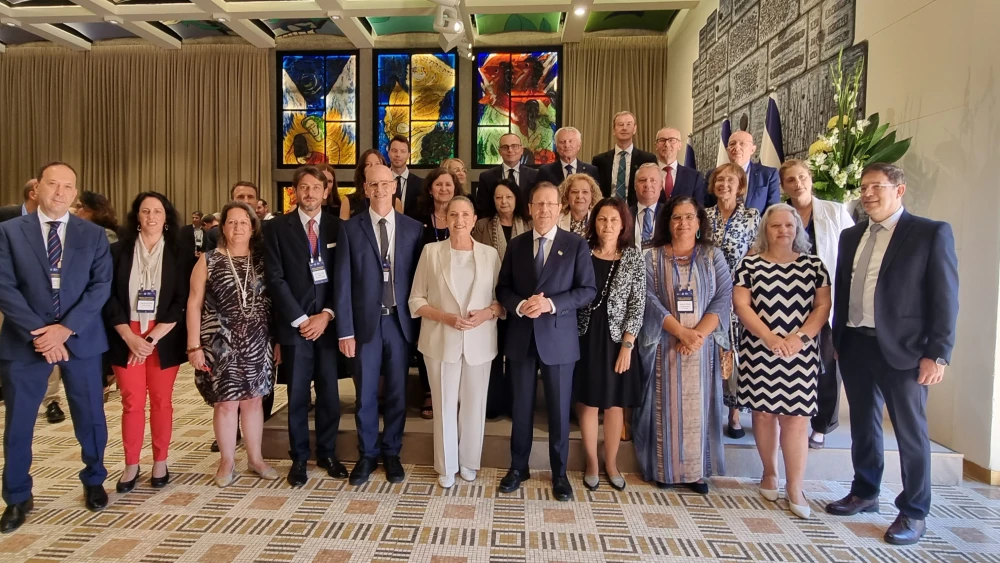
At a time when Israel’s relations with parts of Europe are under increasing political strain, Israeli and European diplomats, researchers and innovators gathered Tuesday at the President’s Residence in Jerusalem to celebrate a very different kind of relationship—one built on science.
The Horizon Europe Award Ceremony, jointly hosted by ISERD, the Israel-Europe R&D Directorate of the Israel Innovation Authority, and the European Union Delegation to Israel, recognized Israeli researchers, companies and institutions whose projects have won highly competitive Horizon Europe grants.
But beyond the awards, the gathering offered a reminder that scientific cooperation continues even when political relations are strained.
“Scientific diplomacy” was a recurring theme, describing partnerships and adding to the story of countries working together to build resilience—a story that is “still being written.”
Horizon Europe is the European Union’s €95.5 billion research and innovation program for 2021–2027. Israel, though not an EU member, participates as an associated country, allowing eligible Israeli researchers, universities and companies to compete for funding and collaborate with European partners.
Israel has participated in European research framework programs since 1996. Over three decades, the cooperation has generated more than 5,000 joint projects involving thousands of Israeli researchers and companies.
Innovation, Science and Technology Minister Gila Gamliel pointed to that history during the ceremony, citing more than 5,000 joint projects, more than 6,000 Israeli participants and more than 1,000 companies involved in the broader cooperation, representing billions of euros in research activity.
But she also emphasized what is happening now.
Despite the upheaval caused by the war and difficulties surrounding Israeli participation in parts of European academia, she said, 140 collaborations were awarded during the past year.
The numbers, she suggested, tell a story of continuity.
“This is not just about funding,” was the message running through her remarks. “It is about cooperation.”
That cooperation has practical consequences, from Israeli expertise in water and agricultural technology to medical research, advanced technology and the exchange of doctoral students and researchers.
A short video at the ceremony put a human face on the numbers, highlighting innovations emerging from Israeli-European collaborations. One example was coffee grown from cells in a laboratory, an eye-catching glimpse of how scientific research can move from the lab toward solutions for future challenges.
EU Ambassador to Israel Michael Mann, who has served in Israel since September 2025, told JNS before the ceremony that he was pleased to be marking the partnership at the President’s Residence.
“It is 30 years of fantastic cooperation between the European Union and Israel in research and innovation,” Mann said, describing participation in Horizon Europe as “very useful for Israel and Europeans.”
“I hope it continues for years to come,” he added.
Mann emphasized that the relationship produces economic benefits as well as benefits for society, while stressing the importance of a positive agenda and academic freedom.
The European diplomatic presence at the ceremony underscored the breadth of that cooperation. Ambassadors and heads of mission from Portugal, Finland, Ireland, Cyprus and Malta, among others, attended the event.
Millo Potsonen, Finland’s deputy head of mission, told JNS afterward that the challenges facing Europe and Israel make scientific cooperation particularly important.
“The challenges we are facing” require joint solutions, he said. “Academic, science and research collaboration is required; there are no borders.”
The ceremony’s panel discussion, moderated by Dr. Nati Bloch Damati, included Mann, Israel Innovation Authority CEO Dror Bin and ISERD Managing Director Shlomi Kofman, who discussed Horizon Europe’s achievements and the future of the partnership.
The discussion highlighted collaborations between European countries and Israeli startups, as well as the role of international research cooperation in economic security, resilience and building trust between countries and communities.

For Israeli President Isaac Herzog, the gathering also carried historical significance.
Speaking at the beginning of the ceremony, Herzog acknowledged the forces currently seeking to pull Israel and Europe apart before turning to the history of European scientific cooperation.
“Europe’s modern story is itself a testament to the power of choice,” he said. “On a continent scarred by the horrors of extremism and war, scientific cooperation became an expression of commitment to peace and the sustainable future.”
Europe, he noted, had descended into the catastrophe of the Holocaust. Yet the continent also experienced extraordinary rebuilding. Israel and Europe subsequently developed a relationship in which science became a bridge between them.
Herzog recalled Albert Einstein, who entrusted his intellectual legacy to the Jewish national home, where it is preserved today at the Hebrew University of Jerusalem.
The president’s remarks then moved from the history of scientific cooperation to the diplomatic tensions of the present, including Britain’s announcement of trade sanctions related to Israeli settlements. The contrast was striking.
Inside the President’s Residence, European and Israeli representatives were celebrating three decades of scientific cooperation. Outside, political disagreements continue to test Israel’s relationship with European governments.
Yet the researchers recognized at the ceremony represented something more enduring than a diplomatic statement.
They demonstrated that scientists continue to work together across borders, sharing knowledge, developing technologies and tackling challenges that no country can solve alone.
As Kofman put it, the story of scientific diplomacy is not finished. It is still being written.


