
Israeli Foreign Minister Gideon Sa’ar declared “countermeasures” against the United Kingdom following Tuesday’s announcement by his British counterpart, Ed Miliband, that the United Kingdom would ban products from Judea and Samaria.
“The accusations made today by the Foreign Secretary of the Labour government in the British Parliament were outrageous lies,” said Sa’ar.
“A boycott of goods from Judea and Samaria is a despicable practice that harms hard-working, law-abiding citizens. The Labour Government has decided to employ this practice of boycotts and BDS only against the Jewish state,” he continued.
The measures Sa’ar imposed include closing the British Consulate in Jerusalem; removing British representatives from the International Gaza Support Center, an organization established to coordinate stabilization and relief efforts in the aftermath of the Gaza war and headquartered in Israel; terminating British training of Palestinian Authority forces in Judea and Samaria; and denying entry to Israel to 12 British elected representatives and other British nationals involved in antisemitic or anti-Israel activity. (Among them is former Labour Party leader Jeremy Corbyn.)
U.K. Foreign Secretary Miliband told the British Parliament on Tuesday that “the government believes the unlawfulness of the occupation should be reflected in the economic relationship we choose to have with the occupied territories.” The ban is set to come into effect within six months.
Describing the British move as “morally distorted,” Sa’ar called Labour’s actions “blatant interference in the affairs of a sovereign state and in its electoral process ... [a] completely unacceptable attempt by a foreign government to exert external influence in the midst of an election campaign.”
Israel’s national election is set to take place on Oct. 27.
The United Kingdom on Tuesday also joined 11 other countries in announcing that they would sanction, or consider sanctioning, goods from Judea and Samaria in response to what they said were Israeli government actions undermining the “two-state solution.”
Sa’ar accused Miliband and the Labour government of imposing sanctions for “domestic political reasons,” noting his counterpart made the move ahead of the Labour Party Conference (Sept. 27-30).
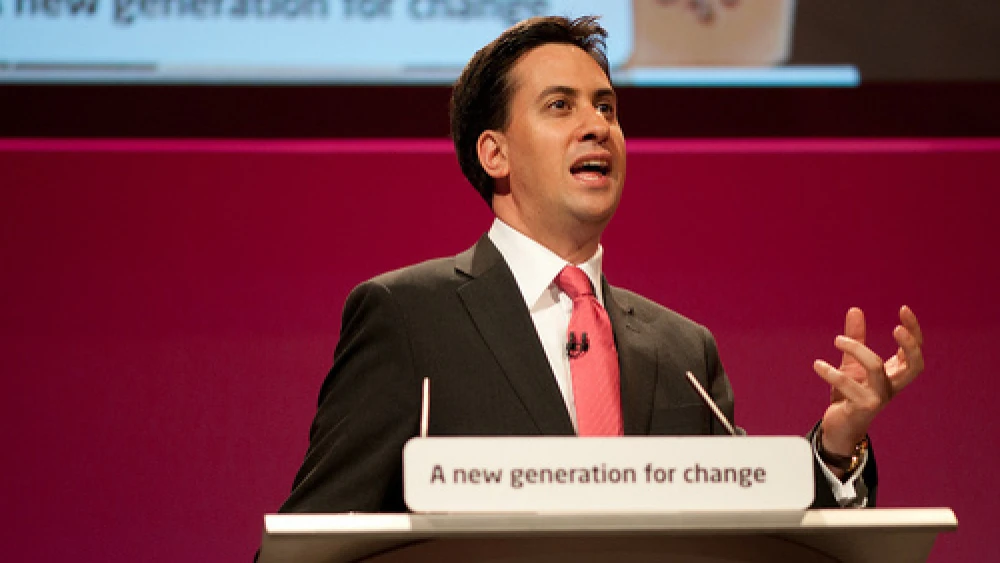
Israel’s foreign minister also addressed the pretexts cited by Miliband for the sanctions, namely that they were in protest against Israel’s announcement that it would market tenders for 1,400 housing units in Israel’s strategic E1 corridor.
“Contrary to the false claims of the Labour government, no new decisions have been made regarding development in E1. ... The tender process has been underway for many months,” said Sa’ar.
“The claims regarding the severing of potential Palestinian territorial contiguity are also baseless. The decision of the government of Israel, taken more than a year ago, stipulated that two roads would be built: the first, Road 80, which will serve as a major transportation route from the Bethlehem area to the Ramallah area; the second, known as the ‘Fabric of Life’ Road, between a-Za’im and al-Ezariya.”
Sa’ar added that the Israeli public overwhelmingly supports the Jewish communities in Judea and Samaria and just as overwhelmingly opposes the creation of a Palestinian state in its heartland. “This is something that the Labour government is attempting, through measures that are doomed to fail, to force upon Israel. It will not work,” he said.
“The Israeli-Palestinian conflict is an age-old conflict. Unfortunately, the Palestinians have always rejected proposals to resolve it and have never abandoned terrorism and incitement. This conflict will not be resolved through declarations from London or Paris, and a one-sided, anti-Israel approach only pushes the possibility of reaching a solution further away rather than bringing it closer,” he said.
It is “particularly astonishing” that the Labour government hasn’t considered imposing sanctions on the Palestinian Authority, which continues to fuel terrorism through its “pay-for-slay” program, which financially rewards terror acts, Sa’ar added.
He noted the Labour government’s decision is the latest in an “increasingly escalating series of unilateral measures against Israel” since it took office in July 2024.
Among those actions are the recognition of a non-existent “State of Palestine,” the renewal of funding for UNRWA, some of whose employees took part in the Oct. 7, 2023, massacre, and sanctions imposed on Israeli ministers.
“These measures by the Labour Government in Britain, along with biased and one-sided anti-Israel rhetoric, have already contributed significantly to the unprecedented rise in antisemitic attacks, including violent attacks against British Jews,” he said.
Sa’ar’s statement was bolstered by the U.K.'s shadow foreign secretary Tom Tugendhat, who protested Labour’s move, which he said risked “encouraging sectarianism and antisemitism at home.”
Sa’ar posted to X that he spoke with Tugendhat and U.K. opposition leader Kemi Badenoch Tuesday evening, thanking them for their firm opposition to the Labour government’s actions and welcoming their friendship with Israel.
“We know that we have many friends in the U.K., but unfortunately we are faced with the ongoing hostility of the current Labour government. I also thanked Kemi for her warm wishes ahead of the Jewish New Year,” said Sa’ar.
Israeli coalition members also expressed their dissatisfaction with Labour.
Bezalel Smotrich, Israel’s finance minister, called for the British ambassador to be “expelled” immediately, adding: “We will not be a doormat trampled by an antisemitic government, in a country conquered by radical Islam, trying to save itself from economic and social decline by attacking Jews and the State of Israel.”
Itamar Ben-Gvir, Israel’s national security minister, in a Spanish-language post, called for Israel to recognize “that the Malvinas Islands are Argentine territory under occupation, which the British are violently stealing from the Argentine people,” a reference to the decades-long British-Argentine dispute over the Falklands.

The British decision also brought condemnation from U.K. Chief Rabbi Sir Ephraim Mirvis and the Board of Deputies of British Jews, a representative body of the community.
In an X post on Tuesday, Mirvis wrote: “This is truly a dark day for British Jews. Today our Government has chosen to ignore the deep concerns expressed by so many of us. The measures announced amount to little more than political flag-bearing for mendacious anti-Israel rhetoric and those who harbour a dangerous obsession with the Jewish State. These measures will succeed only in bolstering the very extremism they seek to target.”
The Board of Deputies said it “felt a deep sense of anguish about this breakdown in relations” and warned that the Labour government’s decision risked “perverse consequences which go against the U.K.'s stated objectives.”
However, the organization also appeared to blame Israel, saying “intolerable settler violence” and “provocative measures” undermine Israel’s international reputation. It claimed that both governments appeared to be pursuing party interests over national interests.
U.S. Secretary of State Marco Rubio, questioned by the press about the U.K.'s decision, said the United States would not make any move similar to London’s, but that Washington didn’t want to see any “destabilizing moves” in Judea and Samaria that could jeopardize progress with the 20-point plan announced by U.S. President Donald Trump to bring about a long-term resolution to the war Hamas launched with the Oct. 7, 2023, massacre.