


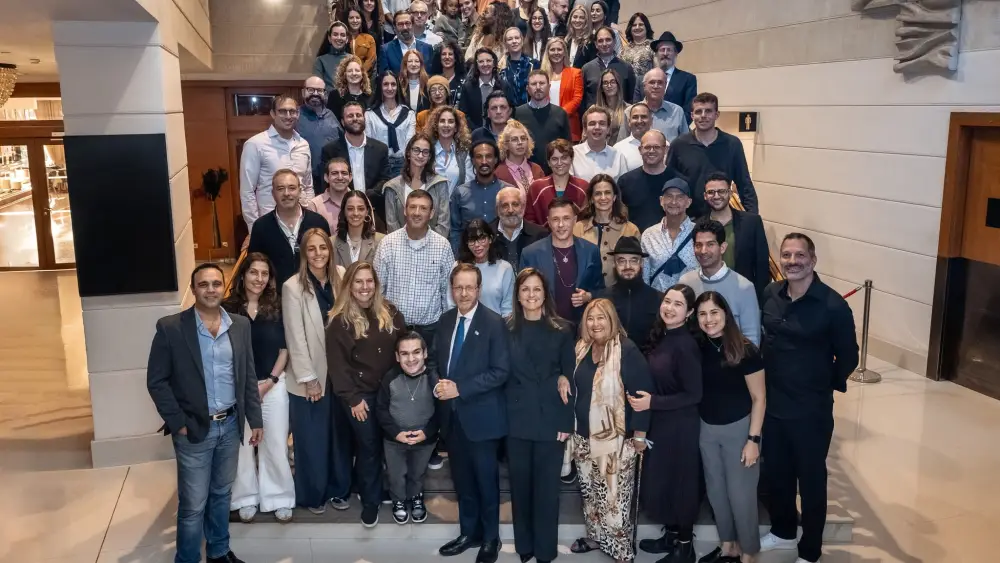
The Voice of the People network, which Israeli President Isaac Herzog initiated last year, received 2,500 applications for its second round, more than double the number of applicants for its inaugural cycle, organizers said on Tuesday.
The network, a nonprofit with a $10 million budget, funds and guides selected initiatives led by individuals—many of them new to nongovernmental work in the Jewish peoplehood field—that are deemed to advance shared interests, including internal cohesion, the fight against antisemitism and innovation for the common good.
The first cohort, whose conclusion was marked at an international conference in Budapest, Hungary, last month, had 20 initiatives, and the selection process has begun for the second cohort, a spokesperson told JNS. The network has a council of 150 members, equally divided among Israel, the United States and the rest of the Jewish Diaspora.
“The incoming cohort will build on this foundation, bringing new perspectives and ideas into a growing network of people committed to addressing shared challenges across the Jewish world,” Shirel Dagan Levy, CEO of Voice of the People, said in a statement.
Applicants are selected according to an algorithm and only then evaluated by staff, “precisely to eliminate Jewish politics,” one of the program’s initiators said.
One of the first cohort’s initiatives was OneBayit, a nonprofit founded by Joshua Buchalter, a recent immigrant from South Africa to Israel, which connects Jewish travelers with Jewish families abroad for Shabbat and holiday meals.
“Presenting OneBayit to President Herzog was one of the coolest experiences of my life,” Buchalter said of the conference in Budapest, which Herzog attended. “Last year, OneBayit was just an idea. This year, I got to present what we’ve built and how far we’ve come. There’s still a long way to go, but getting out of your comfort zone and doing exciting things is what life should be about.”
Another participant at the conference was Gvira Milworm, CEO of Temech, a nonprofit that helps haredi women integrate into the Israeli job market. She is a member of the inaugural Voice of the People council and has decided to remain on the council for its second cohort.
Neither Temech nor Milworm receives funding from Voice of the People, she said. Rather, the benefit of attending the conferences and being part of the network was “making connections that I would not have made any other way,” she told JNS.
Voice of the People has a level of diversity rarely found in Jewish nonprofits, she said.
Temech recently launched an accelerator for haredi women working in infrastructure, including construction and transportation, Milworm said. The first group of 13 women in the accelerator, all business owners, have hired nine haredi women following the program, she said. Milworm said she hoped the second cohort would include more haredim.
The diversity at Voice of the People was part of the initiative’s basic design, Herzog said at the Budapest event.
He recalled not recognizing most of the names recruited to the council by the project’s CEO, Dagan Levy, a former high-tech executive. This meant they came from outside the Jewish peoplehood circles he knew so well, Herzog explained.
“We wanted to see people outside the system who go in and take a leadership role,” he said.


