


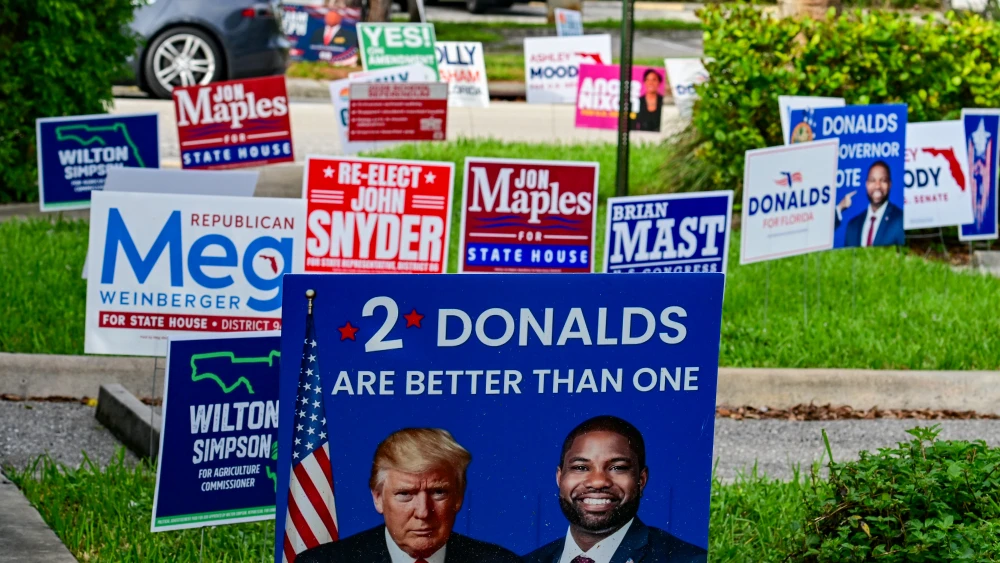
Republicans won the race for governor and Senate in Florida on Tuesday, as House races in the Sunshine State point to a long and difficult night for the GOP in the rest of the country.
The Associated Press called the gubernatorial election for Rep. Byron Donalds (R-Fla.) and incumbent Sen. Ashley Moody (R-Fla.) after polls closed at 8 p.m.
Donalds’s race to replace outgoing Gov. Ron DeSantis, a Republican, was the closer of the two contests as he squared off against former Republican congressman David Jolly, who registered as a Democrat in 2025.
At press time, Donalds had 50.1% of the vote to Jolly’s 48.6%, with 99% of votes counted.
The Senate race offered a clearer contrast for voters, who rejected former Florida state representative Angie Nixon by about 250,000 votes—50.9% to 47.9%—with about 99% of votes counted.
Nixon, a member of the Democratic Socialists of America, rose to notoriety in November 2023 when she introduced a ceasefire resolution in the legislature just weeks after the Hamas-led Oct. 7 attacks. Republicans in the chamber turned their backs on her as she spoke in favor of the resolution, which failed by a vote of 104-2.
Nixon’s victory in the Democratic primary in August was an upset over Alex Vindman, who was one of the key witnesses against U.S. President Donald Trump during his first impeachment.
Nixon ran on a left-wing platform that included Medicare-for-all, a national rent freeze and opposition to Israel. In August, ahead of the primaries, her campaign website called for “ending unconditional U.S. military aid that has fueled the genocide in Palestine.”
That language referring to Israel committing “genocide” no longer appeared on her website on Election Day.
In the House, Republicans had high hopes that Florida would net as many as four seats for the GOP when the state carried out mid-decade redistricting earlier this year.
The revised map in Florida forced some incumbent Democrats to seek re-election in new districts. Those Democrats included Rep. Debbie Wasserman Schultz (D-Fla.), who chose to run in the safely Democratic, plurality-black 20th District, and Rep. Jared Moskowitz (D-Fla.), who ran in the newly-drawn 25th district north of Miami. The latter was intended to be friendlier to Republicans like his opponent, Boca Raton Mayor Scott Singer.
On Tuesday, Wasserman Schultz cruised to victory as expected, winning nearly 75% of the vote in her district with 95% of the votes counted.
Moskowitz won re-election more narrowly, beating Singer 51% to 47%.
He credited voters for recognizing his willingness to oppose extreme views on the left and right. “This district was re-drawn to defeat me,” Moskowitz stated. “Voters had other plans.”
The overall picture in the House at press time suggests that Republicans will pick up fewer seats from redistricting than they had hoped and could face a blowout in House races across the country.
Rep. Mario Diaz-Balart (R-Fla.), the 12-term congressman from South Florida’s 26th District, whose race was rated as “safe Republican” by Cook Political Report before Election Day, led by just under 2,000 votes against Nicole Locklin, a 38-year-old lawyer who moved to the district in 2024, in a race that remains too close for the Associated Press to call.
Locklin included a “Palestine” page on her campaign site that called for an arms embargo against Israel and accused the country of “genocide” in her race against one of the most stalwart pro-Israel Republicans in the House.
Other Republicans in nail-biter races in Florida included Rep. Maria Elvira Salazar (R-Fla.), who broke from Trump on immigration issues in September when she released an ad accusing him of having “gone too far” in her heavily Hispanic district.
With 95% of votes counted, Salazar led Elliott Rodriguez 50.2% to 49.8%. The Associated Press had yet to call the race.
In an interview with Stephen A. Smith on Monday, DeSantis, the outgoing governor, blamed Trump’s decision to attack Iran in February as the likely cause of Republican woes on Tuesday, calling it a “big, big drag.”
“He obviously ran saying he wasn’t going to do a Middle East war, then he did,” DeSantis said of Trump. “We have some of our voters who’ve checked out because they’re like, ‘I didn’t want any more Middle East wars,’ and now we’re doing it.”
“It’s kind of an open-ended conflict, and it’s having a direct impact on people’s finances,” he said.


