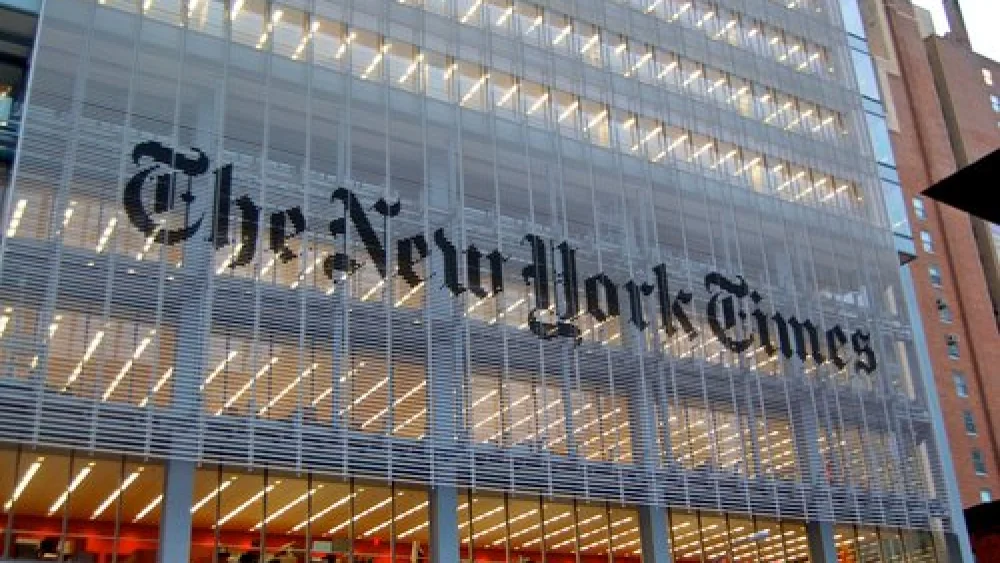
The Middle East media watchdog CAMERA prompted a correction in The New York Times which Israeli ambassador Dani Dayan is describing as the “Correction of the Year.”
In a tweet on April 24, Dayan, who serves as the Consul General of Israel in New York, highlighted the Times correction that read:
An article on Sunday about Campbell Brown’s role as Facebook’s head of news partnerships erroneously included a reference to Palestinian actions as an example of the sort of far-right conspiracy stories that have plagued Facebook. In fact, Palestinian officials have acknowledged providing payments to the families of Palestinians killed while carrying out attacks on Israelis or convicted of terrorist acts and imprisoned in Israel; that is not a conspiracy theory.
“Sometimes, people claim that media corrections don’t matter because the error about Israel has already been published,” said CAMERA’s Israel director Tamar Sternthal, who contacted the daily paper about the inaccurate reporting. “But that’s terribly mistaken. Media corrections accomplish several important things.”
Sternthal noted that in the age of social media, published corrections become a permanent record on the Internet. “It’s not like in the past, when the correction got buried in a newspaper that was thrown out the next day,” she said. “Nowadays, the correction gets spread far and wide, which is exactly what we saw with Ambassador Dayan’s tweet about the Times’ correction. It created a social-media uproar.”
Media corrections also act as a deterrent on future errors.
“Editors and journalists don’t always enjoy hearing from us,” said Sternthal. “But they often do correct the record, and we respect that.”
Sternthal said the corrections also assist the overall media discourse. “Often, CAMERA can prompt a correction at, say, Reuters because we can point to another media outlet which previously corrected the same error. That helps establish factual discourse across newspapers,” she said. “CAMERA even leverages these corrections across languages: English, Hebrew, Spanish and Arabic.”
Much of CAMERA’s work goes on behind the scenes. “Nearly every day, our staff are in communication with reporters and editors about factual errors in particular news stories,” said CAMERA executive director Andrea Levin. “Sometimes, corrections have lasting impact, preventing the error from ever recurring at that outlet. That’s our goal—lasting improvement.”
In 2017, CAMERA prompted 185 media corrections at major news outlets around the world.
“We’re not letting up in 2018,” insisted Levin. “Media corrections matter.”