Israel signed a non-binding letter of intent with the Inter-American Development Bank on Monday, creating a new fund tied to the “Isaac Accords” to attract public and private investment in Latin America and the Caribbean.
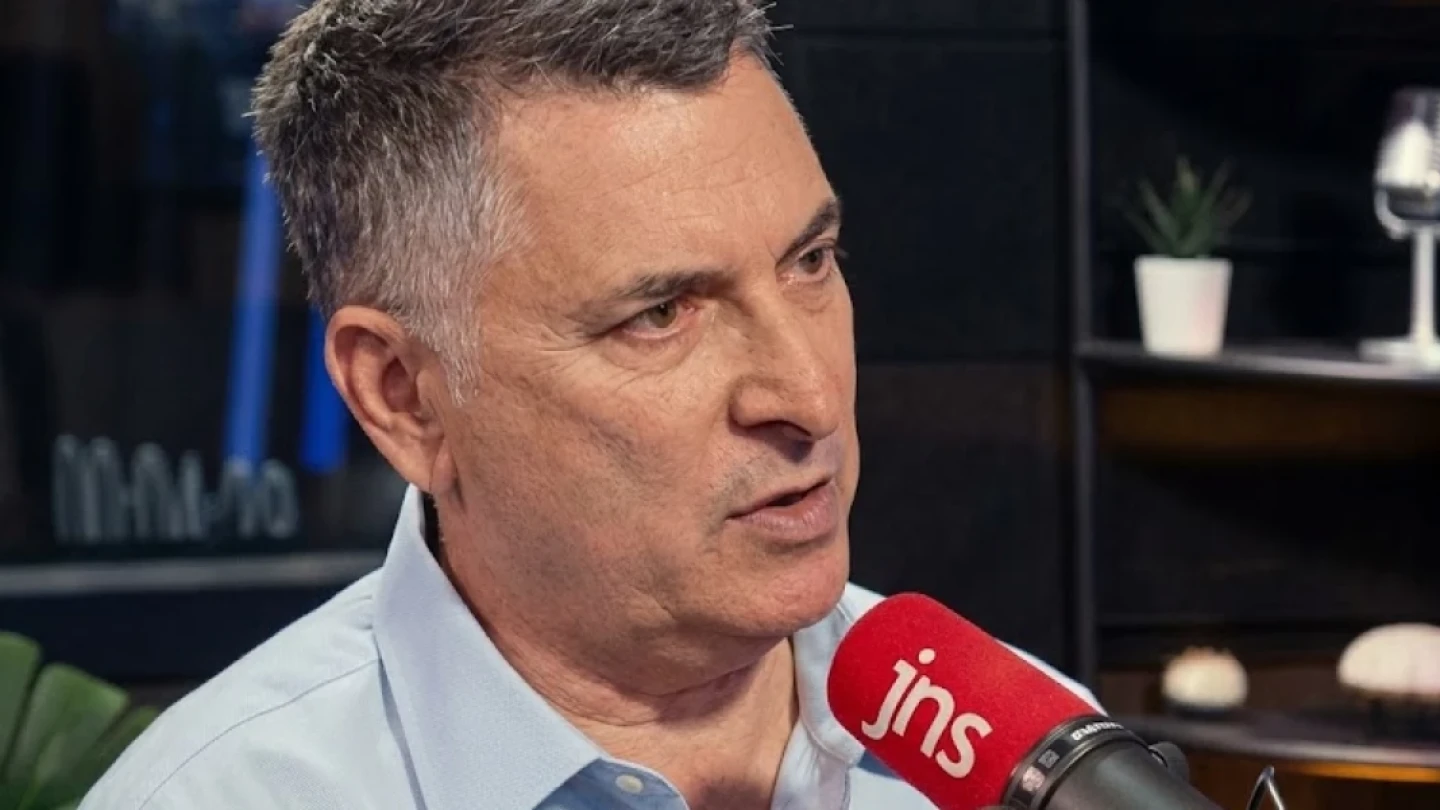
Bezalel Smotrich, the Israeli finance minister, told JNS that the partnership that he inked with Ilan Goldfajn, president of the bank, at the Israeli embassy in Washington will establish two funds.
A government fund will be flush with “large amounts of money from the Israeli government that will be leveraged in a very significant way, through the bank, for investments in the Isaac Accords countries,” the minister told JNS.
The United States, Argentina and Israel launched the Isaac Accords in November 2025, modeled on the Abraham Accords, which brought Middle East economies and governments together.
Javier Milei, president of Argentina, and Gideon Sa’ar, foreign minister of Israel, signed the Isaac Accords at a meeting in Buenos Aires. Milei donated the $1 million he won in Genesis Prize grant money from Israel to bolster the financial infrastructure of the new accords.
The greater focus will be a fund for private funds from institutional bodies in Israel and private investors.
Smotrich told those in attendance on Monday that the fund will focus on agriculture and food security, water, energy, digital systems and technology.
“These are essential sectors for sustainable economic growth,” he told attendees. “It is no coincidence that these are also sectors in which Israeli technology and Israeli industry have a great deal to offer.”
The cooperative agreement will capitalize on the bank’s AAA investment rating, massive portfolio and expertise in Latin America. The fund is intended to become self-sustaining and not require additional capital injections.
“We are actually making a deal that is a win-win,” Smotrich told JNS. “It is good for the Israeli economy. It is good for the Latin American and Caribbean countries, and it is also good for the political status of the state of Israel, which knows how to patronize and be on the side of countries that support it and partner with it.”
“Given the war that we have been waging for the past two and a half years, this is politically and security-wise correct and economically correct for both countries,” the minister told JNS.
‘Resilience of the Israeli economy’
The war situation was top of mind on Monday, as Yechiel Leiter, the Israeli ambassador to the United States, hurriedly left the podium, scrambling away to handle what appeared to be an urgent matter. The matter was later revealed to be developments in the Israel-Hezbollah conflict.
He returned later, telling Smotrich and Goldfajn, “You’re working on the Isaac Accords. I’m working on the Lebanon accords.”
Smotrich and Goldfajn both pegged the Israeli economy’s resilience during the war as a key factor in the agreement’s development.
“The savings of Israeli citizens, which are currently managed by the institutional bodies in the State of Israel, are over $2 trillion. That’s a lot of money,” Smotrich told attendees.
A large part of Israeli savings is invested abroad, Smotrich told JNS, and the new investment channel created on Monday “is a very good platform to pave this path for Israeli companies.”
That includes “companies that are technological breakthroughs that will carry out a large part of these projects in Latin American countries,” he said.
Goldfajn said from the podium that the fund will connect public resources and mobilize private resources to scale up development in the region.
It is to be based on three pillars: technical expertise, a finance facility that will make financing cheaper for the region and “a platform to mobilize private capital into the region from the rest of the world, particularly from Israel,” he said.
Israel is already involved with the bank, which has a team of Israelis working in cybersecurity and other areas of expertise, such as water management and energy.
Goldfajn noted that trade between Israel and Latin America and the Caribbean is a small fraction of the Jewish state’s global trade.
“If you look at Latin America as one place, one market, we are talking about 660 million people, young, dynamic and with a combined GDP of $6.6 trillion, with relative political stability,” Goldfajn said.
He mentioned large and dynamic Jewish communities in places like Argentina and elsewhere in the region, and the opening for Israel to build new diplomatic alliances.
A former governor of the Central Bank of Brazil, Goldfajn is an Israeli-Brazilian and was born in Haifa. He spoke some Hebrew from the dais on Monday.
“Ilan has an amazing role in this process, no doubt. Ilan has a very, very warm heart for the State of Israel. His heart is in the right place,” Smotrich told JNS.
The Israeli minister also credited U.S. President Donald Trump and the Argentinian president for jump-starting the accords and for the impact it has already had in areas like direct flights beginning next summer between Israel and Argentina.
“We respect and we know how to be on the side of those who know how to be on our side,” Smotrich told JNS.
“We will make sure that Argentina, and not only Argentina, but also other countries that are on our side will benefit greatly from this for their citizens,” the Israeli minister added.