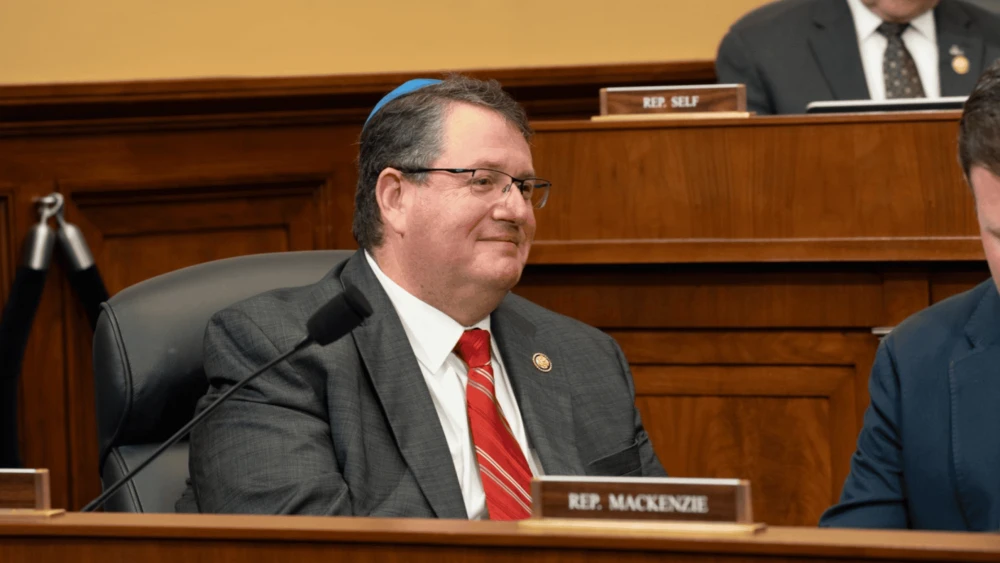
The House Committee on Education and Workforce voted to pass three bills on Thursday aimed at combating antisemitism in schools and preventing universities from boycotting Israel.
At the start of the markup hearing, the chairman of the committee, Rep. Tim Walberg (R-Mich.), said that Jew-hatred had “exploded at educational institutions” across the country and that schools had failed to meet their obligations to Jews under Title VI of the 1964 Civil Rights Act.
“We have all heard the excuses from college presidents and school district superintendents for why they can’t put a stop to the horrific incidents of antisemitism happening in their classrooms, yet we all know that if similar incidents were happening to other protected classes under Title VI, no excuses would be acceptable,” Walberg said.
Rep. Elise Stefanik (R-N.Y.) sponsored H.R. 9203, which mandates that schools publish information about Title VI complaint investigations and requires the Department of Education to brief Congress about civil rights complaints. Rep. Virginia Foxx (R-N.C.) introduced H.R. 4795, a federal version of state bills barring universities from participating in the movement to boycott Israel. Both of those bills had Democratic co-sponsors.
Rep. Randy Fine (R-Fla.), who is Jewish, introduced the third bill, H.R. 8476, which requires educational institutions that receive federal funding to respond to “discrimination motivated by antisemitism” with the same vigor as other Civil Rights Act violations and incorporates the International Holocaust Remembrance Alliance’s working definition of Jew-hatred.
“When someone uses the N-word on campus, no one thinks about free speech. No one talks about, ‘Let’s understand what they’re thinking. Let’s have a discussion,’” Fine said. “But somehow when it came to Jews, everyone wanted to rediscover the idea of free speech.”
Title VI bars discrimination on the basis of “race, color or national origin” but not religion. The Supreme Court and the Department of Education have generally included discrimination against Jews and some other religious groups, including Sikhs and Muslims, as violations of the act, because members of those groups frequently have a real or perceived shared ancestry or ethnicity.
Rep. Bobby Scott (D-Va.), ranking member of the Republican-led committee, raised objections to all three bills, accusing Republicans of defunding the Department of Education, seeking to pre-emptively ban boycotts of Israel in which no university is actually participating and adopting a definition of Jew-hatred that is constitutionally suspect.
“It’s a solution in search of a problem,” Scott said of the anti-boycott bill. “There is not an institution of higher education in this country that has joined the global BDS movement. There have been student assemblies or faculty senates who have expressed their legally-protected First Amendment opinions that their school should join that movement, but those votes were invariably followed by the schools publicly stating that they weren’t taking that action.”
“HR 8476 is an attempt to rewrite civil rights laws in a manner that is grossly inequitable and probably unconstitutional,” Scott said. “The bill attempts to piggyback on the provisions of Title VI, asking those provisions apply to religious discrimination as well, but only for antisemitic discrimination.”
“This bill would position Jewish victims of discrimination differently than Christian, Muslim, Sikh or other religions who are victims of discrimination,” he said. “I don’t believe it’s his intent to write a bill that establishes one religion as having a higher priority over others, but the plain text of the bill clearly has to be construed in that way.”
The IHRA definition of antisemitism has been adopted by 38 states and the federal government in an executive order signed during the first Trump administration, but Scott repeated objections that some Democrats have made to the definition, arguing that it chills constitutionally protected criticism of Israel.
Scott and some other Democrats on the committee have also frequently accused the Republican majority in past hearings of focusing on Jew-hatred to the exclusion of other forms of discrimination and allege that the Trump administration has gutted the civil rights office responsible for enforcing Title VI in the Department of Education.
Fine called those objections “smokescreens” and cited the performance of the Department of Education in responding to campus Jew-hatred under the Biden administration.
“We heard that we’ve got an office of civil rights being defunded, they’re the ones who are supposed to deal with this,” Fine said. “They weren’t defunded under Joe Biden. No one was going after them then, and they failed abjectly to solve the problem.”
“The number of recorded cases of antisemitism has fallen for the first time in years in 2025,” Fine said. “All we needed was a new president.”
The committee approved all three bills along mostly party lines. Scott and five other Democrats on the committee ultimately voted in favor of the boycott bill, along with every Republican who voted.
Reps. Donald Norcross (D-N.J.) and Jahana Hayes (D-Conn.) voted in favor of Fine’s IHRA bill. Every Democrat on the committee voted against Stefanik’s transparency bill after Republicans voted down a pair of amendments from Scott attempting to limit the Trump administration’s efforts to shift the Department of Education’s Title VI investigatory role to the Department of Justice.