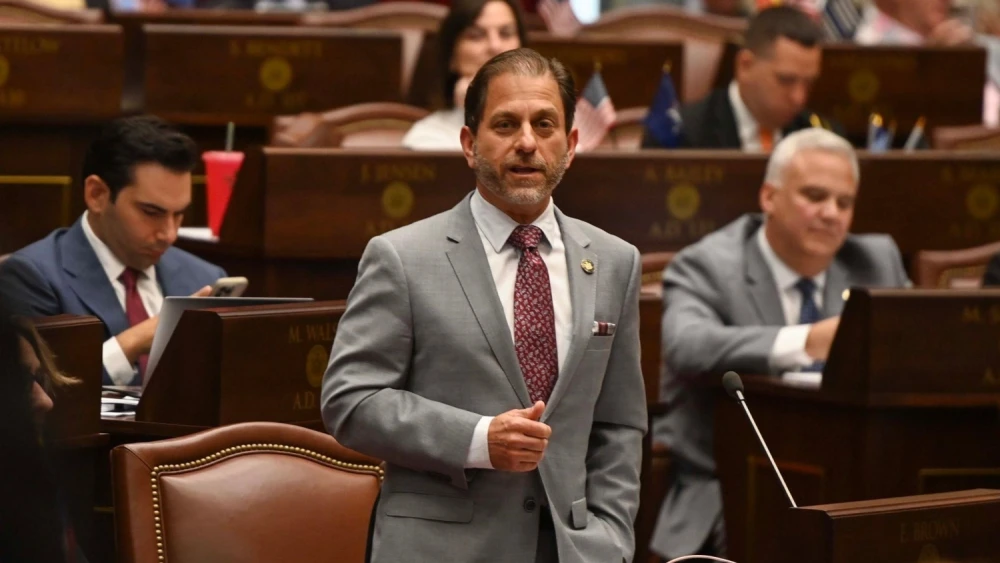
Ari Brown starts his day with two reminders on his phone: one to give tzedakah (charity) at 9 a.m. and another at 11 a.m. to help someone find a job.
“I don’t want to just keep it in mind,” he said of the latter. “I want to stop myself from what I’m doing, and I want to help someone get a job.”
Brown has spent five decades in construction, building homes and communities across Long Island. But the New York state Assembly member, who is also deputy mayor of Cedarhurst, N.Y., says his most important work has never been about buildings or political titles.
“I don’t consider myself a politician by any stretch of the imagination,” he told JNS. “I’m here to serve. If you’re not a public servant, you shouldn’t be in office.”
Brown’s first role in public service, 29 years ago, was a business improvement district position in Cedarhurst that he accepted at the request of the village’s then mayor. At the time, the district had roughly 22% to 25% vacancies, he told JNS. Three decades later, it has none, he said.
He also served on the Town of Hempstead’s Industrial Development Agency and as its vice chairman, overseeing major economic development projects in Nassau County.
Brown told JNS that he never set out to become a politician.
“Don’t seek elected office,” he said. “If they ask you if you can serve, do it. But don’t run it. Don’t chase accolades.”

That approach has helped him maintain relationships across party lines, even as he is an outspoken Republican on Jewish issues in Albany, he told JNS.
Brown describes himself as the only kippah-wearing Republican ever elected to the New York state legislature. He said he has introduced nine bills addressing Jew-hatred, but none has yet passed.
Among his proposals are measures addressing Jew-hatred on college campuses and withdrawing scholarships from students involved in antisemitic activity. He also introduced a Good Samaritan bill named for Daniel Penny, a 28-year-old former U.S. Marine, who was found not guilty by a New York jury in December 2024 in the death of Jordan Neely, 30, a mentally ill homeless man who was menacing passengers on the New York City subway. Penny put Neely in a chokehold until the man was no longer a threat.
Brown said Penny is an example of the importance of encouraging people to intervene when others are in danger.
He has continued raising the proposals during committee proceedings and on the Assembly floor. Even minority-party lawmakers can influence legislation through debate and public pressure, he told JNS.
Brown’s political identity contrasts with his heavily Democratic district, and he thinks his electoral success comes from focusing on local concerns rather than party affiliation.
As a ranking member of the Assembly’s local governments committee, Brown works with Democratic colleagues on municipal issues, including budgets and local services. He said that his Democratic colleague, Michaelle Solages, is a close colleague despite their political differences.
“In my village, we don’t run under Republican or Democrat,” he told JNS. “We run under the ‘citizens party.’ No politics in local government.”
Brown’s approach to Jewish communal issues has put him at odds with many of his colleagues.
He criticized Jewish Democratic lawmakers for what he said is a lack of will to publicly support his legislation. Some are reluctant to risk political relationships or funding for their districts, he told JNS.
He also expressed concern about Jewish voting patterns and the growing influence of the Democratic Socialists of America and support for New York City Mayor Zohran Mamdani, who campaigned on arresting the Israeli prime minister.
“It’s the wrong way,” Brown said, of Jewish support for Democratic candidates whom he opposes. “You see it now more than ever in this election.”
His concern about Jew-hatred is rooted partly in his family history. The son of a Holocaust survivor, he grew up hearing firsthand accounts of the Shoah, which makes contemporary threats against Jews particularly troubling.
“We lived this in real time,” he said. “I’ve heard these stories in real time.”
Brown thinks that Jewish communities need to move beyond incremental political victories and take a stronger stand against Jew-hatred.
“The time now is to be strong and resolute,” he told JNS.
Of religion and family
Brown’s Jewish upbringing differed from that of many Orthodox Jews in the New York area.
He grew up in Franklin Square, on Long Island, in a predominantly Italian, non-Jewish neighborhood. His mother was Jewish and Italian, and his family maintained a kosher home but did not grow up Orthodox.
As a child, Brown and his two brothers decided to walk some two miles each Shabbat to Young Israel of West Hempstead, an Orthodox congregation, because their local synagogue did not have a minyan, the 10-men minimum quorum for public prayer.
The walk was not always easy. Brown remembers encountering antisemitic hostility regularly and getting into physical fights with other children along the way. At one point, he said, his neighbor Sean Hannity, several years his elder, came out to defend him. (JNS sought comment from the Fox News host.)
Brown said that those experiences shaped his relationship with his Jewish identity. “I never take my kippah off, ever,” he said. “Under any circumstance.”
Wearing a kippah publicly also comes with a responsibility to maintain a strict kosher standard, since people might assume a restaurant is kosher if they see him wearing it, he told JNS.
Brown’s religious observance deepened after he spent a year studying in Israel at Beit Medresh Hatorah as a teenager. He returned home to find his parents had become more religious, he said.
“I said, ‘Mom and Dad, you got it backward. I was the one that went to Israel,’” he told JNS.
He came to appreciate the structure and stability that religious life could provide his family.
Brown raised seven children and has six grandchildren. Not all of his children are religious, he told JNS, but he maintains kosher homes and regularly gathers at his home for Shabbat dinners and family occasions.
“Whether they drive to me or not, if I didn’t have that, the collective family wouldn’t get together every week,” he said.
He described his commitment to physical fitness as part of his understanding of Jewish identity. Brown, 58, said that he can do 283 consecutive pushups and has long encouraged young Jewish men to prioritize physical strength alongside religious learning.
He recalled addressing a political science college class and asking students to stand and shake his hand. Afterward, he told them that most had weak handshakes and shifted his talk toward what he considers the importance of building strong Jewish men.
Brown believes that Jewish education should emphasize not only religious study but also the application of Jewish values through action, responsibility and standing for others.
‘Urgency, now’
Brown’s work ethic, he said, began long before his political career.
He skipped two grades and graduated high school shortly after turning 16. But rather than spending his teenage years in summer camps, he worked alongside his father in the construction business.
His father developed Parkinson’s disease, and Brown kept working with him for more than four decades. He said the two did not simply oversee construction projects but physically did the work themselves.
Working alongside men who served in World War II, the Korean War and Vietnam had a lasting impact on him.
“They were the greatest generation,” he said. “You better believe your life is going to be shaped very differently than working alongside someone else.”
The men taught him about patriotism, family and American values, lessons he thinks are emphasized less today.
His mother also shaped his outlook. She had attended Bais Yaakov, an Orthodox school for girls, and graduated in 1958.
When she died several years ago, Brown visited Israel for the shiva and gave a religious book to the head of Bais Yaakov in the Jewish state. Inside the sefer, he discovered his mother’s commencement program, which listed the presentation of the color guard and the pledge of allegiance among the ceremony’s opening events.
For Brown, the discovery represented a connection between Jewish education and American patriotism that he believes should be preserved.

Today, much of his time outside the Assembly is devoted to helping constituents with employment, housing, food and school-busing issues.
He recalled donating a kidney to a Purple Heart veteran, an experience he described as particularly meaningful.
“I had an opportunity to do something a little more impactful,” he told JNS of the donation.
When he is not working, Brown spends his time helping his children with projects around their homes, caring for his grandchildren and working out. He maintains two gyms at his home.
Despite his demanding schedule, he tries to approach everything with urgency.
“There is no tomorrow,” he told JNS. “Urgency, now. Get it done.”
Brown hopes people remember him for his character.
“No one is ever going to remember being an assemblyman or being a congressman,” he said. “They will remember if you were there for them, and you were a good person and you were honorable.”
He hopes to be remembered as a gentleman, a good father and son and someone who stood up for his community and for Americans more broadly.
“Nothing else means anything,” he said.