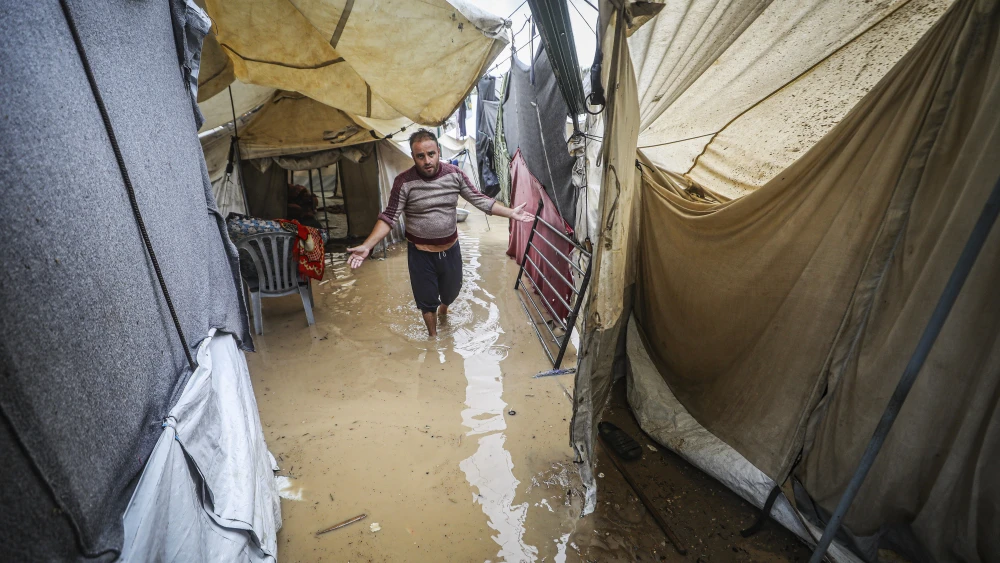

As Gaza is battered by seasonal flooding, the Palestinian Authority has accused Hamas of denying humanitarian assistance to Palestinian civilians in the coastal enclave, thousands of whom are living in tents.
A statement issued on Nov. 9 by Fatah, the dominant nationalist faction within the P.A., held the Hamas terrorist organization “responsible for negligence and failure to intervene to save citizens and alleviate their suffering in the Gaza Strip, at a time when employees from the Ministry of Labor and relief agencies are being summoned and forced to sign pledges that prevent them from carrying out their professional and humanitarian duties in the service of our people.”
If the Hamas-run government media office in Gaza is to be believed, the damage from the relentless rainfall has been extensive, although no fatalities have been reported so far. The terrorist group has predictably blamed Israel for this latest twist in Gaza’s humanitarian crisis, claiming that the Israeli authorities have prevented the delivery of shelters and construction materials into Gaza.
But according to COGAT, the Israeli Defense Forces’ agency responsible for coordinating the delivery of aid, more than 90,000 tents have reached Gaza, along with 8,000-plus trucks carrying winter supplies. In addition, upwards of 800 requests from international aid groups to bring supplies into Gaza have been approved.
Even so, there is little doubt that the coming winter in Gaza will be a harsh experience for the Palestinians living there. Equally, there is little doubt that Hamas’s determination to place the lion’s share of the blame on Israel for their suffering will be echoed by foreign governments, particularly in Europe; by the United Nations; and by the assorted celebrities, influencers and activists still shrieking the word “genocide” in Israel’s direction.
Were senior Hamas leader Yahya Sinwar—the architect of the Oct. 7, 2023 atrocities in southern Israel who was eliminated by IDF forces a little more than a year later—able to glimpse up at the current situation from the depths of hell, he would doubtless approve.
Sinwar always believed that compounding the suffering of ordinary Palestinians was a vital component of his “resistance” strategy. “We are ready to sacrifice twenty thousand, thirty thousand, a hundred thousand,” he once told an Israeli prison official who spent hundreds of hours in conversation with him. When the IDF went to war against Hamas in the wake of the Oct. 7 massacre, Sinwar compared the death toll among Palestinians to those incurred during the Algerian independence struggle against France, all of which were “necessary sacrifices.”
The images we will doubtlessly see in the coming cold months—tents ripped and blown away by lashing rain and high winds, thousands of people corralling outside food distribution centers, aid trucks surrounded by desperate recipients—are in perfect sync with the Sinwar playbook.
It is hardly shocking, therefore, to learn that Hamas is issuing warnings to those P.A. officials in Gaza charged with the distribution of aid. The independent Palestinian observer Ahmad Fouad Alkhatib, citing P.A. sources inside Gaza, asserted that P.A. employees have been “intimidated, summoned and coerced by Hamas into signing pledges not to undertake humanitarian projects without the group’s approval,” facing the threat of “so-called ‘field justice,’ including beatings and worse,” if they decline to cooperate. The dispute has reportedly centered on demands made by senior P.A. officials, among them Najla Hamad, the director of shelter centers at Gaza’s Ministry of Public Works and Housing, for the construction of more durable fiberglass structures to replace the tent-based accommodation.
For that reason, it is disappointing that the Board of Peace, the international organization created by the Trump administration to restore stability to Gaza, is expressing frustration with Israel, labeling its response to the current winter emergency as “insufficient” in a Nov. 9 statement. At no point did the board acknowledge that Israel faces the same brutal dilemma as always: Compounding the suffering of Palestinian civilians by restricting aid does little for either its international image or for the cause of peace, but an overly liberal policy on aid materials risks playing directly into Hamas’s hands.
The cement and concrete that can be used to rebuild homes can also be used to construct bunkers, fortifications and the elaborate underground tunnel network that Hamas has deployed to deadly effect. Steel and metal poles for the erection of tents can be diverted into the manufacture of weapons. Metal pipes to ensure water distribution and the disposal of sewage can be converted into missiles. None of these concerns are theoretical; since its seized power two decades ago, Hamas has developed unrivaled expertise in exploiting these dual-use materials for waging war on Israel.
Ultimately, what this highlights is the manifestation of the same problem that has dogged Gaza before and after Oct. 7, just in different contexts. Hamas remains in power. Hamas remains armed. As long as those two facts remain true, a peaceful resolution—Palestinians benefiting from the reconstruction of Gaza, Israel’s southern border secured, an indefinite ban on Gazan civilians entering Israel except in situations where prior approval has been granted—will remain elusive.
Perhaps understandably, the board is impatient to show that progress is being made. It wants to house thousands of displaced Palestinians. It wants Hamas to surrender its weapons and hand over power to the National Committee for the Administration of Gaza (NCAG), a group of Palestinian technocrats. And it wants to deploy an International Stabilization Force (ISF) to train law enforcement in Gaza and assist with the delivery of aid.
In that regard, Israel announced last week that 250 foreign troops from the proposed ISF had been authorized to enter Gaza. Contributing countries to the ISF include Indonesia, Morocco, Kazakhstan, Kosovo, Uganda and Albania. Ultimately, the goal is to deploy 20,000 troops under the rubric of the ISF, alongside 12,000 Palestinian police officers who will all, we are told, be thoroughly vetted for any links to Hamas.
Even assuming that Israel would allow the introduction of additional troops, to do so while Hamas still enforces its rule through the barrel of a gun would be an act of madness. I saw this myself in Bosnia and Croatia during the mid-1990s, when the United Nations deployed more than 40,000 “Blue Helmet” peacekeepers during an active conflict. Those troops were effectively hostage to the Serb forces, never challenging the paramilitaries out of the entirely reasonable fear that doing so would turn them into targets. Hamas would be in a very similar position, able to exploit the ISF on the ground and then manipulate the information flow to depict Israel as culpable for Gaza’s ongoing misery.
Right now, that outcome can be avoided. The conditions are not in place for a serious reconstruction effort and the deployment of a large-scale international force.
If Trump’s 20-point peace plan is to survive, and if the board is to obtain Israel’s full cooperation with the implementation of its goals, then it needs to recognize that no Israeli government—whether led by Benjamin Netanyahu or Gadi Eisenkot—will display any enthusiasm for the rehabilitation of Gaza as long as Hamas remains the unrivaled power there.
That is why, in the coming months, all diplomatic and, if necessary, military efforts must focus on the point that Trump’s plan opens with: the disarmament of Hamas.