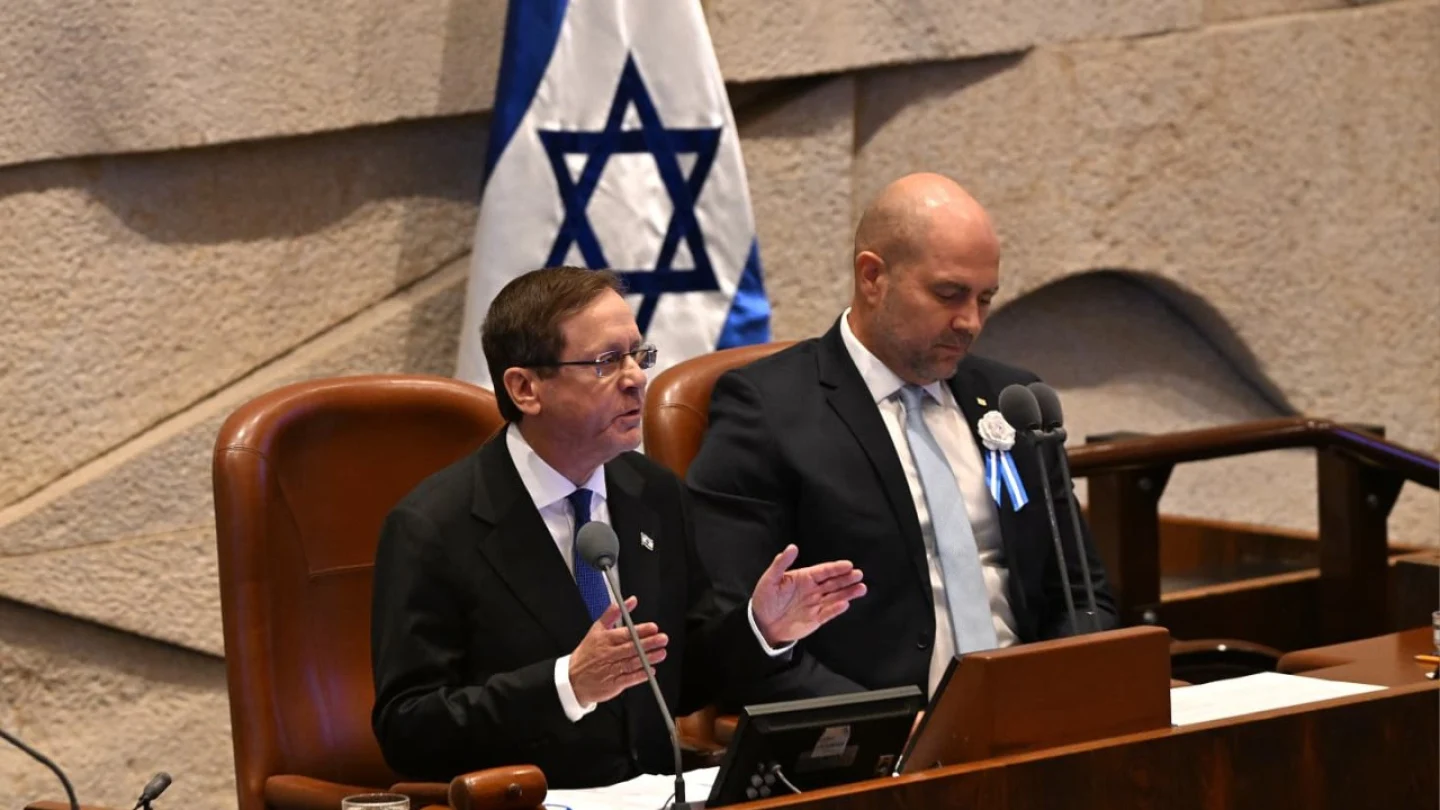

For Israel, the Knesset is like a Greek temple, a place of worship dedicated to democracy in a desert of terrorism and war.
On Tuesday, for the inauguration of the 26th Knesset, it was adorned with flowers, flags and festive decorations. There were smiles, ceremonies and mounted guards.
But the Knesset is also a boxing ring, where political confrontations can become extreme. And on Tuesday, the celebration turned into a volcanic eruption as the festivities gave way to a harsh confrontation with reality.
Knesset Speaker Amir Ohana, of Likud, now faces the prospect of being replaced by an emerging coalition that is not yet a government but has suddenly appeared on the horizon. A total of 67 lawmakers signed a request for an early vote to elect a new speaker, bringing together Zionist parties opposed to Benjamin Netanyahu and Arab lawmakers. The vote is scheduled for Nov. 17.
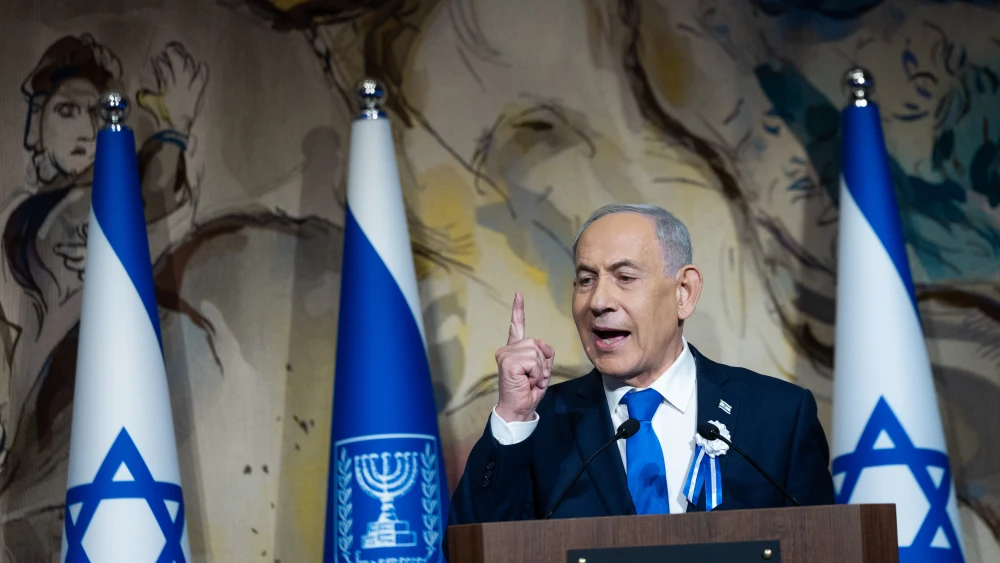
In a 21-minute speech, Israeli Prime Minister Benjamin Netanyahu made clear his conviction that Israel cannot afford to gamble with political forces he regards as hostile to the Jewish state.
For Netanyahu, the 19 lawmakers elected from Ra’am and the Joint List represent a profound danger.
“Are you prepared to depend on people whose goal is the destruction of the Jewish state?” Netanyahu asked. “Do you prefer them over Zionist parties that represent an enormous Zionist public?”
He went further, accusing the two Arab parties of being “supporters of terrorism who hate Israel” and arguing that “the only difference” between them “is that they disagree over what kind of state will arise here on the ruins of the Jewish state.”
In a country living in a state of perpetual conflict, Netanyahu warned, their participation in government could inflict irreparable damage.
The fact that some newly elected lawmakers walked out during the national anthem is hardly reassuring. Neither are the refusals to condemn Hamas.
Beyond the flowers and flags, Netanyahu’s speech marked the beginning of a crisis of conscience.
At its heart lies the danger that Gadi Eisenkot, despite his promise to form a government only with Zionist parties, might ultimately be drawn into an alliance with two Arab parties whose political histories and attitudes toward the so-called “shahids,” or martyrs, raise troubling questions.
The wounds of war
The moral landscape upon which Netanyahu’s harsh words fell was that of an elected assembly unlike any Israel has seen before.
The pain of war, the determination to persevere despite everything, and the struggle against hatred and antisemitism are part of the lives of its members, regardless of political affiliation.
At least 11 newly elected lawmakers have lost close family members as a result of the Oct. 7, 2023, Hamas massacre and the war that followed.
Among them is Shira Shapiro of Yashar, the mother of Aner Shapiro, who was 22 when he attended the Nova music festival.
As Hamas terrorists attacked, Aner stood at the entrance to a small roadside bomb shelter, using his body to protect those inside. He managed to throw back eight grenades before another exploded and killed him.
Talik Gvili, of Likud, is a petite blonde woman who holds the hand of her youngest daughter. Her son, Ran, was 24 when he was killed fighting to defend Kibbutz Alumim. His body was abducted to Gaza and returned only after a struggle lasting some 800 days.
Then there is Sharon Sharabi, of Yisrael Beiteinu, who lost his brother Yossi and two nieces, Yahel and Naya, murdered at Kibbutz Be’eri.
The list is long.
It includes Gadi Eisenkot himself, who lost his 25-year-old son Meir in Gaza, his 19-year-old nephew Maor, and 22-year-old Yugev Pazy.
It also includes Bezalel Smotrich, leader of Religious Zionism, whose cousin, reserve commander Amichai Ben David, 43, was killed in Gaza, leaving behind a family waiting for him at home.
Every member of this Knesset has known loss, whether of a relative, a teacher, a colleague or a loved one. So many young women have been left bereaved, their lives forever marked by the sacrifice of those who died protecting them.
Further back in history, Netanyahu himself lost his brother Yoni, who was killed during the 1976 Entebbe rescue operation.
They all know what war means. They all know the hatred of terrorism.
Democracy’s dangerous dilemma
Netanyahu undoubtedly made a political move by confronting the possibility of a government that might include parties whose members have questioned the legitimacy of the Jewish state.
Many say he went too far in his tone, that he accused the Arab lawmakers collectively.
Naftali Bennett rose to his feet, shouting. Yair Golan walked out of the chamber, as did several lawmakers from the Arab parties.
Nevertheless, Eisenkot cannot simply dismiss the statements Netanyahu cited or the questions they raise.
The prime minister touched a raw nerve: the danger that democracy can be turned against itself, used to wound and perhaps even destroy the civilization that gave birth to it.
This is an unresolved question throughout the Western world. How can democratic societies defend themselves against movements that seek to exploit their freedoms while rejecting the principles on which those freedoms rest?
In Israel, however, the question takes on the dramatic colors of a country living through war, surrounded by enemies and still mourning the victims of the Hamas massacre.
Netanyahu has brought the issue of an internal jihadist threat to the center of the political debate. His warning is that the danger does not come only from terrorists beyond Israel’s borders, but also from those within its democratic institutions who may sympathize with their cause.
The political consequences were immediate. Eisenkot canceled a scheduled meeting between Yashar and Likud negotiating teams, denouncing Netanyahu’s speech as “delusional, divisive, hateful and disgraceful.”
Likud responded that Netanyahu “stands by his statement that it is impossible to cooperate with supporters of terrorism,” while maintaining that the prime minister continues to seek a national unity government.
The confrontation has made the formation of a broad coalition even more difficult.
But it also raises a question that cannot be avoided: Can a democracy preserve itself if it allows forces hostile to its very existence to determine its future?
Bibi has returned to the political battlefield with a warning about what he sees as an uncomfortable reality.
And in his view, leadership means having the courage to say it aloud.