It is a tragedy in its own right that Ilana Gritzewsky, a liberated Israeli hostage whom Hamas abused sexually, had to confront the United Nations expert on violence against women, according to Hillel Neuer, executive director of UN Watch.
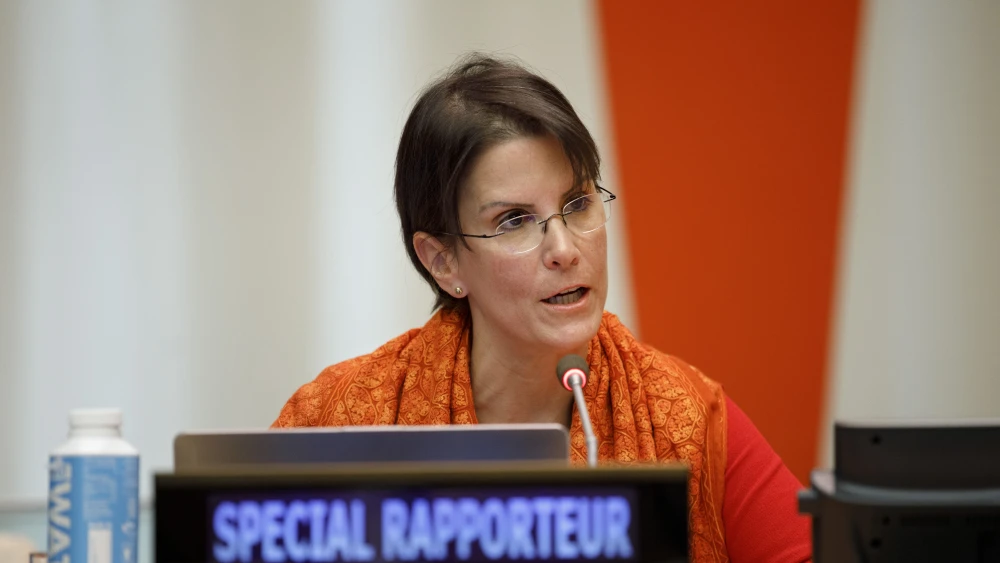
“It’s absolutely horrible that this should have to be the case,” Neuer told JNS on Wednesday, the day after Gritzewsky appeared before the U.N. Human Rights Council to address Reem Alsalem, special rapporteur on violence against women and girls.
“It’s absolutely absurd and tragic that there are U.N. experts who are supposed to care about the rights of women, especially to combat sexual violence, and she’s one of the world’s major deniers of sexual violence against Israeli women,” Neuer said.
The United Nations considers special rapporteurs to be independent “experts,” whom it is loath to censure even when they make offensive comments. Francesca Albanese, a U.N. adviser on what the global body calls the “occupied Palestinian territories,” has a long history of antisemitic comments. The United Nations has told JNS often that it doesn’t tell its advisers what to say, or not say.
A Jordanian national who has held the unpaid, U.N. advisory role since 2021, Alsalem has denied survivor accounts of Hamas sexual violence on and after Oct. 7 repeatedly. She has said that “no independent investigation found that rape took place on Oct. 7.”
“She’s made some rather horrible statements that have either doubted or denied the violence against Israeli women, and in general against Israel as a whole,” Neuer told JNS.
Since Oct. 7, Alsalem has not met with a single survivor of the Hamas-led attacks, according to Neuer. That could change after Gritzewsky’s testimony, he said.
The special rapporteur stated on Tuesday that “if any other survivor of Oct. 7 is ready to finally meet with me, I am always ready to meet,” he told JNS.

“She claimed that she always was willing to meet with Israeli victims, but Israel never got back to her,” Neuer said. “So she said if Ilana and any other survivor wants to meet with her, they could do so anytime.”
Gritzewsky is willing to meet with Alsalem, Neuer said.
JNS sought comment from Alsalem about whether and when she would meet with Gritzewsky and if Gritzewsky’s testimony would prompt her to update or revisit her past reporting and public statements about sexual violence on and after Oct. 7.
Gritzewsky, who appeared before the Human Rights Council on Tuesday as part of an event organized by UN Watch, recounted the sexual abuse she endured in Gaza after terrorists kidnapped her from her home in Kibbutz Nir Oz.
“I woke up half-naked with seven terrorists standing over me, not knowing what happened to me in those lost moments,” she told Alsalem. “I went through days of pain and horror in captivity and even now, the feeling of being powerless and violated still lingers. I came back with a broken hip, a broken jaw and a shattered soul.”
“When I and other Israeli women begged not to be raped, why were you silent?” Gritzewsky demanded. “Please look at me. Do you believe us now? Will you apologize?”
Video footage, in which Alsalem appeared to sit without visible reaction as Gritzewsky delivered her testimony, spread widely on social media. Neuer told JNS that the U.N. adviser was “stone-faced.”
“It’s not inconsistent with her positions until now,” he said.
Neuer pointed to past comments, in which Alsalem claimed that no independent investigation had found that rape occurred during the Oct. 7 Hamas-led attacks, despite a March 2024 U.N. report that found “reasonable grounds” to believe that sexual violence, including rape and gang rape, occurred at several locations during the attacks.
That report also found “clear and convincing information” that Hamas and other terrorists subjected hostages, whom they held in Gaza, to sexual violence.
Neuer also cited a 2024 interview with Israel’s Channel 13, in which he said that Alsalem claimed not to know about the rockets that Hamas and Hezbollah fired at the Jewish state.
“She seems extremely uninterested in hearing about Hamas crimes,” Neuer told JNS. “On the contrary, she has been quite aggressive in doubting or denying, in particular, Hamas sexual violence.”
“That’s tragic,” he said. “Sadly, she’s not the only U.N. rapporteur who seems to be more sympathetic to terrorists than to their victims.”
Neuer pointed to U.N. documents, which he said that UN Watch saw, which suggest that Alsalem received $70,000 from Saudi Arabia in 2024. That raises questions about her impartiality as a supposed defender of women against violence, according to Neuer.
“It’s peculiar that someone who’s an expert in women’s rights would take money from a country that is notorious as a violator of women’s rights,” he said.
“It’s relevant because in the Arab-Israeli conflict, she has very much adopted the anti-Israel position,” he said. “It seems that she’s not acting as an objective, impartial human rights expert. She seems to be funded by Arab states and acting in a way that’s extremely anti-Israel, extremely hostile.”
Neuer said that the widespread response to Gritzewsky’s testimony should serve as a wake-up call about the U.N. system of special rapporteurs, whom the Human Rights Council appoints.
“It’s a system that’s completely out of control,” he told JNS. “There’s no accountability. Many people who get appointed are the opposite of human rights defenders. They are defenders of terrorists.”
“Unfortunately, they do need to be exposed,” he said. “We need member states, European member states, France, Germany, the United Kingdom, Canada, to take leadership and speak out against the appointment of rapporteurs who subvert and pervert human rights.”
JNS asked Neuer what accountability would look like.
“It begins with words,” he said. “Someone like Reem Alsalem should not have been appointed if she has such extreme views that she’s unable to be objective to victims of sexual violence, depending on what their background is.”
When U.N. officials are appointed for political reasons, democracies must speak out, according to Neuer.
“That’s the basic way accountability begins,” he said. “To say, this is wrong.”
“The Human Rights Council itself has a majority of dictatorships, so it’s very hard to get the council itself to change,” he told JNS. “But at least the democracies should be speaking out when nasty applicants are appointed and when they act in a manner that betrays the U.N.’s values.”