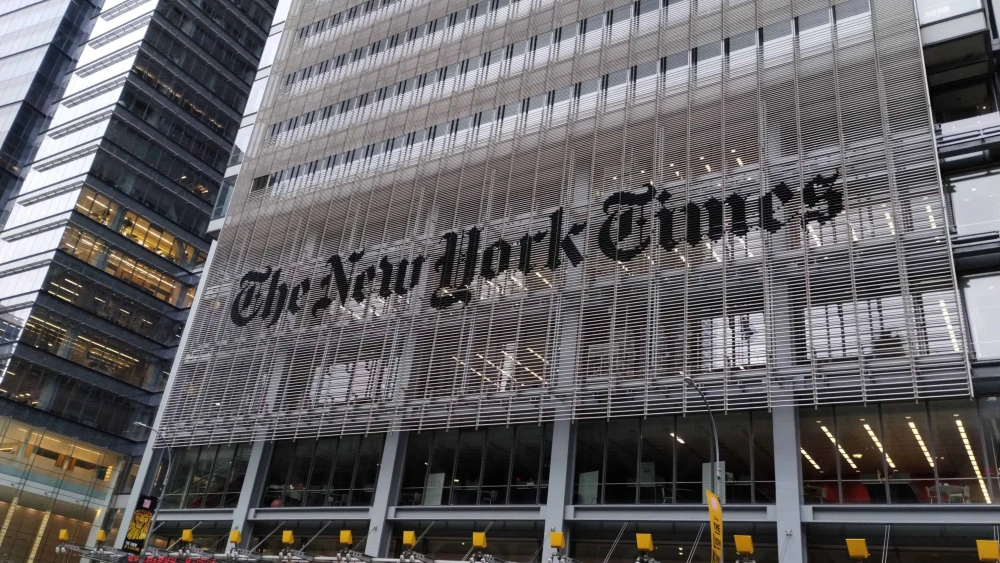
Shareholders sued the New York Times Company on Wednesday to obtain internal records that could show if its board oversees the paper’s editorial standards, citing alleged failures in Israel coverage and an employee’s complaints about anti-Israel bias.
“The Times tells investors that its business depends on its credibility, then refuses to show a single document proving anyone on its board protects it,” Mark Goldfeder, an attorney for the shareholders and CEO of the National Jewish Advocacy Center, told JNS. “This case will be decided on charters, agendas and reporting lines, not on anyone’s opinion of the coverage.”
“But for Jewish and pro-Israel readers, the stakes run far past a balance sheet,” he said.
The Florida State Board of Administrators, acting for the state’s retirement fund, and the National Center for Public Policy Research allege that a longtime newsroom employee reported concerns about standards on at least 15 occasions beginning in 2019.
When she complained about widespread anti-Israel bias, a human resources representative told her that “if you don’t like our values here, maybe you should go find a place whose values align with yours,” according to the complaint.
The filing also alleges that the Times rehired Gaza freelancer Soliman Hijjy shortly after Oct. 7, despite social media posts praising Adolf Hitler that had previously come to light.
According to the complaint, a manager acknowledged in a recorded conversation that Hijjy’s posts “don’t in any way meet our standards.” The Times said at the time that it had addressed the posts and that the freelancer “has maintained high journalistic standards.”
The shareholders also cited the paper’s July 2025 front-page photograph of a malnourished child in Gaza. Its caption said he “was born healthy but was recently diagnosed with severe malnutrition,” while a Getty Images caption two days earlier reported that doctors had identified preexisting conditions.
The Times later revised its article to include those preexisting conditions. The petition seeks records that could establish when its photo editors learned about the context.
“When the paper of record pins a hospital strike on Israel on Hamas’s word, puts a ‘born healthy’ child on the front page whose diagnosis was sitting on a wire service two days earlier, and then only corrects six days late or never, that shapes how Israel is judged and how Jews are treated,” Goldfeder told JNS.
Charlie Stadtlander, executive director of media relations and communications for the Times, told JNS that “this lawsuit has no merit and was brought for an improper purpose,”
“Although it is positioned as a corporate governance petition to inspect the company’s books and records, it is a transparent attempt to exert agenda-driven pressure against an independent media organization, level false allegations of bias and chill journalism protected by the First Amendment,” he told JNS. “We will defend against the suit vigorously.”
The lawsuit comes after shareholders demanded in May that the company turn over documents tied to its publication of a New York Times opinion piece by Nicholas Kristof that accused Israeli authorities of training dogs to sexually assault Palestinians in Israeli prisons.
According to the petition, the Times refused the May records request, calling the concerns “transparently pretextual and made in bad faith.”