Newsletter
Newsletter Support JNS

Vance defends Iran talks as position of strength

The U.S. vice president said airstrikes secured shipping and weakened Tehran’s military and nuclear program, creating leverage for negotiations.

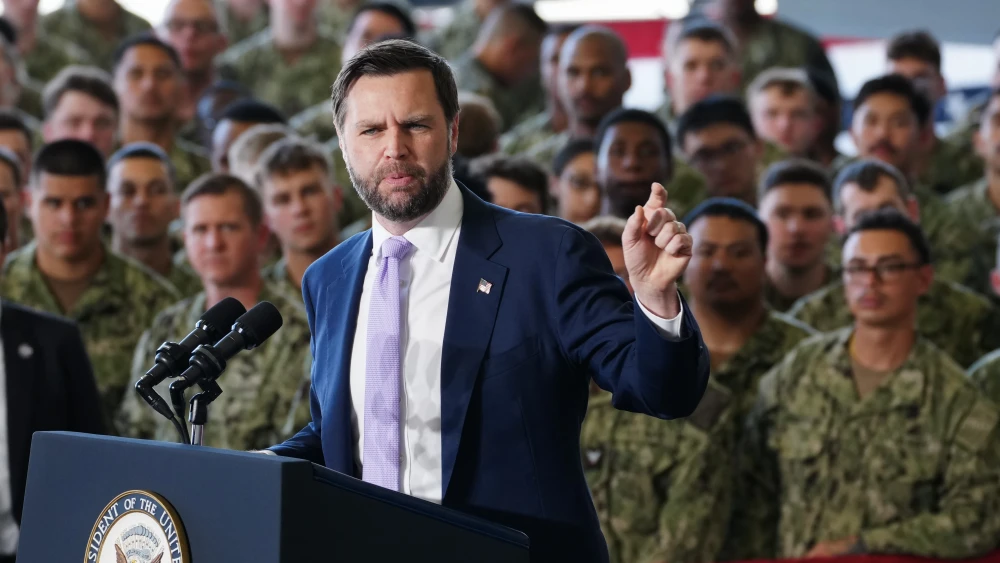
U.S. Vice President JD Vance speaks at an event marking 250 years of the American military at Naval Air Station Oceana on July 1, 2026 in Virginia Beach, Virginia. Photo by Ken Cedeno - Pool/Getty Images.
U.S. Vice President JD Vance speaks at an event marking 250 years of the American military at Naval Air Station Oceana in Virginia Beach, Va., on July 1, 2026. Photo by Ken Cedeno/POOL/Getty Images.

U.S. Vice President JD Vance on Wednesday defended the administration’s negotiations with Iran as being conducted “from a position of strength,” pushing back on critics who have called for continued military escalation.

Speaking at Naval Air Station Oceana in Virginia Beach, Va., Vance said the U.S. is leveraging recent military gains to pursue diplomacy, arguing that force should only be used with clearly defined objectives. “We must never drop bombs just for the sake of dropping bombs,” he said.

He pointed to recent U.S. airstrikes targeting Iran-linked threats to commercial shipping, saying the action restored maritime transit after attacks on vessels. “We dropped some bombs, we applied some leverage, and we’ve had free commercial transit,” he said.

Vance said broader U.S. military actions had significantly weakened Iran’s capabilities, asserting that its navy had been effectively destroyed and that it can no longer project power as it did a year ago. He added that U.S. intelligence assessments show Iran is further from developing a nuclear weapon than at any point in recent decades, and said its defense industrial base has also been degraded, limiting its ability to rebuild.

The three leaders pledged nuclear-risk talks and challenge the International Criminal Court’s jurisdiction, potentially affecting Israel.
Laying claim to the breadstuff “may seem amusing at first glance,” said Asaf Rost of Israeli NGO “Preserving the Eternal,” “but behind it lies a much more dangerous and broader strategy.”
“There’s still a robust Jewish community in the United States,” Alan Cooperman, director of religion research at Pew Research Center, told JNS.
“Instead of focusing on disarming Hamas and ensuring that the terrorist organization never returns to power in the Gaza Strip, they choose to confront Israel with a series of one-sided demands,” Danny Danon, Israel’s U.N. ambassador, told JNS.