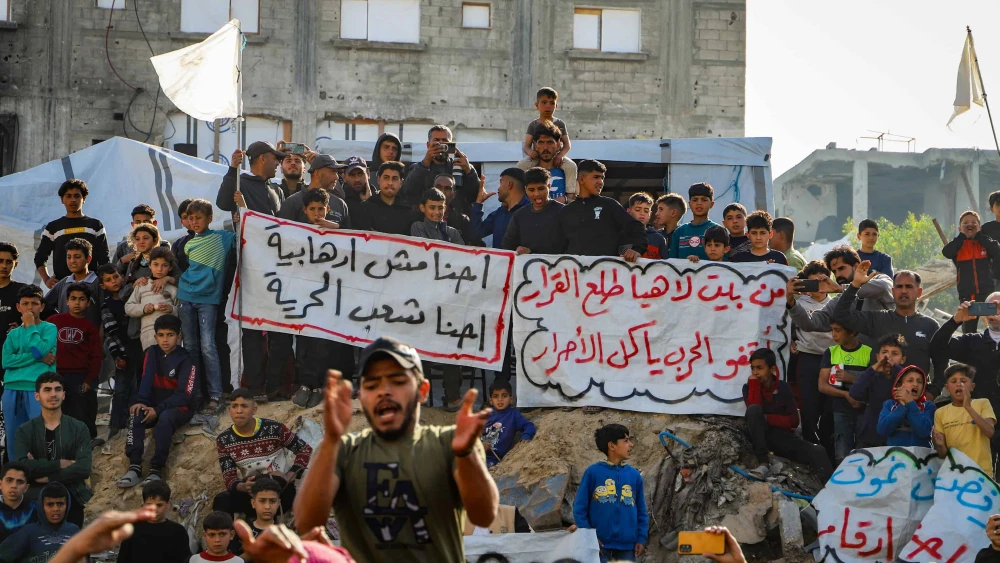
Mass demonstrations against Hamas are scheduled to take place across the Gaza Strip on Friday in what organizers are calling a “Day of Rage,” part of a broader campaign also referred to as the “June 26 Revolution.”
Organizers say rally locations will be announced shortly before the protests begin to reduce the risk of Hamas disrupting the demonstrations or identifying participants.
Ahed Al Hendi, a senior fellow at the Center for Peace Communications, told JNS that the primary objective of the demonstrations is “simple.”
“Gazans are demanding an end to Hamas rule and an end to the cycle of war and destruction that Hamas brought upon them,” he said. “This is not something that appeared suddenly. It is part of a longer social current inside Gaza that has existed for years.”
He also pointed to the involvement of the “We Want to Live” movement, a grassroots campaign that emerged during anti-Hamas protests in 2019. Abdullah Hwaihi, co-founder of the movement and an anti-Hamas activist living in Gaza, has said he was repeatedly arrested and tortured by the terror group.
Al Hendi told JNS that “We Want to Live” began “as a cry from ordinary Gazans against poverty, corruption, taxation, repression and Hamas’s control over every aspect of life,” noting that anti-Hamas protests also took place in July 2023, months before the Oct. 7 attacks on Israel.
The Center for Peace Communications, which works to empower civilians in the Arab world to counter extremism, has documented how Hamas placed Palestinians in Gaza “under a communications blockade.”
Al Hendi called Friday’s planned demonstrations a “continuation of a Gazan phenomenon: people inside Gaza saying clearly that Hamas does not represent them, that they want to live and that they want the nightmare of Hamas rule and endless war to end.”
Other organizers include Mustafa Asfour, a Belgium-based political activist and former Hamas detainee, and Murad Ahmad, a Gaza-based activist and former music professor at the Edward Said National Conservatory of Music.
“The current organizing reflects cooperation between people on the ground and diaspora groups,” Al Hendi told JNS. “The people inside Gaza carry the real moral weight and risk, while diaspora activists can help package, amplify and explain the demonstrations more freely to the media and international community.”
He noted that protesters risk “arrest, torture, disappearance, public accusation of collaboration or retaliation against their families,” and that “even a small crowd is significant.”
Because of those risks, Al Hendi declined to disclose gathering points or operational details in advance, saying he did not want to provide “anything that allows Hamas to identify or preempt participants.”
He did, however, have a message for the international community in advance of the protests: “Gaza is not Hamas.”
“There are Palestinians inside Gaza who reject Hamas, reject being used as human shields, reject the militarization of their neighborhoods and reject having their lives sacrificed for the survival of an armed movement,” Al Hendi told JNS.