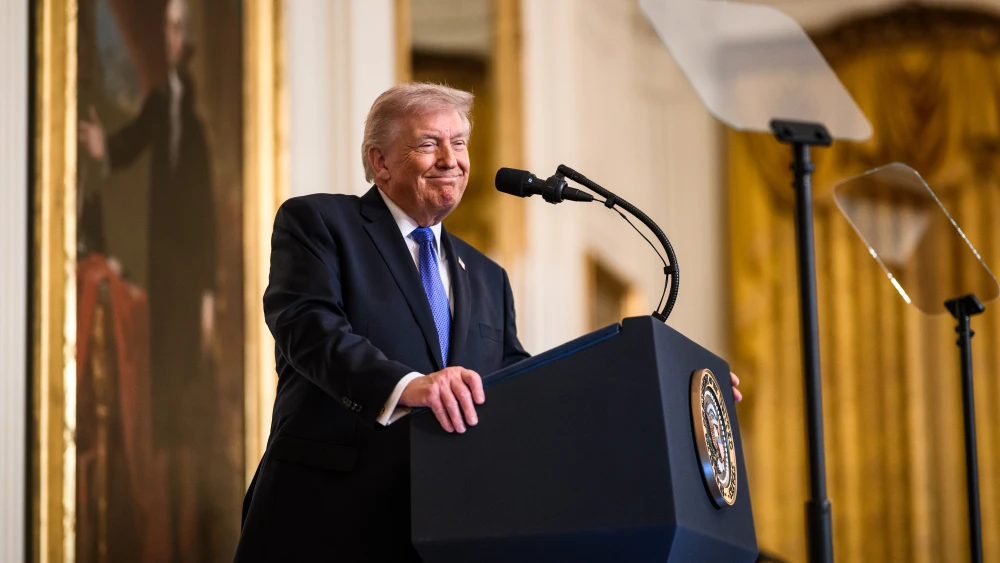
U.S. President Donald Trump on Wednesday suggested that countries dependent on Middle East oil should secure the Strait of Hormuz after Washington had “finished off what’s left of the Iranian terror state.”
“I wonder what would happen if we ‘finished off’ what’s left of the Iranian terror state, and let the countries that use it, we don’t, be responsible for the so called ‘straight?” he said on Truth Social.
The president added, “That would get some of our non-responsive ‘allies’ in gear, and fast!!!”
On Tuesday, Trump said that most NATO allies turned down his request to help provide safe passage to ships through the Strait of Hormuz amid the Iranian blockade, but that the United States doesn’t need their help.
“The United States has been informed by most of our NATO ‘allies’ that they don’t want to get involved with our military operation against the terrorist regime of Iran, in the Middle East,” he wrote on Truth Social.
“This, despite the fact that almost every country strongly agreed with what we are doing, and that Iran cannot, in any way, shape, or form, be allowed to have a nuclear weapon,” the president added.
“I am not surprised by their action, however, because I always considered NATO, where we spend hundreds of billions of dollars per year protecting these same countries, to be a one way street. We will protect them, but they will do nothing for us, in particular, in a time of need,” he continued.
“Fortunately, we have decimated Iran’s military. Their navy is gone, their air force is gone, their anti-aircraft and radar is gone and perhaps, most importantly, their leaders, at virtually every level, are gone, never to threaten us, our Middle Eastern allies, or the world, again!” he said.
“Because of the fact that we have had such military success, we no longer ‘need,’ or desire, the NATO countries’ assistance—we never did! Likewise, Japan, Australia, or South Korea,” the American leader stated.
“In fact, speaking as president of the United States of America, by far the most powerful country anywhere in the world, we do not need the help of anyone!” he concluded.
Trump over the weekend said he was hopeful that China, France, Japan, South Korea, the United Kingdom and other countries “that are affected by this artificial constraint” would dispatch warships as part of a global coalition to keep the Strait of Hormuz “open and safe” amid the war.
“In the meantime, the United States will be bombing the hell out of the shoreline, and continually shooting Iranian boats and ships out of the water,” the president said, vowing: “One way or the other, we will soon get the Hormuz Strait open, safe and free.”
Since the start of “Operation Epic Fury” on Feb. 28, the Strait of Hormuz—a narrow waterway between Iran and Oman through which roughly a fifth of the world’s oil passes—has seen repeated Iranian attacks on commercial shipping vessels and a sharp drop in maritime traffic.
Iranian Supreme Leader Ayatollah Mojtaba Khamenei, who replaced his slain father, said in a written statement on March 12 that the “lever of blocking the Strait of Hormuz must certainly continue to be used.”