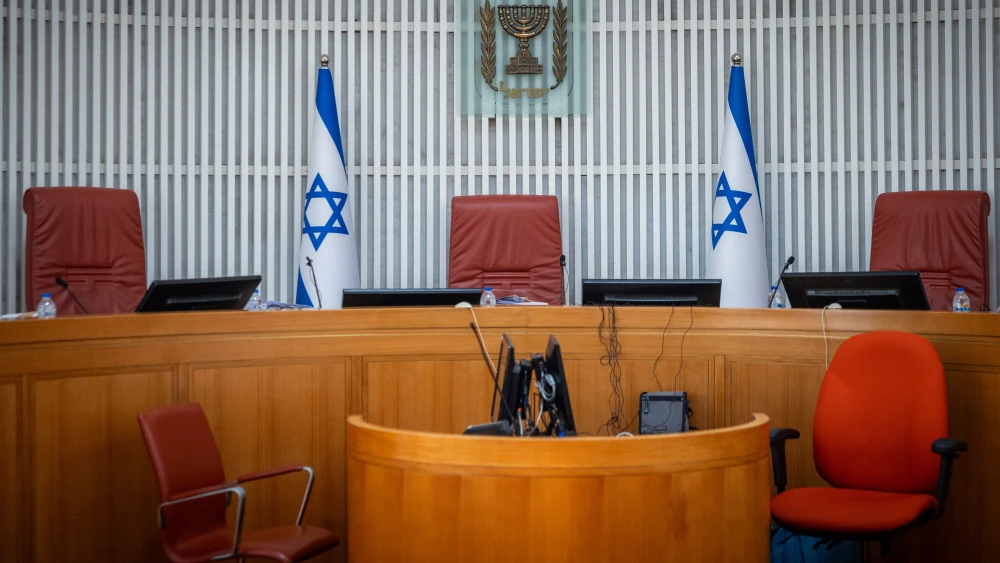

Despite all of its myriad accomplishments, the modern State of Israel has never excelled in upholding the democratic principle of governmental separation of powers. Indeed, for those steeped in the American tradition, the Israeli practice seems to suffer from inherent faults and contradictions that undermine the very integrity of a “tripartite system.”
The comparisons are instructive.
In lieu of a proper constitution, Israel’s body politic is formed by a series of Basic Laws, the first of which, enacted in 1958, established the Knesset as “the house of representatives of the State,” i.e., the legislative branch. Decades later, Basic Law: The Government decreed that, “The Government is collectively responsible to the Knesset.” In practical terms, this means that the Knesset effectively appoints the executive branch of government and correspondingly retains authority to disband it by means of a vote of non-confidence. On the other hand, the prime minister is entitled to order the dissolution of the Knesset, which necessarily leads to new elections.
While on the face of it, this might seem an optimal arrangement guaranteeing checks and balances between these two powerful branches of government, the system has proven rife with cynical manipulation and political extortion. Instead of two independent actors with clearly delineated lines of demarcation, the government serves as agent for the Knesset, while at the same time neither branch can act with pure autonomous discretion, lest the other employ an Armageddon-type reprisal.
Whereas these two players maintain an ongoing tension—peppered with mutual suspicion and moderation—the third branch of government is not only immune to such agitation, but has learned to exploit the situation to unprecedented results.
Basic Law: The Judiciary was adopted in 1984, vesting in the courts unrestricted judicial discretion, subject solely to the law. That is, of course, how it should be, but the statute goes on to bestow upon the Supreme Court the capacity to serve as the High Court of Justice (known by its Hebrew acronym: Bagatz), and this judicial venue has been endowed with authorities well overshadowing those of the other two competing branches of government. Section 15 of the Basic Law empowers the High Court to adjudicate any matter which it deems necessary “to provide relief for the sake of justice.”
Moreover, Bagatz is authorized to issue injunctions and decrees against the state, local authorities, public officials and essentially every administrative bureau, including the entire judicial system.
For decades now, there’s been a growing tendency on the part of this tribunal to officiate as the ultimate supervisor of all state agencies—intervening, superseding and administering authority over practically every realm of public policy in Israel. And, in recent years, the rapacious appetite for overruling government decisions, acts and appointments has reached astonishing levels. Former Seventh Circuit U.S. Court of Appeals judge Richard Posner has gone so far as to refer to this process as “judicial piracy,” no less.
By virtue of a plethora of self-styled “public petitioners”—i.e., parties who have no direct grievance against the particular matter in dispute but are nevertheless allowed to approach the court on behalf of the afflicted populace as a whole—Bagatz eagerly involves itself in nearly every major policy decision the administration wishes to implement. An example is the Israeli Supreme Court’s adamant opposition to the government’s efforts to shut down Israel’s Army Radio station (Galei Tzahal, or “Galatz”) on the pretense of alleged procedural defects in the decision-making process.
Yet even more alarming is the High Court’s virtual obsession with the question of Haredi enlistment in the military, perhaps the most heatedly debated question in Israeli politics today. Aside from the nearly intractable complexity of this volatile issue, at bottom it is manifestly a political one: The government’s prerogative to prioritize Torah study over army service for a certain segment of society, a principle recognized by every administration since the founding of the state.
Bagatz, however, abides by its own set of values, the predominant and most hermitically impenetrable of which is “equality.” These activist Supreme Court justices simply cannot countenance any instance they perceive as unwarranted discrimination and demonstrate no restraint in pursuing their holy agenda.
More often than not, the results are patently absurd and self-defeating. Associate justice Dafna Barak-Erez, easily the most openly progressive judge in a pool of liberal-leaning justices, was steadfast against allowing any government funding for training Haredi men to enter the workforce, unless equivalent financing be allotted for women, along with other sectors of society.
“The starting point for the discussion is that, as a rule, gender segregation in the activities of public bodies infringes upon the principle of equality. Distinctions in the provision of services on the basis of gender are suspect as irrelevant distinctions that may amount to prohibited discrimination,” she wrote in her majority opinion. “In light of the fact that Haredi men are not the only population whose increased integration into the labor market is currently necessary, granting substantial direct support exclusively to them constitutes a violation of the right to equality, which cannot be accepted.”
Questions of policy priorities, budgetary constraints, legitimate considerations of macro-economics and essentially every pertinent factor the administration must weigh in making these difficult decisions, are summarily sacrificed on the uncompromising altar of equality.
So, too, practically no government appointment of a high-ranking official escapes the magnified scrutiny of Bagatz. Not only did the Supreme Court deny Israeli Prime Minister Benjamin Netanyahu the right to dismiss the chief of the Israeli Security Agency (Shin Bet), Ronen Bar, but suspended the cabinet’s decision to replace him with Israel Defense Forces Maj. Gen. David Zini. Nor has the Supreme Court allowed the government to terminate its own “legal advisor,” the tireless contrarian Gali Baharav-Miara.
More recently, Bagatz simply couldn’t resist intruding on the cabinet’s nomination of IDF Maj. Gen. Roman Gofman as the next Mossad chief. While the petitions against this appointment were eventually rejected, the majority in the case refrained from imposing any monetary sanctions upon the petitioners. And when the somewhat erratic associate justice Alex Stein recommended fining them NIS 70,000 (nearly $24,000) for the respondents’ expenses, one of the petitioners, the disingenuously self-labeled “Movement for the Quality of Government,” hastily filed a bizarre and acrimonious motion for Stein to recuse himself from adjudicating any future petitions submitted by this “public petitioner.”
One might ask how the other two branches of government have succumbed so obediently to the whims of an unrestrained activist judiciary. Sadly, the answer is borne out by the question itself. As originally conceived, the government’s proposed judicial reform was to address a variety of defects prevalent throughout the legal system. But even the least threatening of these amendments—negating “the rule of unreasonableness,” whereby the Supreme Court arrogated to itself the authority to disqualify any official fiat for not meeting the “reasonableness standard”—was overturned as an “unconstitutional constitutional amendment.”
The principle of checks and balances between the three separate branches of government is a foundational tenet of any functioning democracy. When that delicate equilibrium is breached, continually and over a period spanning decades, it becomes clear that the system itself is gravely flawed and dangerously exposed to tyrannical manipulation and control. Israel’s unelected judiciary all but admits openly its compelling conviction to serve as an “enlightened despot,” imposing a “rule of judges” over the prejudiced, myopic and corrupt executive and legislative branches.
Despite the increasing severity of the situation, neither the government nor the Knesset seems to provide any practical solution to this incessant menace to the republic, other than bitterly lamenting their inability to restore fundamental democratic precepts to Israel’s political system.