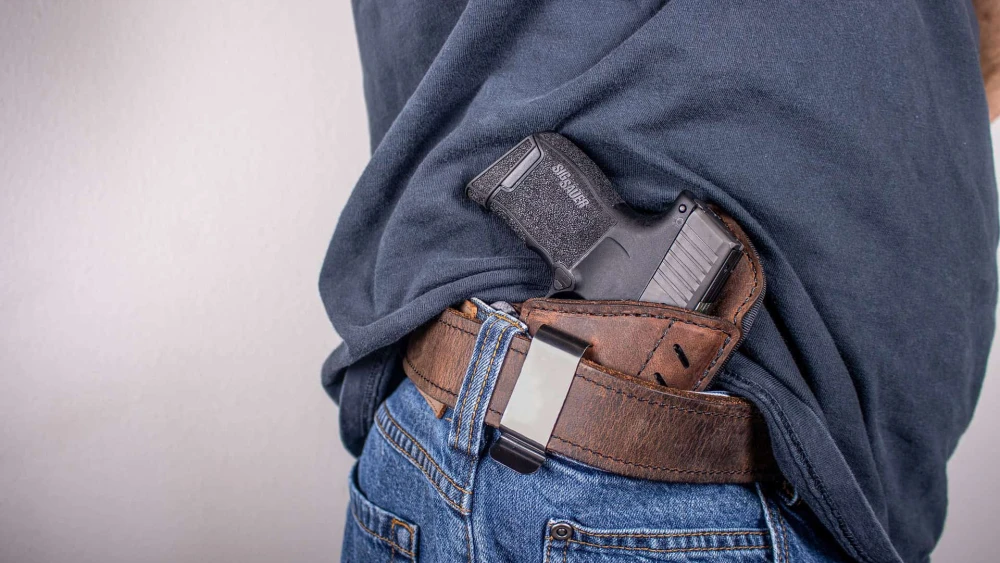
After allowing members of the Silver Spring Jewish Center, an Orthodox synagogue in heavily Jewish Montgomery County, Md., to carry guns inside the building, which also includes a school, a federal judge ruled that members cannot walk there armed.
That ruling, an attorney for the members says, means that Shabbat-observant congregants essentially can’t bring guns to services on the Sabbath and holidays.
On Tuesday, Deborah Chasanow, a judge on the U.S. District Court for the District of Maryland, rejected the synagogue’s request to reconsider and to block Montgomery County’s firearm restrictions within 100 yards of places of public assembly, including private houses of worship.
“Although they can theoretically have firearms at the synagogue, they cannot carry them there when they walk on the days when they have to walk there,” Jacob Huebert, senior litigation counsel at the New Civil Liberties Alliance and an attorney for the synagogue, told JNS.
In her ruling, Chasanow wrote that the plaintiffs established a religious obligation to defend themselves while in synagogue, and therefore carry their guns, and established that they have a religious obligation to walk to synagogue on Shabbat and Jewish holidays. But they did not establish that there was a religious mandate to make that walk while armed, she ruled.
The judge also rejected their argument that an exemption allowing people in vehicles to have their guns within 100 yards of places of public assembly discriminated against Shabbat-observant Jews.
“Most other religions that I know of don’t require you to walk to the place of worship on the days when you go there to worship,” Huebert told JNS. “So this law doesn’t affect their ability to carry a firearm to their place of worship and have it there, because they can drive there.”
“But since these people have to walk, they’re not able to fulfill their religious obligation to defend themselves and other members of the synagogue,” the lawyer said.
Huebert added that the plaintiffs’ religious obligation to protect themselves and other Jews extends beyond the grounds of a synagogue.
“If you’re walking to the synagogue with your family, and you’re out and about, you have the same obligation and at least as much need, because you’re out in public,” he told JNS.
Violence has targeted Jews outside Jewish institutions and in public, including two Israeli embassy employees murdered outside a Jewish museum in Washington, D.C., in 2025, a Jewish woman murdered during a march for Israeli hostages in Colorado in 2025 and a Jewish man stabbed in the chest outside a Manhattan synagogue in 2026.
Menashe Shapiro, a congregant who is also a plaintiff, told JNS that the county’s law “unfairly and unduly burdens Jewish religious firearms carriers” and violates both the First and Second Amendments.
The heavily Jewish county contains about 45% of Jews in the state.