
The discussion held last week in the Knesset’s Immigration and Absorption Committee on the detention and deportation of two American Jewish activists was not an isolated matter. It touches the very core of a broad, ongoing phenomenon that is well known to Israel’s security establishment: foreign activists who enter Israel on tourist visas, systematically violate the law, confront soldiers in the Israel Defense Forces and operate as part of a coordinated international campaign against the State of Israel.
This phenomenon is not new. It began as early as 2001, during what was then referred to as the “Second Intifada,” or more accurately, the “Oslo War”—a period in which Israeli civilians faced a wave of suicide bombings and murderous terrorism.
Since then, hundreds of foreign activists every year, both non-Jews and Jews, have entered Israel under false pretenses, concealing the true purpose of their visit, in violation of Israel’s Entry Law. They operate alongside Israeli left-wing activists and Arab activists, violate military orders, block roads, interfere with the activities of security forces, document soldiers and military training, and take part in deliberate disturbances of public order.
In some cases, these organizations and activists even cooperate with designated terrorist organizations or express sympathy and support for terrorism. They are involved in the boycott campaign against Israel, the so-called “settler violence” campaign, campaigns for the release of terrorists, the olive harvest campaign, and, in the past two years, a broader campaign aimed at accusing IDF soldiers of war crimes in the international arena and filing complaints against soldiers abroad.
Against this background, the current case must be understood.
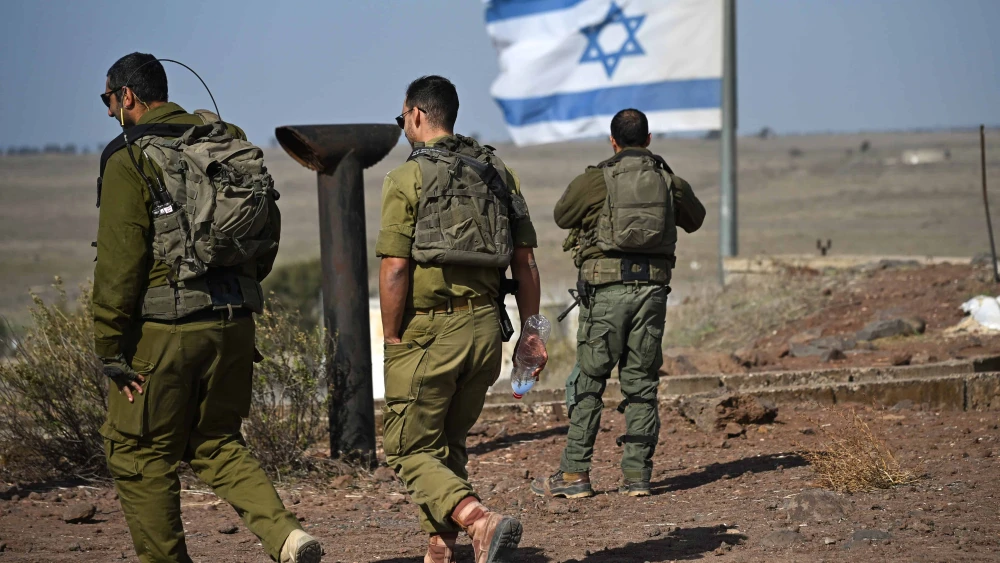
Two American activists, sent by the organization “Achvat Amim,” interfered with the operational activity of IDF reserve soldiers during a military operation. These were reservists who were very likely serving their fourth or fifth rotation within two years of war, and who had dealt with a similar incident involving other organizations in the same area just days earlier. According to the organization’s own statement—signed by its CEO, Becca Strober—the activists did not comply with the soldiers’ instructions. This is not an interpretation; it is an explicit admission.
This is not the first time that the organization and its activists have violated Israeli law and confronted IDF soldiers. Until 2017, “Achvat Amim” operated within the Jewish Agency’s MASA program, but in practice brought foreign Jewish activists to participate in disturbances
of public order in the Mount Hebron area.
Following an exposure aired in an investigative report on Channel 2 News, the program’s funding was terminated. Even afterward, the organization continued to bring activists to confrontations on the ground, with disturbances in some cases carried out under the banner of another organization called “All That’s Left.” These activities included road blockages, barricading inside buildings designated for evacuation—among them in Silwan (Jerusalem)—graffiti and participation in violent disturbances of public order.
And yet, in two discussions held by the Immigration and Absorption Committee, the committee’s chair, Knesset member Gilad Kariv, together with activists from “Rabbis for Human Rights,” attempted to argue that the activists should not have been deported because they are Jewish, and that this harms relations with the American Jewish community. This is a serious claim—not only from a security perspective, but also from a moral one. It creates an improper distinction between Jews and non-Jews before the law.
The law must be the same for everyone. There is no such thing as a “Jewish tourist visa” that grants immunity from violating military orders. There is no such thing as an “educational provocation.” And there is no justification for someone arriving from abroad, in the midst of a war, to confront soldiers, especially reserve soldiers.
Those same actors also claimed that this was an “educational and Zionist program.” In practice, in the materials published by “Achvat Amim” relating to the program, it is difficult to find even a single mention of the word Zionism. But even without entering into semantic debates, there is nothing Jewish, Zionist or educational about breaking the law, harassing soldiers and obstructing security operations, certainly not during wartime. It reflects contempt for the soldiers, for their right to carry out their mission and for the security of Israeli civilians.
Anyone who truly feels a “Jewish connection” or considers themselves a Zionist does not come to Israel during a war to burden exhausted soldiers, but rather to support them—or at the very least, not to interfere with them.
It must also be said honestly: The olive harvest and plowing seasons have for years become two agricultural periods exploited for planned provocations, initiated confrontations and attempts to seize land, as part of well-known political programs such as the Salam Fayyad Plan.
The two main olive harvest campaigns are the “Faz‘a” (Faz3a) campaign and the “Baqa” campaign, led by the Union of Agricultural Work Committees—an organization designated as a terrorist organization by Benny Gantz when he was serving as minister of defense. After Oct. 7, when the entire public is alert, wounded, and free of illusions, there is no possibility that such actions, especially in close proximity to Jewish communities or security fences, will be perceived as “innocent activity.”
The army will not turn a blind eye. The residents will not remain silent. And what was—will no longer be.
The State of Israel cannot allow itself a policy of selective enforcement out of fear of criticism or public relations concerns. Not Jews, not foreigners, not Israelis—no one is entitled to endanger the security of IDF soldiers and Israeli citizens.
Precisely in the name of solidarity with IDF soldiers, precisely in the name of equality, precisely in the name of the rule of law and precisely in the name of national responsibility, the deportation was justified.