


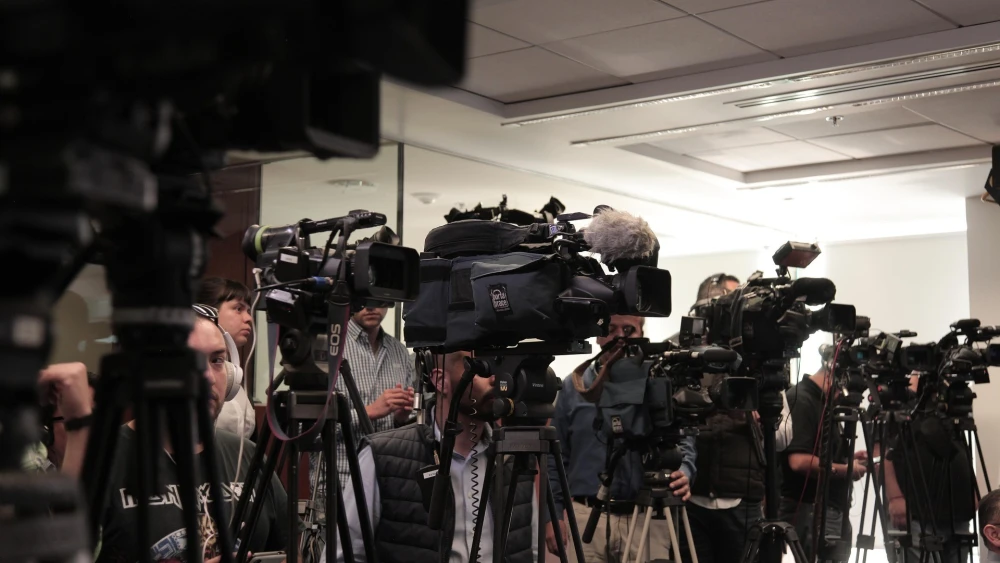

Have you ever wondered why a major story never made the headline?
Why a groundbreaking medical innovation, a powerful act of heroism, a rising trend in antisemitism or an important community story failed to gain traction beyond a small audience? Why some stories seem to dominate the news cycle while others barely register at all?
Like many people, I’ve asked those questions myself. After years working as a journalist across broadcast and print media, including contributing to and appearing on CNN, ABC, CBS, CNBC, Bloomberg, Fox and MSNBC, I’ve come to believe the answer is often far more practical than political.
It starts with access.
Access to sources. Access to experts. Access to communities. Access to information. And, perhaps most importantly, access to firsthand experiences that help journalists better understand the stories they are being asked to cover.
The reality is that journalists cannot report on stories they don’t know exist. They cannot interview sources they have never met. They cannot provide context that they have never been given. In a media environment where reporters are expected to move faster than ever before and cover increasingly complex issues, access often determines which stories get told and which stories get left behind.
At a time when antisemitism is rising globally and misinformation spreads at unprecedented speed, communities cannot afford to remain reactive. According to FBI hate-crime statistics, Jews consistently remain among the most targeted religious groups in America, despite representing only a small percentage of the population. At the same time, social media has fundamentally transformed how people consume information, often rewarding speed and outrage over context and nuance.
Whether we like it or not, media shapes how the world understands almost everything. According to the Reuters Institute’s Digital News Report, nearly 70% of people access news online each week. Every day, journalists, producers, editors, writers, bookers, anchors and digital creators help determine which stories are told, which voices are heard, and how issues are understood by the public.
In other words, media does not simply report on our work. It amplifies it.
Every nonprofit, advocacy organization, hospital, university, faith based institution and community group depends on public understanding to advance its mission. Whether the goal is fighting antisemitism, supporting Israel, advancing medical innovation, promoting education or strengthening communities, none of that work exists in a vacuum.
At some point, every organization needs the media.
Yet despite this reality, relatively little attention is given to engaging the very people responsible for informing millions of people every day: journalists.
For decades, the Jewish community has invested heavily in advocacy, education, philanthropy, security, healthcare, public affairs and combating antisemitism. Those investments remain essential. But if we are serious about ensuring our stories, concerns, achievements, innovations and values reach beyond our own circles, journalist engagement deserves to stand alongside those priorities.
Every major Jewish organization has a communications strategy. Every major challenge facing our community requires public understanding. Yet there remains a significant gap between the stories we want the public to understand and the relationships needed to help those stories reach broader audiences.
If advocacy is an investment in policymakers, journalist engagement is an investment in public understanding.
We have spent decades building entities that speak for our community. We should spend just as much time building relationships with the people listening to it.
At a time when misinformation spreads rapidly and public understanding is often shaped by headlines, social media and breaking news coverage, communities cannot afford to engage only after a story has already been written. If the goal is to ensure that key stories, innovations, challenges and achievements reach beyond our own circles, then engagement with the people who tell those stories must become part of the conversation.
This is not about telling journalists what to think. It is not about creating talking points or seeking favorable coverage. It is about creating opportunities for access, context, education and firsthand experience so that reporting is informed by a deeper understanding of the people, places and issues involved.
One example of this approach is the growing effort to create firsthand engagement opportunities for journalists and media professionals, allowing them to ask questions, challenge assumptions, meet a diverse range of voices, and gain context that is often difficult to acquire from thousands of miles away.
A delegation of journalists and media professionals will travel to Israel to participate in the JNS International Policy Summit, where policymakers, diplomats, journalists, military leaders, innovators, academics and educators gather for conversations about media, security, technology, diplomacy, public policy and the future of the Middle East.
For participating journalists, the value extends far beyond attending a conference. It creates opportunities to discover new sources, build relationships with experts and engage with voices they may one day turn to when major stories break. These are not simply conference speakers. They are future sources, future interviews and future voices who can help provide context when complex stories emerge.
As part of the delegation, journalists will also visit Hadassah Medical Organization, widely recognized as Israel’s leading smart hospital and the only American-affiliated hospital in Israel. The visit serves as a reminder that Israel’s story extends far beyond conflict and geopolitics. Hadassah sits at the intersection of medicine, technology, artificial intelligence, humanitarian care and innovation, offering insight into a side of the country that is often overlooked in international coverage.
That philosophy guided an earlier journalist delegation to Israel in October 2024. Before participants ever boarded a plane, the work had already begun. Months were spent engaging with participants, answering questions, discussing misconceptions and understanding the types of stories they covered.
What changed was something far more important than agreement.
The experience encouraged participants to pause, ask additional questions, seek greater context and challenge assumptions. It reinforced something every journalist understands: the most complicated stories require more than a headline, a soundbite or a social-media clip.
The work does not end when a delegation concludes. In many ways, the greatest impact occurs not during the visit itself, but in the months and years that follow, when relationships become trusted sources of information, context and understanding.
The strongest relationships are built organically, through trust, access, conversation and continued engagement. Those relationships ultimately help ensure that important stories, emerging trends, innovations and challenges reach audiences far beyond our own communities.
While our delegations focus on Israel, the principle is universal. Every community, nonprofit, institution and cause seeking to influence public understanding faces the same challenge. If people do not know your story, they cannot understand it. If journalists do not have access to your story, they cannot tell it.
The media landscape is challenging. Newsrooms are shrinking. Reporters are expected to do more with less. Social media has accelerated the pace of information and misinformation alike. None of that is likely to change anytime soon.
Changing the narrative surrounding antisemitism requires more than responding after a story is published.
This is not public relations. It is public education. And none of that happens without media.
The answer is not to complain about the media from the sidelines but to engage it. To educate. To invite. To build relationships. To create trust before it is needed.
We may not control every headline, but we can help shape the understanding behind it. In an age defined by misinformation, polarization and information overload, that may be one of the most important investments we can make.
The question is no longer whether media matters. It’s whether communities are willing to engage the people helping shape public understanding before the next major story is written.


