
U.S. President Donald Trump and the Gaza Board of Peace announced last week that the Hamas terror organization would relinquish its weapons. The leading nations in the Board of Peace are Egypt, Qatar and Turkey.
Jerusalem is supposed to withdraw the Israel Defense Forces to the so-called “yellow line.” At this point, there is no announced timetable of expectations.
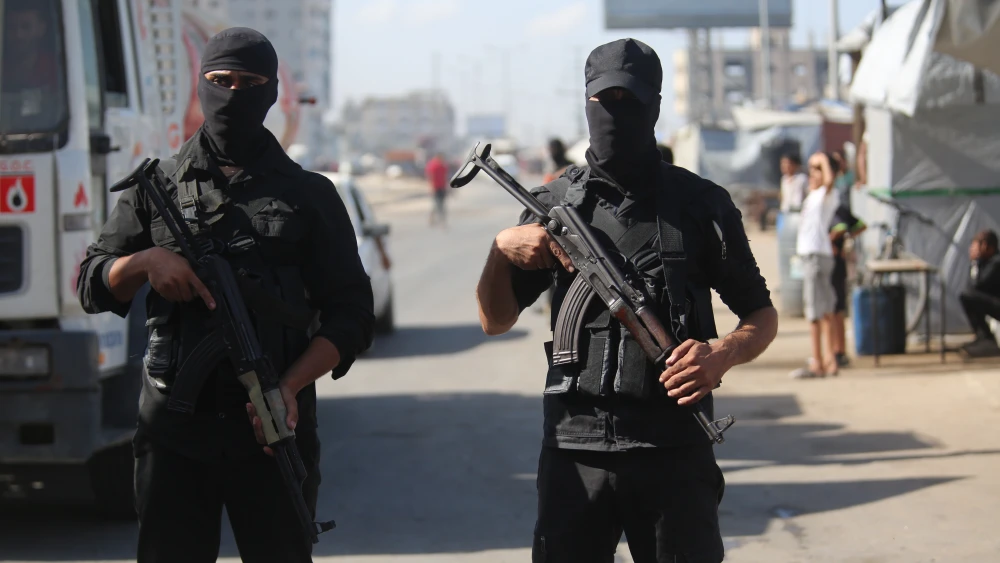
Hamas has declared that it is willing to do so, but only after the total withdrawal of the Israel Defense Forces “for the eyes and ears of the world.” Nevertheless, they passed out rifles this week to the Palestinian Arab citizens in the Gaza Strip.
Doron Spielman, spokesman for Israeli Prime Minister Netanyahu’s office, announced this week that there is no intelligence information confirming that Hamas has any intention of generally dismantling any armaments.
He continued: “If we redeploy before Hamas is disarmed, it will quickly expand its presence throughout Gaza, rebuild its terrorist structure once again, threaten Israeli communities again and seek to carry out another Oct. 7-style attack.”
The High Representative in Gaza, Nickolay Mladenov, has stated that “giving up weapons is not negotiable. He has spent the last month saying, “you could not build a future with armed groups running around the streets. You cannot deliver reconstruction on every corner.”
However, the Gaza Board of Peace is still waiting for the Israelis to respond. Many nations, including France, Spain and Norway, cited concerns about the charter of the board, believing that the scope of this was much too large. Germany and Italy opted out for constitutional reasons. Trump rescinded the invitation to Canada after its prime minister, Mark Carney, rejected his plan concerning Greenland.
We have been through this show before. Pledges and commitments have constantly been made to the kafir (translated from Arabic as the “infidel” or “non-believer”). With Palestinian officials mouthing words, using official statements, and media and public-relations statements seeped in diplomatic rhetoric, Israel realizes that they have no serious intention of commitment.
Israel has not formally accepted this. The Jewish state has been foiled many times before, and the memory of the large-scale devastation, rape, kidnapping and slaughter of Oct. 7, 2023, is still fresh in the minds of every Israeli.
Meanwhile, Hamas has begun passing out rifles to Gazans to make sure that weapons remain in the hands of the Palestinian people. A spokesman for Hamas told The Wall Street Journal, “We didn’t say disarmament. We didn’t say handing over weapons.”
The Palestinians have no idea what constitutes a “large weapon” and a smaller one. It’s all the same in their eyes.
Like so many plans before this one—Oslo, Oslo II, the Hebron Accords, the Wye River talks, the road map to Mideast peace—these accords were all doomed to failure from the start.
Why? Because of a basic lack of goodwill or trust. Each side was supposed to have started to build trust for the next sequential step. There were wholesale violations of basic commitments by the Palestinians. Important calendar-dictated deadlines were missed. The Palestinian Authority, led by the nonagenarian Mahmoud Abbas, has continued to engage in corruption and weakened governance.
Radicalized elements from the Palestinian side felt they could derail the entire process by launching large-scale terror attacks, aiming for thousands of dead Israelis.
The final core issues—the status of Jerusalem, where to place borders and the potential number of refugees allowed to return—were never discussed. These processes were derailed by religious and nationalist aspirations for dominance, rooted in atavistic tribalism, hyper-nationalism and militarism.
Today, Hamas operates in Gaza as a state within a state, executing citizens who fail to comply with its Islamist demands through public shootings and military tribunals. Cooperation with Israel is treated as a capital offense. During the first intifada, Hamas executed hundreds of Arab Fatah Party officials.
In October, Hamas rounded up several men, who were forced to kneel in the street, and summarily executed them with machine guns. Hamas militia wearing olive-green headbands work to quash any internal opposition, singling out rival gangs or political forces, as an attempt to re-establish internal control. A story in June depicts how Hamas terrorists beat, maim, break bones and publicly execute dozens of Palestinians who are former Hamas activists or who have worked with the Israelis. Blindfolded victims are forced to grovel on the ground while the Izz-al-Din al Qassam Brigades carry out these extrajudicial executions.
Israelis are still suffering from the immediate aftershocks of Oct. 7, particularly as the third anniversary approaches. There is little to no way they are willing to go back to the era of the 1990s and take risks for peace.
As the saying goes, “Fool me once, shame on you. Fool me twice, shame on me.”