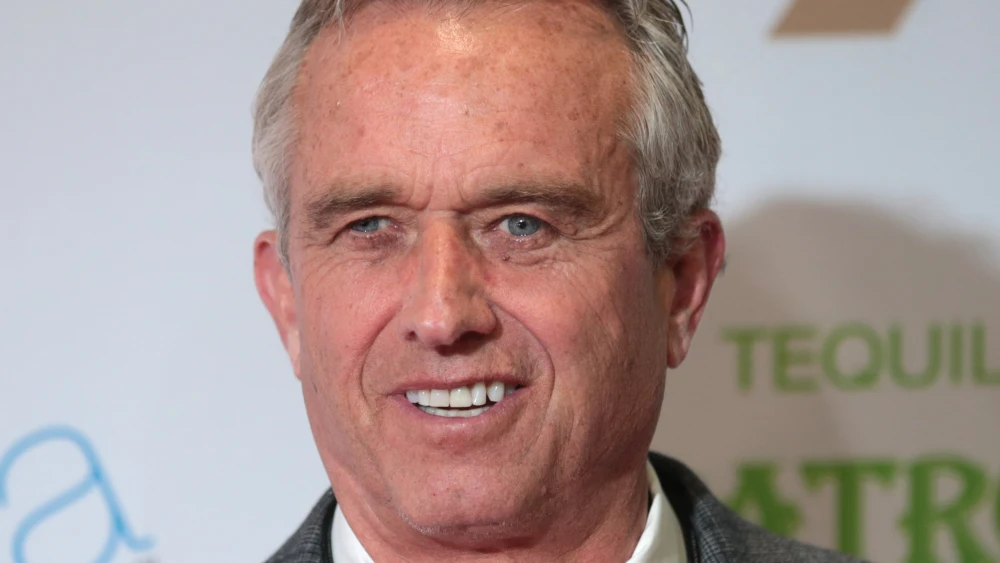

Campaigning in Michigan last week, Health and Human Services Secretary Robert F. Kennedy, Jr. criticized the stultifying effects of political Islam—what academics soft-pedal as Islamism—on Arab-Islamic countries.
Kennedy’s efforts on behalf of Republican Senate candidate Mike Rogers against Democrat Dr. Abdul El-Sayed proved unsuccessful, but he hit the bull’s-eye with his observation that the greater the influence of the Muslim Brotherhood, the less scientific, economic or democratic progress affected societies make.
The century-old Brotherhood is the wellspring of anti-Western, anti-American, anti-Christian, anti-Jewish and anti-modern Islamism. Kennedy’s observations echoed turn-of-the-century United Nations reports. But made in the closing days of the battle for Senate control, they sent defenders of El-Sayed and his Brotherhood-connected family to the barricades.
The Council on American Islamic Relations, itself a Muslim Brotherhood derivative and unindicted co-conspirator in a major federal terrorism financing case, accused the secretary of using “white supremacist talking points” to launch a “vile anti-Arab rant.”
Rep. Rashida Tlaib (D-Mich.) fulminated that “RFK Jr.’s a racist. … We won’t let these fascists win.”
Lazy commentators opined with exception-to-the-rule counterexamples to accuse the secretary and Republicans in general of fomenting anti-Muslim prejudice.
In 2002, 2003, 2004 and 2005, the United Nations, in producing annual Human Development Reports, looked at Arab countries and found numerous “freedom deficits.”
Among these shortfalls, according to studies done primarily by Arab specialists, were those in individual and political freedom, education, research, knowledge, economic growth, living standards, artistic output, women and minority rights and religious tolerance.
One reason given was religious, that is, Islamic fundamentalist intolerance.
On Nov. 1, Kennedy posted a long essay rebutting critics’ attempts to smear him while ignoring “the troubling dearth of scientific output from the world’s 22 Arab nations over the past five decades.” He insisted his campaign speech was “not a critique of Arabs or Islam, but of Islamism (also known as ‘Islamofascism’ or ‘political Islam’), a toxic ideology conceived and promoted” by the Brotherhood.
What is it about the Brotherhood, Arab countries and El-Sayed that left-leaning media and supporters of El-Sayed like Tlaib and opportunistic politicians like Senate Minority Leader Chuck Schumer (D-N.Y.) ignore?
One thing is the Brotherhood’s continuing role as the mothership of Islamist terrorism via spinoffs including al-Qaeda, Islamic State and Hamas. For example, the Brotherhood condemned the 2011 U.S. killing of al-Qaeda leader Osama bin Laden for the Sept. 11, 2001 attacks on the World Trade Center and the Pentagon.
Another, as Kennedy notes, is the influence of early Brotherhood philosopher Sayyid Qutb. Qutb “was contemptuous toward public education in science, math and philosophy, believing that the only source of truth is the Quran,” Kennedy said, and “derided pluralism, rationalism, innovation and tolerance. In doing so, he deprived Islam of its modern potential.”
Is there support for Kennedy’s sweeping claim that “the anti-intellectualism of Islamism … has helped close off the Islamic mind”? Among several examples, the secretary pointed to South Korea, which “issued 260,000 patents in 2024, while nine Arab countries, including Egypt, Saudi Arabia and the UAE issued fewer than 10,000 in total, with 8,000 of these coming from a single nation—Saudi Arabia—which has made herculean efforts in recent years to de-Islamize its society.”
Then there are the Jews, who are not quite 16 million worldwide compared to 500 million Arabs and roughly two billion Muslims. Says Kennedy, “As of 2025, no Muslim has ever received the Nobel Prize in medicine or economics, and only four Muslim scientists—all living in Western democracies—have received the Nobel Prize in chemistry or physics. In contrast, some 200 Jews have received Nobel Prizes in science.”
El-Sayed, a former public health official, belatedly disavowed the Brotherhood on the campaign trail. But Zach Kessel, writing in The Wall Street Journal, noted that his mother, Fatten Elkomy, had worked for the Islamic American Relief Agency until the Treasury Department flagged it “for allegedly funneling money to Hamas and Osama bin Laden.”
The candidate’s father-in-law, Tayeb Jukaku, led the Michigan chapter of CAIR and was associated with the Islamic Society of North America, another Brotherhood affiliate.
Steve Emerson, head of the Investigative Project on Terrorism, noted media incuriosity about El-Sayed’s “extensive affiliation with the Muslim Brotherhood.” This affiliation began with the senator-elect’s stint as vice president of the University of Michigan’s Muslim Student Association, described by the FBI as part of the Brotherhood. Emerson says such connections have endured for two decades.
Kennedy was on to something. But that something is disguised in the vocabulary of political pluralism and civil rights, so many Americans can’t see it.