


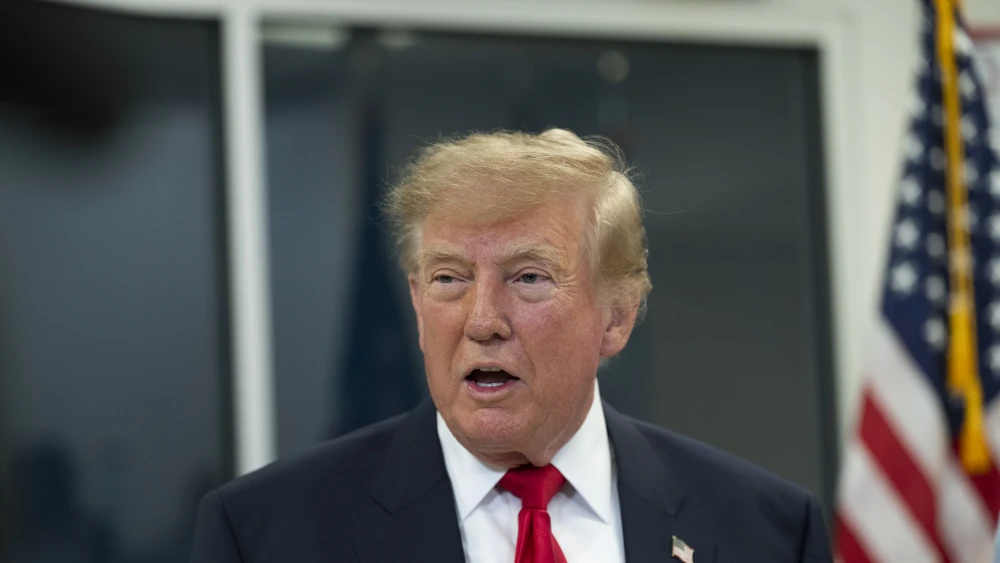
U.S. President Donald Trump told Fox News in a phone interview on Monday that Iran wants to make a deal to end the war “very badly.”
“We’re dealing from total strength,” he said. “We can end it at any time.”
“They’re in not a good negotiating position,” Trump continued, adding that the Islamic Republic’s economy is “cratering because of us.”
The regime has no money and is not paying its soldiers or police, he said, adding that the U.S. military had dealt Iran “a big hit,” taking out some 159 of its ships.
There was a very good chance of an agreement, he continued, but the Iranians “want to wait.” He said he would rather make a deal and “save a lot of lives.”
.@POTUS on Iran: "A war is fighting... When was the last time you saw us fighting with them? We go months and months; we talk. They're in not a good negotiating position... We're dealing from total strength." pic.twitter.com/0xHDpj7Nqm
— Rapid Response 47 (@RapidResponse47) November 3, 2026
Echoing a similar message on Truth Social on Monday, the president said that oil prices “are dropping like a rock” because investors believe a military confrontation with Iran will not restart. “Iran wants a settlement, as soon as possible. It could happen!” he added.
— Rapid Response 47 (@RapidResponse47) November 2, 2026
Oil prices rebounded on Tuesday after they sold off more than seven percent the previous day. The price of crude oil dropped to around $103.80 per barrel on Monday, and as of Tuesday morning climbed back to $106.50 per barrel.
The rise came after The Wall Street Journal reported fresh U.S. strikes on Iran’s Qeshm Island, located in the Persian Gulf in the Strait of Hormuz.
U.S. officials who spoke on condition of anonymity told the newspaper that the U.S. has been carrying out “limited strikes” against the Islamic Republic in recent weeks.
Vance: The president retains kinetic and non-kinetic options
Meanwhile on Monday, Vice President JD Vance told reporters that “The president and I both feel pretty good about the prospects for potentially coming to a negotiated settlement [with Tehran]. We’re going to keep on working at it.”
Standing on the tarmac at the Joint Base Andrews air base in Maryland, Vance continued, “You never know, of course, the Iranians are always a little unpredictable and as the president always says, he retains kinetic options, he retains non-kinetic options, but we’ve certainly made some progress. We’ll see if we can make some more.”
Asked if there was a deadline to reach a settlement before the United States would resume strikes, the vice president said, “No... We’ve said, here’s what we want. And what we want is, having destroyed their nuclear program, we want to make sure they don’t rebuild it or try to rebuild it; that’s what matters most to the United States.”
Vance further said the Iranians “care a lot about their sovereignty, they care a lot about economically rebuilding. We do think there is a pathway there, but it really does require a firm commitment and a verifiable commitment that they don’t rebuild that nuclear program.”
.@VP on Iran: "The President and I both feel pretty good about the prospects for potentially coming to a negotiated settlement. We're going to keep on working at it... We've certainly made some progress. We'll see if we can make some more." pic.twitter.com/i2OSmoBfyt
— Rapid Response 47 (@RapidResponse47) November 2, 2026
Trump, Netanyahu discuss Iran in phone call
On Sunday, Trump said that he had discussed Iran during his telephone conversation with Israeli Prime Minister Benjamin Netanyahu the previous day, as he warned that the U.S. could carry out further military strikes if diplomatic efforts fail.
Trump on Iran:
— Clash Report (@clashreport) November 1, 2026
I had a very good talk with Netanyahu.
We discussed Iran. pic.twitter.com/7ewwnGtMu0
Speaking at a campaign rally in Dubuque, Iowa, on Sunday, Trump said he was holding back from further military action to avoid additional loss of life.
“The only reason why I’m not finished with Iran is I want to be nice. I want to try and save all those lives if I can,” he said. “But at some point we’re going to have to give them the hammer.”


