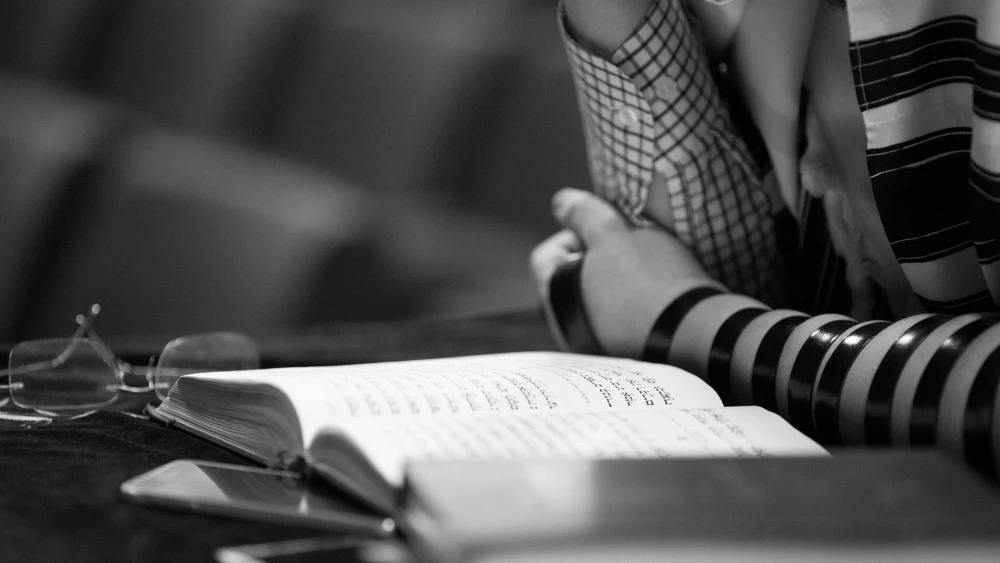

There is a fascinating idea about the human psychology involved in observing the commandments of the Torah. The Talmud states that “one who is commanded to do something, and does it, is greater than one who is not commanded to do it and still does so.”
It’s very intriguing because it’s counterintuitive. One would have imagined that someone who does a good deed without being instructed to do so should be greater than someone who is simply following instructions. Surely, those who go beyond the call of duty and volunteer are superior to those who are only performing what they were ordered to do.
The explanation given is that human nature is such that what we must do, we resist. What we don’t have to do, we embrace—and even want to do it.
Think of your own family situation. Mom is handing out chores to the children after dinner.
“Ellen, won’t you clear off the table, please?”
Well, Ellen doesn’t exactly spring into action. But her brother Mark, who wasn’t asked, jumps up and offers, “I’ll do it, Mom.”
Now, the last time Mom asked Mark to do something, he was an immovable object. A statue. No response. And if there was a response, it was a sigh, “Why me, Mom?!”
But as soon as Mom asks Ellen to do it, suddenly, Mark is a man on fire.
And that precisely is the mystery of human psychology. As soon as something becomes a command, we resist it, we even bristle; we play deaf, dumb and blind. But when it’s someone else’s command and an optional extra for us, then often very quickly we are happy to offer our help.
So the Talmud teaches that before we become a bar or bat mitzvah, we can’t wait to do the commandments that we are not yet obligated to do. Little kids in religious communities dream of the day when they will be able to wear their very own pair of tefillin. They play with it as kids, wrapping their father’s or grandfather’s tefillin whenever they can.
But as soon as they are over bar or bat mitzvah age, and Judaism’s commandments become obligations, then they are rather slow to respond. The tefillin are exciting at first, but all too quickly can become a burden.
The yetzer hara (“evil inclination”)—that little voice of temptation inside our heart that always gets us into trouble—works much harder when we are commanded to do a mitzvah. But if it’s only an optional extra, then it’s not as serious, so we are left to our own devices. Nisht geferlich, as they say in Yiddish.
And that’s why the reward for doing something we are commanded to do is greater than the reward when we are not commanded. Because it’s emotionally more challenging and harder to do when it’s a mitzvah, a commandment.
To explain, let me use something current and topical.
On June 14, more than 20,000 people of otherwise sane mind will be running the Comrades Marathon. This is a very famous race in South Africa that draws athletes from all over the world to run nearly 90 kilometres (55 miles) from Durban to Pietermaritzburg. Some are even from my own synagogue. I wish them well.
These people train for and dream about it; they plan and prepare for months before the actual race.
Now, if I told you that, according to Jewish law, it’s a halachah that every Jew must run 87 kilometers straight and that you had to do it because it’s a mitzvah, would you? Would anyone?
If I pronounced from my pulpit that it was a religious requirement to engage in an activity that would result in three heart attacks, 543 cases of dehydration, the winner on a drip in hospital, seven broken legs, 1,389 torn ligaments, 47 cases of sunstroke and thousands of ruined running shoes, would this be acceptable? Or would the Minister of Health step in and actually ban such a religion?
But since it’s not a commandment, law, obligation or requirement of any kind and only optional, we see 20,000 people doing it happily—spending fortunes of money and undergoing months of training. All completely voluntarily.
Now, if I told you that in my shul, we have two morning minyans every day and that you must be there for one of them every morning, will you get up for the 6 a.m. early minyan or the later 7 a.m. one?
I can talk from my pulpit until I need a drip, until I’m green in the face, about commandments and obligations: “You must, you should, please!” But, ladies and gentlemen, at the end of the day, if you don’t want to do it, nothing and no one can make you do it.
It’s my job to teach you what we should and should not do. But if you don’t want to, then my words will remain just that—words, and empty ones at that.
So, let’s forget about doing it for God, for Torah, for Judaism, for the shul, the rabbi or the cantor. Let’s do it not out of obligation, but out of joy. Because we want to do it. Because we are Jewish and proud, and we want to do the right thing, and then we will indeed enjoy it.
My friends, I promise you, compared to the Comrades Marathon, Judaism is easy. Simple even.
In this week’s Torah portion, Shelach, we read the story of the spies who were commanded by Moses to do a reconnaissance mission to the Promised Land ahead of the Israelites entering the land. Unfortunately, the spies messed up badly and returned with a deliberately negative report, designed to discourage the people from ascending to Israel.
It was a tragic mistake, and it cost the Jewish people an extra 40 years of wandering in the wilderness.
Later, we also read of a man who deliberately violated the Sabbath by collecting wood on the holy day.
I was wondering how these individuals may have responded if they weren’t “commanded” about these things. Would they have behaved in the same way? We’ll never know, but it’s an intriguing thought.
Still, I have to believe that we all want to do the right thing, whether commanded to or not.