Newsletter
Newsletter Support JNS

Bahrain, Kuwait reportedly carried out secret Iran air strikes

The Arab Gulf countries attacked drone- and missile-storage depots inside the Islamic Republic after months of Iranian attacks on their countries, the “Wall Street Journal” reported.

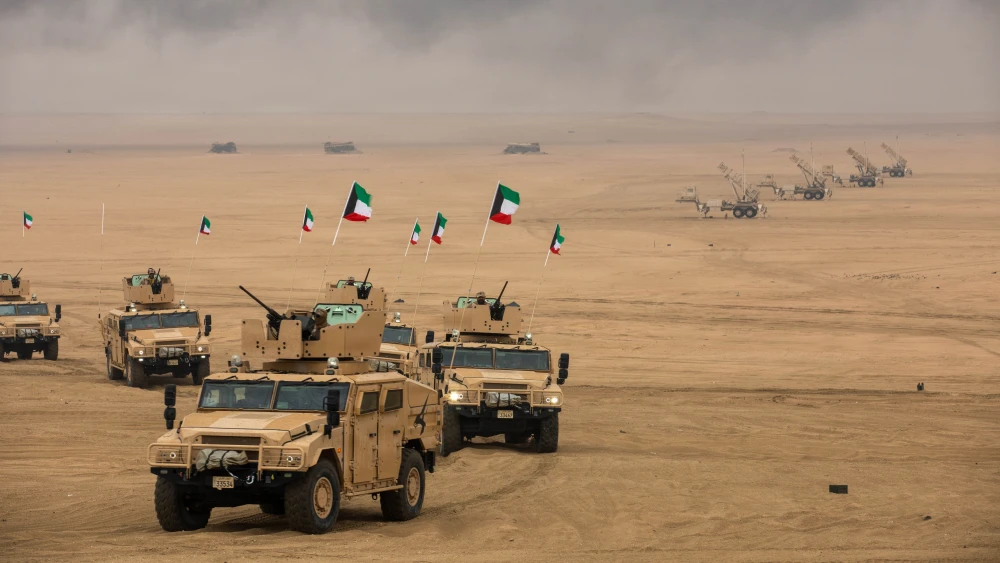
CENTCOM Kuwait
U.S. forces participate in a live fire involving Patriot missile launches during exercise Sky Shield at the Udari Range Complex, Kuwait, Dec. 9, 2025. Credit: U.S. Central Command.

Bahrain and Kuwait secretly attacked military targets inside Iran earlier this month, the Wall Street Journal reported on Friday.

The Persian Gulf monarchies carried out air strikes on Iranian drone- and missile-storage depots, along with other targets, after sustaining months of Iranian missile and drone attacks since the war began in late February.

The strikes mark the first time that the two countries conducted offensive operations inside the Islamic Republic and follow a similar round of unacknowledged strikes carried out by Saudi Arabia and the United Arab Emirates earlier in the war.

The UAE reportedly provided Bahrain and Kuwait with targeting intelligence and provided defensive air cover for the strikes.

Arab countries allied to the United States have been the targets of the vast majority of Iran’s missile and drone attacks since the start of the war.

Iran claims frequently that it is targeting U.S. military bases in those countries, but its attacks have also struck civilian infrastructure, including a state-owned oil refinery in Bahrain and Kuwaiti power and desalination plants.

“The loss of deterrence for Iran with strikes on Iranian soil that have become the new normal has truly been something to behold,” stated Jason Brodsky, policy director at United Against Nuclear Iran.

“I can’t believe these Arab countries are fighting ‘Israel’s war,’” stated David Harsanyi, a syndicated columnist and senior writer at the Washington Examiner.

Art historian Jacob Wisse told JNS that he is concerned “when museums, which I value for the rigor, depth and richness of their curatorial voice, fall back, lazily, on untruths.”
“Shame on Mamdani and those who continue to parade this dangerous rhetoric,” Daniel S. Mariaschin of B’nai B’rith International told JNS.
“Every community deserves a seat at the table when healthcare policy is being shaped,” Eveline Shekhman, CEO of the American Jewish Medical Association, told JNS.
Khan “sought to scapegoat Israel in an attempt to divert attention from his own misconduct,” said Danny Danon, the Israeli envoy to the United Nations. “The international community rejected that cynical attempt today.”
“Any discussion of Sebastia must recognize, explicitly, the ancient Jewish presence and connection to this land,” Israeli U.N. diplomat Nina Ben-Ami said. “Yet the Palestinian submission deliberately ignores this historic fact.”
The International Committee of the Red Cross “failed every test with respect to Israelis held captive by Hamas terrorists,” said Rabbi Eric Fusfield of B’nai B’rith.

