


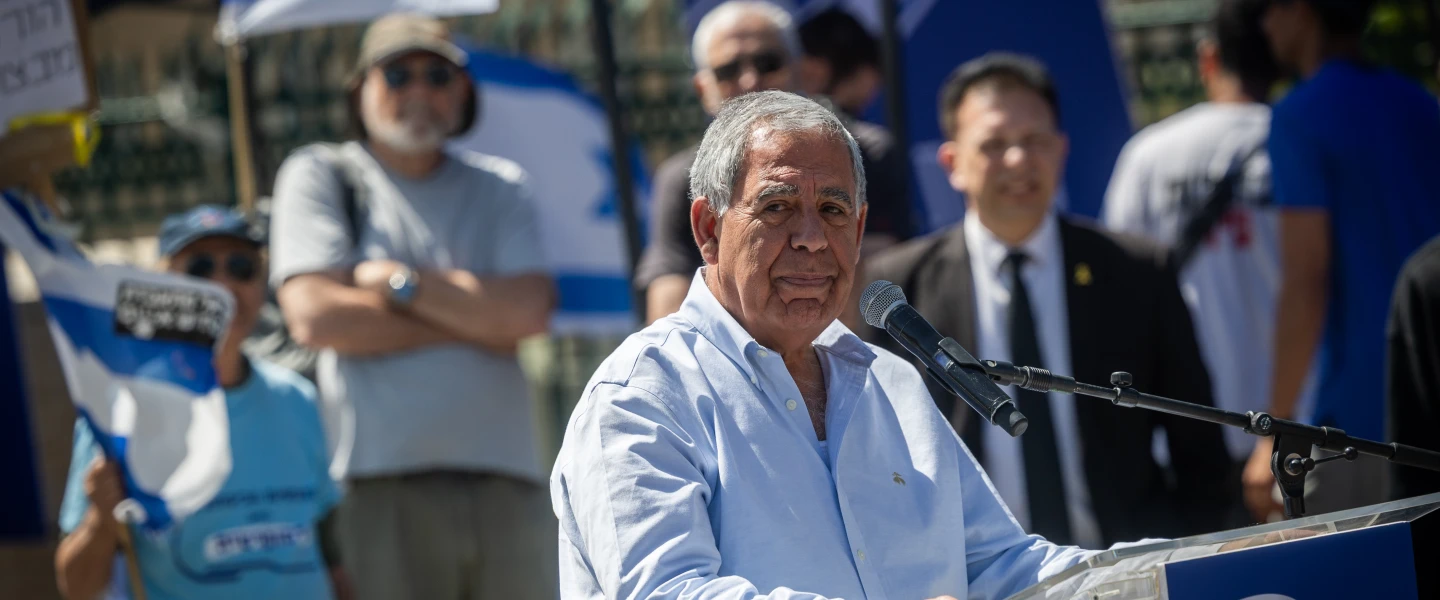
Israel must translate its military achievements into political gains, Yesh Atid lawmaker Mickey Levy told JNS on Wednesday, in an interview at his Knesset office in Jerusalem.
“We have an army of heroes. It is a small army that accomplishes a great deal. It is one of the strongest in the Middle East, but we cannot continue to live like this. We are a young country. Some 3,000 years ago, we lost the war to the Babylonians. We spent 2,000 years in exile. We cannot afford to lose another war,” Levy said.
“In the end, we need political solutions. After the Second World War claimed the lives of 60 million people, leaders sat around a table and signed agreements. There is no alternative to political agreements. It is difficult but necessary,” he added.
Levy held several senior positions in the Israel Police, most notably serving as commander of the Jerusalem District Police during the Second Intifada from 2000 to 2004.
“If you called me on any day except Shabbat, I either slept in my car or at the office, because I was afraid something would happen and I wouldn’t be there,” Levy said.
During a Palestinian terrorist attack, Levy suffered a heart attack but continued directing the evacuation of the wounded despite the pain. Only 34 minutes later did he go to the hospital himself.
“I wasn’t a hero, and neither were the police officers who were with me. The true heroes were the people of Jerusalem who did not break, who woke up every day to go to work, who sent their children on buses that sometimes exploded, or went to restaurants,” he said. “They were the real heroes who held the city together so that it did not fall.”
Levy later served as the Israel Police attaché at the Israeli embassy in Washington, D.C. He returned to Israel when his daughter reached the age for military service, because he did not want her to serve as a lone soldier.
Levy connected with Yesh Atid leader Yair Lapid through a mutual acquaintance and first entered the Knesset in 2013. He served as deputy finance minister in Israel’s 33rd government, sat on the Knesset Finance Committee for eight years, and served as speaker of the 24th Knesset.
As deputy finance minister, Levy oversaw the Israel Tax Authority and fought unreported capital and money laundering. In his interview with JNS, he stressed the importance of addressing Israel’s government debt, estimated at 1.3 trillion shekels (about $427 billion).
‘This country runs through my veins’
“We live in a complex country, and the politics here are more complex than anywhere else in the world. We are still tribes that are not connected to one another. Every system has its problems. This country runs through my veins. If you ask my children what their father says about the country, they will answer, ‘The nation first and the family next, because without the nation there is no family.’ That’s the key,” he said.
“The nation is above everything. Everything I do is for my country. My parents fought the British Mandate. My dad was caught and sat in British prison in Latrun for two years. This is the upbringing that I received and the upbringing my children received. We have four kids. Everyone served in combat. Because of her command of English and Spanish, our youngest daughter served in foreign relations,” he added.
Levy said he is most proud of one specific law, related to the grant soldiers receive once they are released from mandatory service in the IDF.
Levy said that before the law was passed, soldiers needed to justify their use of the grant, and only then would receive it. The use had to be for either studies, real estate, opening a business or getting married.
“I checked and realized the country was sitting on 50 million shekels [$16.4 million] from released IDF soldiers who did not claim the money. I passed a law that stipulates that after three years, regardless of how it will be used, soldiers will automatically receive their grant,” he said.
While Levy passed numerous bills that relate to the development of the periphery and the underprivileged, he said a lawmaker should not be solely evaluated based on the number of laws he passes. Levy currently holds the place of the second-most present lawmaker, based on hours spent at the Knesset.
Discussing the national election set for Oct. 27, Levy said the next government will focus on the economy, education and internal security.



