
U.S. President Donald Trump was speaking to the press last week from the White House Oval Office alongside Sanae Takaichi, the prime minister of Japan. A news correspondent asked Trump about why Washington had not informed its Asian and European allies about the planned attack on Iran prior to Feb. 28.
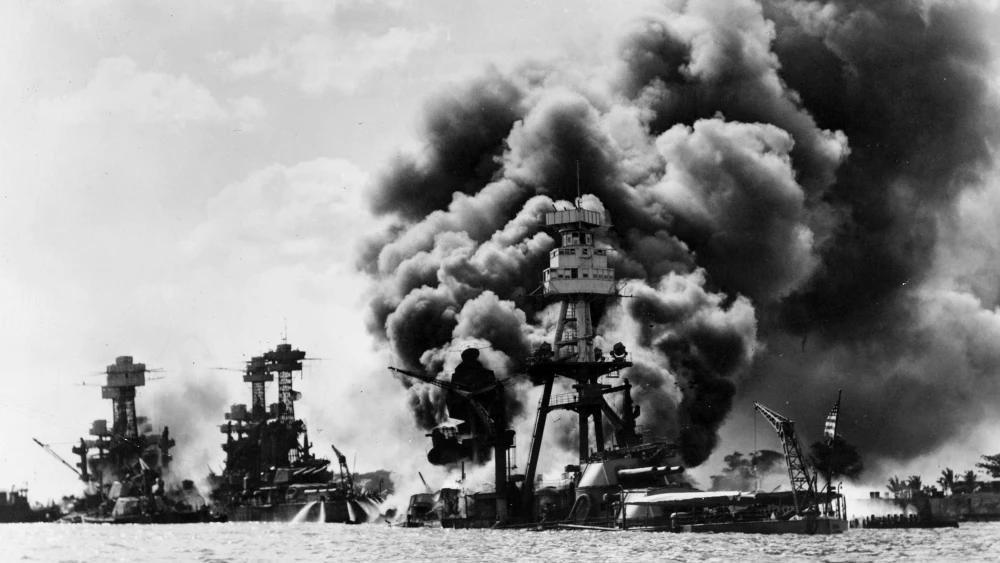
Many were taken aback when Trump, seated close to the demure and supportive Takaichi, used, as an example, Japan’s 1941 surprise attack on Pearl Harbor that killed 2,400 Americans, “ … who know better about surprises than Japan?”
Beyond violating diplomatic guidelines, Trump’s reference to a day that still lives in “infamy” messaged his adversaries that he means business and that he will speak plainly. It was part of a clear-eyed calling out and decisively acting to defeat evil. It was typical of his rhetorical style, favoring impact and a display of power. His approach compared favorably to “ … he’s sharp as a tack” and “ … our borders are secure.”
Trump chose to explain the necessity of being secretive before launching combat operations against Iran. His pointing out the Pearl Harbor attack on March 19 highlighted the absurdity of the question. Despite obvious awkwardness and his jovial demeanor, it demonstrated once again Trump’s uncompromising approach to protecting his troops as commander in chief.
While the press probed for a “gotcha” moment to support their “negativity” narrative, the president showed another small way he was focused on defeating Iran and removing a terrible threat in the world.
Following almost five decades of America’s diplomatic weakness and capitulation in the face of Iran’s malign behaviors and mounting military capability, Trump’s June 2025 and February 2026 attacks reasserted the reality of American backbone. As far back as the 1980s, a younger Trump addressed Iran’s hostage capture of 66 diplomats and personnel, and he called out the need for immediate troops to intercede. He highlighted how Iran did not respect weakness.
On Nov. 4, 2011, well before Trump was a candidate for the presidency, he said: “We can’t allow Iran to go nuclear.” His focus on the existential threat of a nuclear Iran parallels that of Israeli Prime Minister Benjamin Netanyahu.
For years, Iran has pursued the tools to complete their promise of “Death to America!” Iran’s reach for lethal armaments came at the direction of Supreme Leader Ayatollah Ali Khamenei, whose apocalyptic belief included “end times” that are deeply rooted in Shi’ite Islamic theology. An Iranian nuclear weapon or a dirty bomb atop a ballistic missile exploding in Israel, Europe or near an American base would have horrific geopolitical consequences.
Thousands of American soldiers have been killed or injured by Iranian weapons in Syria, Lebanon, Iraq and Afghanistan. Iran’s proxy network of terrorists has destabilized the Middle East. Former President Barack Obama foolishly rewarded Iran with $150 billion in cash and signed a nuclear deal in 2015 that eventually guaranteed a path to nuclear bombs. After the Hamas-led terrorist attacks in southern Israel on Oct. 7, 2023, we witnessed former President Joe Biden handcuff Israel with conditional military and diplomatic support as the Jewish state battled a multifront war.
Many presidents kicked the “nuclear blackmail can” down the road. Trump has instead stood firm behind Israel in facing this threat. He withdrew from the nuclear agreement in 2018, started a “maximum pressure” campaign against Tehran, and was resolute on Israel’s war against Hamas in Gaza, as well as the 2025 and 2026 destruction of Iranian military assets.
The president must have calculated that the momentary diplomatic discomfort of Japan’s leader was a small price to pay to clarify that many Americans and American allies—and anyone else in the region—could have died had Iran instead executed a surprise attack.
Trump is the realist this country and Western civilization needs. He has withstood bullets in Butler, Pa.; two flawed impeachments; and being the target of a weaponized legal system. He doesn’t pull punches—not with allies, the press, the United Nations, and now, it is clear, most definitely not with America’s adversaries.