


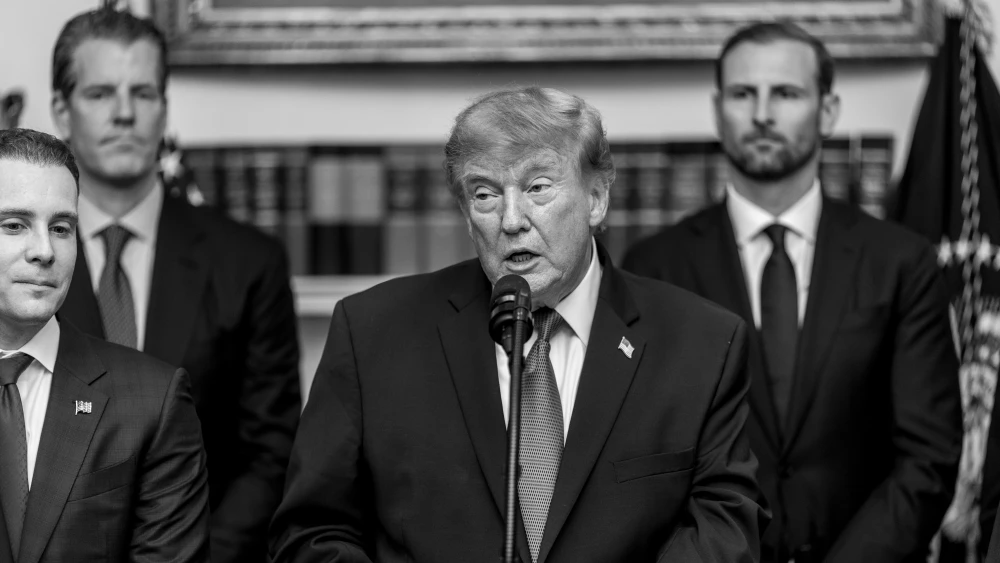

U.S. President Donald Trump has been frustrated for weeks, if not months, by the impasse in the U.S.-Iran conflict.
The increased economic pressure recently ordered by Trump was described by U.S. Secretary of the Treasury Scott Bessent as an “economic D-Day against Iran,” a sweeping campaign to isolate the Islamic Republic. Bessent called the measures “the single greatest financial offensive ever marshalled against an adversary.”
Economic pressure alone, however, will not do the job. The Iranian regime’s leaders, as we have seen, will not budge. Moreover, they will be aided and abetted by China, Russia, Turkey and a host of other nations that have sustained Tehran in the past. It is the people of Iran who will suffer the consequences.
An Aug. 31 headline in the New York Daily News read, “Leaders of China, Russia and India are among heads of state meeting to counter U.S. influence.” This alignment, the Shanghai Cooperation Organization (SCO), was founded in 2001 and now includes ten nations: China, India, Russia, Pakistan, Kazakhstan, Kyrgyzstan, Tajikistan, Uzbekistan, Iran and Belarus. Iran’s accession to the SCO was approved by the existing member states in 2021 after the signing of a 25-year strategic partnership agreement.
As the Daily News accurately described it, the organization is intended to be a counterweight to U.S. global influence and the Western alliance. Indeed, with Russia’s support, Beijing has consistently promoted the idea of an “alternative” world order.
Turkey is not a full member of the SCO but has expressed interest in becoming one. Turkish President Recep Tayyip Erdoğan announced Turkey’s ambition to secure permanent membership at a press conference in July 2024. SCO members, including Turkey as a future member, would more than likely continue trading with Iran while evading U.S. sanctions.
Aerial campaigns didn’t bring down the Iranian regime because aerial bombing can’t win a war. Numerous historical examples prove this: During World War II, Nazi Germany’s bombing of Britain did not subdue or defeat its target. Neither did the Allied bombing of Nazi Germany. Victory was only achieved with ground troops. While Israel’s strategic bombing of Iran’s air defenses, ballistic-missile sites and nuclear facilities in June 2025 was effective, they did not cause the fall of the regime. Boots on the ground are needed to achieve victory.
During the Gulf War in the early 1990s, aerial bombings along with ground forces were employed, resulting in Iraq’s ultimate defeat. While boots on the ground are unpopular, especially since the Vietnam and Iraq wars, then-President George H. W. Bush persevered by deploying U.S. troops. The effectiveness of American arms brought about a victory that gave the U.S. immense prestige worldwide and defined Bush’s legacy. While Bill Clinton defeated Bush in 1992, it was primarily due to an economic downturn, not wartime decisions.
Trump has two choices for ending the current impasse with Iran:
One is to submit to the demands of the ayatollahs. However, it appears that the Islamic Revolutionary Guard Corps (IRGC) prefers to continue or even escalate fighting with the United States and its regional partners rather than make any serious concessions.
Indeed, the Iranian demands are akin to a victor dictating terms to the vanquished. They are:
- Never threaten Iran with any language or insult the sanctity of this nation.
- End the war and aggression against Iran and its allies in Lebanon, Palestine, Yemen and Iraq—forever.
- Lift the naval blockade and withdraw its military forces (naval and air) from around Iran.
- Pay the damages for the two wars of aggression and imposition on Iran without any reduction.
- Lift the cruel and illegal sanctions against the Iranian nation.
- Unconditionally release the frozen and stolen assets of the Iranian people.
These are Iran’s conditions for reopening the Strait of Hormuz. The nuclear issue is not even addressed.
Trump’s second option is to put boots on the ground and overwhelm IRGC forces around the Strait of Hormuz while pushing inwards toward Tehran. Trump would have to unleash Kurdish, Balochi and Ahwazi militias against the IRGC, and ask America’s NATO allies (except Turkey) to join in the effort.
The sight of American forces and additional militias on Iranian soil would likely unleash the pent-up fury of the Iranian people, leading to a revolt against the despised regime of the ayatollahs and the IRGC. Moreover, it is likely that U.S. forces would not have to move farther than southwestern Iran and its oil facilities in the Khuzestan and Bushehr provinces—where nuclear infrastructure is also located.
Whether or not this option would lead to Trump and the Republicans losing the midterm elections, it would undoubtedly solidify Trump’s legacy as a president who triumphed over an evil adversary that posed a grave threat to global peace through nuclear weapons, worldwide terrorism and the obstruction of free maritime trade.



