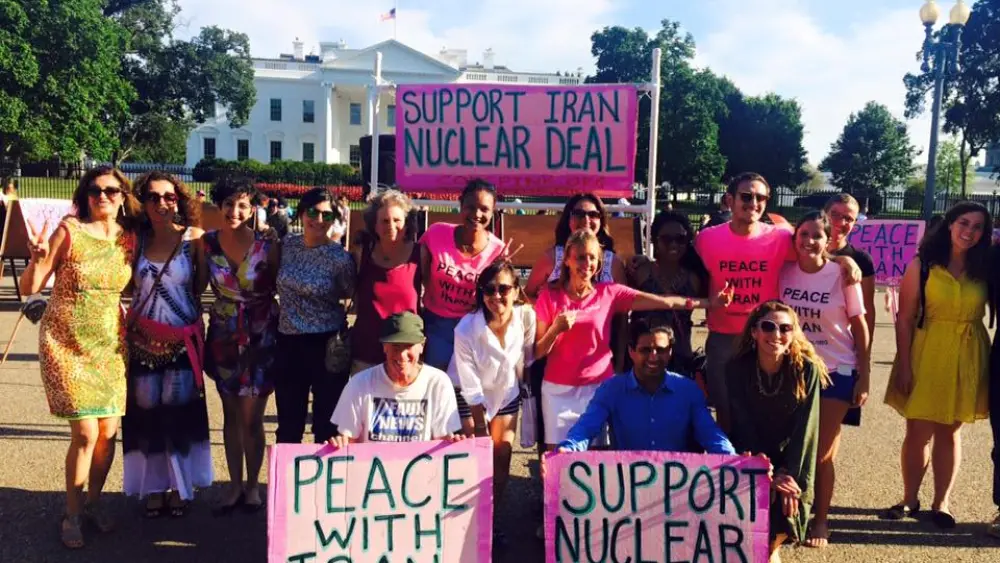
Code Pink, the women’s anti-war group that is active in the anti-Israel boycott campaign, recently announced on its website an obscure “peace delegation” to the Islamic Republic of Iran that is taking place from Jan. 10-18. The group charged that the purpose of their visit was to “move our two nations from a place of hostility and military threats to a place of mutual respect and peace with one another.”
To draw a moral equivalence between Iran, a brutal theocracy, and the United States, a Western democracy, is of course absurd. Peace is not illusive because of a lack of mutual respect, but rather a direct consequence of Iran’s blatant disregard for regional and international peace and security.
But even more absurd is the itinerary of Code Pink’s trip. From a feminist enterprise with a focus on human rights, one would expect meetings scheduled with local women’s rights organizations, activists and free thinkers, civil libertarians and opposition figures, even political prisoners.
But in a disgraceful betrayal of their own principles, at the top of Code Pink’s agenda are meetings with “representatives of the Foreign Ministry and Parliament”—that is to say, officials from the mullah theocracy.
This is the same regime that is complicit in the mass murder of innocent civilians in Syria and planned terrorist attacks on European soil. These are the tyrants that sponsor war in Lebanon, Iraq and Syria. A regime that threatens to wipe Israel off the map and enlists child soldiers in Yemen.
“Wait,” I can hear Code Pink say, “but we are also meeting with professors and their students.” But who has selected these individuals? The same officials who decide who lives or dies in Iran, who control which candidates run in elections, and who bar ethnic and religious minorities from powerful government positions.
Code Pink is meeting with representatives of a system that arrest and sometimes murder women for taking off the hijab in an act of ultimate defiance against the draconian laws of the 1979 Islamic revolution. Women that groups such as Code Pink have vowed to protect.
They are legitimizing a regime that brutally oppresses workers and teachers who peacefully protest the Islamic Republic’s foreign adventurism at the expensive of a collapsing economy. “Death to Palestine,” “No to Gaza, no to Lebanon” and “Leave Syria and think of us,” they shout on the streets. People who are truly anti-war. Code Pink, not so much.
The organization has difficult questions to answer as a member of the progressive feminist community. Why is Code Pink not meeting with human-rights activists such as Narges Mohammadi or Arash Sadeghi, who are both currently lingering in prison. Their crime? Peaceful human-rights activities. Or political prisoners with dual citizenship, including many Americans, who are deprived of all rights and are being illegally detained by the regime as political bargaining chips in negotiations with the West.
The truth is that Code Pink has no interest in communicating with ordinary Iranians fighting for freedom against a regime that tolerates no dissent. Why? Because the stories told by Iran’s violated population don’t corroborate Code Pink’s strident anti-Americanism that has blinded them to the evil of the regime.
In the absence of any hint to the contrary, Code Pink’s trip to Iran is a “peace delegation” in name only. They are useful idiots in a perverted propaganda campaign for the mullah’s repressive and reactionary regime. Whatever Code Pink thinks of the current U.S. administration or the policies of the Israeli government, the fact that many progressives consider America and Israel public enemy No. 1—not Iran, Syria, North Korea or other rogue regimes—demeans liberalism.
Joshua S. Block is president and CEO of The Israel Project.