It was recently announced that Israel and Lebanon have made significant progress in negotiations over gas drilling in the Mediterranean.
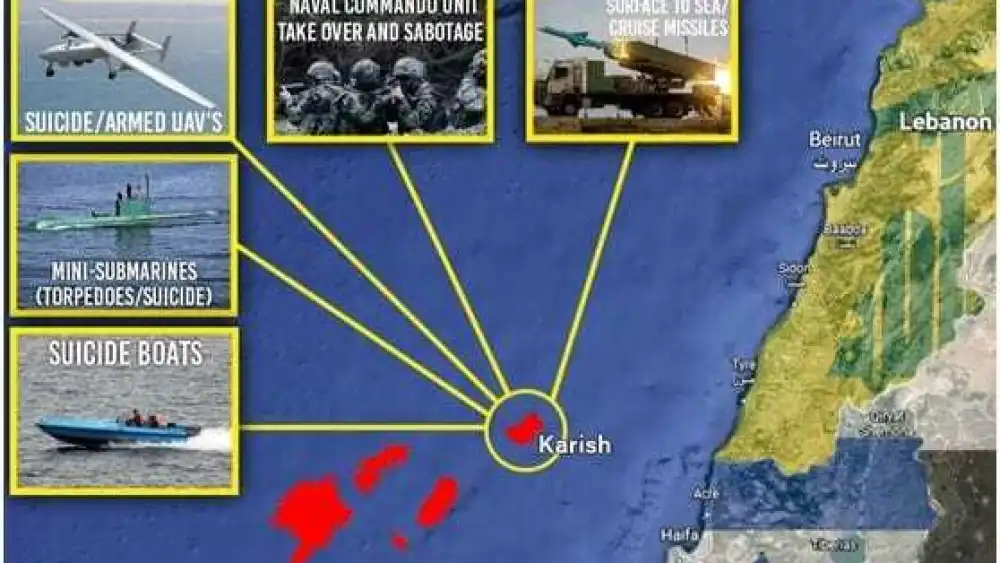
The background story is complicated. There are two gas fields on the border between Israel and Lebanon. The first, Karish, is fully located in Israeli economic waters, but is close to the dividing line. The second, Sidon—called Qana by the Lebanese—is located on both sides of the border. Part is on the Lebanese side, part on the Israeli side and a third part is disputed.
The maritime border between Israel and Lebanon was of no interest to anyone until the gas fields worth billions of dollars were discovered there.
Natural gas is not just a local matter between Israel and Lebanon. Given today’s geopolitical reality, especially the ongoing war in Ukraine and the energy crisis in Europe, the gas supply from these reservoirs could turn Israel into a global energy and strategic powerhouse.
With winter approaching, everyone is stressed. The U.S. and the E.U. are pressing for a quick agreement in order to start producing gas as soon as possible.
Why was there “significant progress” in the negotiations? Because Israel apparently once again gave in to a terror group. This time, it was Hezbollah. The negotiations are being conducted quietly, but if the information that’s been leaked is accurate, Jerusalem has agreed to Lebanese demands, and then some. It agreed to give up its portion of the Sidon gas field in exchange for maritime territory. That means Israel will give up territory rich in gas and receive essentially nothing in return.
A few weeks ago, Hezbollah leader Hassan Nasrallah was reported to have said in closed-door talks that Lebanon was “raising the bar so that Israel would yield on the gas issue.” In early July, the terror group also launched several drones at the Karish rig, where Israel is supposed to start producing gas as early as September.
Nasrallah understands the game and the map of global interests. This equation is important in light of Europe’s need for oil and gas, he said, otherwise the continent will face a disaster, as they are dependent on Russia. That is why Nasrallah sent the drones at a time Europe is at its weakest.
Not only does Nasrallah understand the game, he controls it, making threats that bring political and economic gains. We hope the enemy will withdraw without us having to fire a bullet or a rocket, he said. We are prepared for all scenarios.
As for Israel, an irresponsible transitional government gave in and is slated to sign the fateful agreement, which probably violates a Basic Law. In the Middle East, instead of demanding more, Israel capitulated.
Instead of remaining steadfast against Lebanese threats and violence, Israel yielded and retreated. Instead of taking care of its economic and political interests in the long term, it chose to strengthen the monster from the north.
Sara Ha’etzni-Cohen is a journalist and social activist.
This article was originally published by Israel Hayom.